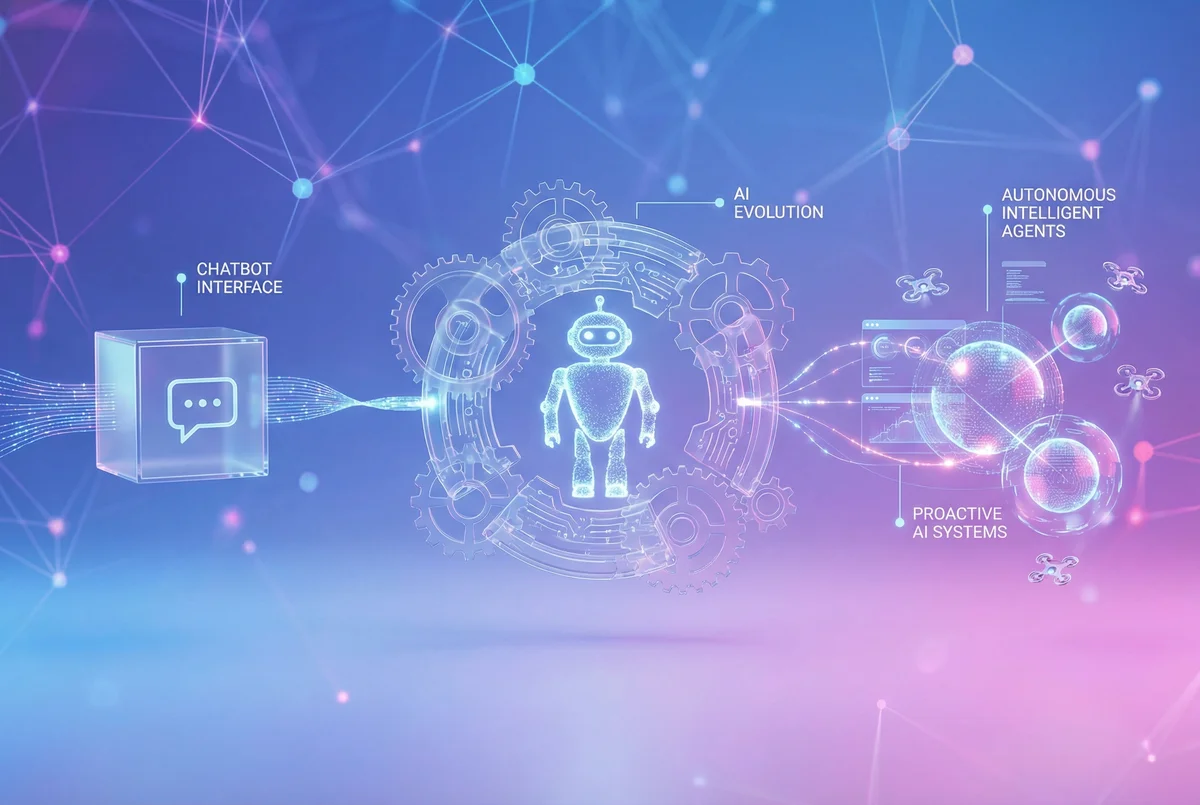
We spent two years typing prompts into chatbots and calling it digital transformation. That era is ending.
In 2026, the most interesting AI deployments don’t wait for you to hit Enter. They take a goal, break it into subtasks, pick the right tools, execute, check their own work, and course-correct when something goes wrong. The industry calls this “agentic AI,” and it represents an architectural shift—not just a marketing rebrand.
The difference matters. A chatbot is a calculator. An agentic system is an accountant. One answers questions. The other gets things done.
What Makes an Agent Different from a Chatbot
The distinction is structural, not cosmetic.
Traditional LLM usage follows a simple loop: you ask a question, the model responds, you decide what to do next. Every step requires human input.
Agentic AI flips this. You define a goal. The agent decomposes it into sub-tasks, selects appropriate tools—APIs, databases, code interpreters—executes each step, observes the results, and decides its next move autonomously. This loop, often called the ReAct (Reason + Act) pattern, runs until the goal is met or the system hits a predefined boundary.
Harrison Chase, CEO of LangChain, draws the line clearly: “If the LLM can change your application’s control flow, it’s an agent. If the flow is fixed by your code, it’s not.”
Here’s what that looks like in practice:
| Dimension | Traditional Chatbot | Agentic System |
|---|---|---|
| Primary role | Generate text responses | Achieve specific outcomes |
| Task complexity | Single-turn Q&A | Multi-step problem solving |
| Interaction model | Text in, text out | Goals in, actions out |
| Adaptability | Follows fixed patterns | Adjusts plans based on feedback |
| Tool use | None or minimal | APIs, databases, code execution |
| Human oversight | Required at every step | Minimal—escalates when needed |
The gap between these two paradigms is why Gartner predicts 33% of enterprise software will include agentic capabilities by 2028, up from less than 1% in 2024. The number is striking, but what matters more is what it means in practice—and that’s where things get interesting.
Why 2026 Is the Inflection Point
People have been talking about AI agents since 2024. AutoGPT went viral, everyone built a “baby AGI” demo, and most of those demos broke after three steps. So what changed?
Three things converged.
Models got reliable enough to plan. Early agent attempts were brittle. GPT-4 in 2023 could sort of plan, but it hallucinated tool calls, lost track of multi-step goals, and needed heavy guardrails. The reasoning models of 2025–2026—with native chain-of-thought, improved function calling, and dramatically better instruction following—changed the equation. Agents can now reliably execute 10 to 15 step workflows without derailing. Claude Opus 4.6 scores 91.9% on retail tool-calling benchmarks. GPT-5.2 handles complex multi-tool orchestration. These aren’t demo numbers—they’re production-grade reliability.
The tool ecosystem matured. A smart model without tools is just a very expensive text generator. In 2026, plugging an LLM into your Jira board, Salesforce instance, or internal database is no longer a weekend hack—it’s a well-documented integration. OpenAI’s function calling, Anthropic’s tool use, Google’s Gemini extensions, and open-source frameworks like LangGraph, CrewAI, and AutoGen have all converged on standardized patterns. The Model Context Protocol (MCP) now provides a universal standard for how AI systems access external data and tools, eliminating hard-coded connections.
The economics forced the issue. With tightening budgets and leaner teams, companies can’t afford humans manually triaging support tickets or reconciling invoices. Agentic AI isn’t a nice-to-have anymore—it’s an economic imperative. Global spending on agentic AI hit €47 billion in 2025.
What Agentic AI Looks Like in Production
Enough theory. Here’s what real teams are deploying right now.
Customer Support That Actually Resolves Issues
Not “let me transfer you to a human.” Agentic systems now handle tier-1 and tier-2 support end-to-end. They read the ticket, pull up the customer’s account history, check the knowledge base, attempt a resolution—issuing a refund, resetting credentials, updating a subscription—and only escalate when they’ve genuinely exhausted their options.
Resolution rates for these systems are hitting 60–70% without human intervention. Gartner predicts agentic AI will autonomously resolve 80% of common customer service issues by 2029, cutting operational costs by 30%.
TELUS, the Canadian telecom giant, reports employees save 40 minutes per AI interaction using their agentic deployment. That’s not a chatbot answering FAQs—that’s an agent navigating internal systems, pulling customer data, and executing actions.
Code Review and DevOps Automation
Engineering teams are using agents that go beyond “suggest a code change.” These agents open PRs, run test suites, analyze failure logs, fix the failing tests, and re-submit—all in a single automated pipeline. The developer’s role shifts from writing every line to reviewing and approving the agent’s work.
Anthropic used Claude Opus 4.6 to find over 500 previously unknown high-severity security flaws in open-source libraries. One developer reported completing a two-day authentication refactor in 90 minutes using agent teams—multiple agents working in parallel on database migrations, API endpoints, and middleware.
Compliance and Financial Workflows
Financial services firms deploy agents that continuously monitor transactions, flag policy violations, generate audit trails, and initiate corrective actions. What used to take a compliance team days of manual review now happens in near-real-time.
A US bank used agentic AI to generate credit risk memos, boosting productivity by 20–60%. Legal teams report agentic systems cutting document drafting time by up to 91%. And 44% of finance teams plan to roll out agentic AI by 2026—a 600% year-over-year increase.
Healthcare Documentation
AtlantiCare’s clinical documentation agents hit an 80% adoption rate among physicians, cutting documentation time by 42% and saving doctors 66 minutes per day. Automated scheduling tools improved appointment throughput by 32%. These aren’t pilot numbers—they’re production deployments handling real patient workflows.
The Architecture Behind Modern Agents
If you’re building agentic systems, here’s what the stack looks like in 2026.
Orchestration layer. Frameworks like LangGraph or custom state machines manage the agent’s planning loop, maintain context across steps, and handle branching logic. The dominant pattern is an orchestrator that routes tasks to specialist agents—one for research, another for drafting, a third for QA—with explicit inputs and outputs. This beats the “one agent does everything” approach on reliability, logging, and rollback.
LLM backbone. A reasoning-capable model—Claude, GPT, Gemini, or fine-tuned open-source models like Llama 4 or Mistral—handles the thinking. It decides what to do next based on current state, available tools, and the goal. The model doesn’t just generate text; it reasons about which action to take and evaluates whether the previous action succeeded.
Tool registry. A catalog of callable functions—APIs, databases, file systems, web browsers, code interpreters—that the agent can invoke. Each tool has a well-defined schema so the LLM knows what arguments to pass. The Model Context Protocol (MCP) is standardizing this layer, making it possible to swap tools without rebuilding the agent.
Memory and state management. Both short-term (within a session) and long-term (across sessions) memory. Vector databases, conversation stores, and structured state objects keep the agent grounded. Without proper memory, agents repeat mistakes and lose track of what they’ve already tried.
Guardrails and safety. Output validators, rate limiters, human-in-the-loop checkpoints for high-stakes decisions, and policy engines that constrain what the agent can do. This layer is non-negotiable in production. Most enterprise systems today operate at Level 3 autonomy—they handle end-to-end processes but involve humans for low-confidence scenarios.
A survey of practitioners found that 70% of production cases rely on pre-built models with tailored prompting rather than fine-tuning model weights. Well-organized orchestration delivers impressive results without expensive retraining.
Multi-Agent Systems: The Next Evolution
The single-agent paradigm is already giving way to something more powerful: teams of specialized agents collaborating on complex tasks.
Instead of one monolithic agent trying to handle everything, modern systems deploy fleets of specialists. An orchestrator assigns market research to one agent, content creation to another, and quality control to a third. Researchers describe the result as “emergent collective intelligence”—agents solving problems collectively that none could handle alone.
Anthropic’s agent teams feature in Claude Opus 4.6 demonstrates this in practice. One orchestrator agent spawns multiple sub-agents, each handling a specific subtask. In cybersecurity testing, this approach produced the best results 38 out of 40 times in blind rankings, with up to 9 sub-agents making over 100 tool calls per session.
The pattern works because it mirrors how effective human teams operate. You don’t ask one person to research, write, edit, fact-check, and design. You assign specialists and coordinate their output.
Frameworks like CrewAI and AutoGen have gained traction by assigning specific roles or “personas” to agents, improving focus and output quality. If one agent fails at a task, the orchestrator identifies the issue and reassigns work to keep the overall process on track.
The Hard Problems Nobody’s Fully Solved
Let’s be honest about what still breaks.
Reliability at scale. Agents work brilliantly in demos. But when you’re processing 10,000 support tickets a day, that 95% success rate means 500 failures. And agentic failures aren’t quiet—they can send wrong refunds, email incorrect information, or make changes that are hard to reverse. A METR study found experienced developers were actually 19% slower on real issues when using AI tools, underscoring that workflow design matters as much as model capability.
Observability. When an agent takes 12 steps to complete a task and something goes wrong at step 8, debugging is painful. Traditional logging isn’t enough. Teams are building specialized trace visualization tools to understand agent decision paths, but this tooling is still nascent. The best practice is treating each run as a trace—storing prompts, decisions, tool results, and human approvals for replay and regression testing.
Cost management. Every “thought” an agent has costs tokens. A complex agentic workflow can burn through hundreds of thousands of tokens per task. Without careful cost guardrails, agentic systems can become more expensive than the humans they replace. Smart teams are implementing effort parameters—using lightweight reasoning for simple steps and deep thinking only when the task demands it.
Trust and accountability. When an agent makes a wrong decision, who’s responsible? The engineer who built the prompt? The company that deployed it? The model provider? We’re in legally uncharted territory. The EU AI Act’s staged obligations are starting to address this, requiring risk management, logging, and human oversight for high-risk applications. Colorado’s SB24-205 introduces duties for high-risk AI in employment contexts.
The productivity paradox. Here’s what bothers me: despite vendor claims of massive efficiency gains, independent evidence is mixed. McKinsey’s 2025 analyses show many companies piloting agents with only a small fraction reporting truly mature rollouts. The Stanford HAI AI Index highlights how little independent RCT evidence exists for general knowledge-worker agent productivity. The strongest numbers often come from vendor-reported cases—which is exactly why you should take them with a grain of salt.
How to Get Started Without Over-Automating
If you’re evaluating agentic AI for your organization, here’s a practical framework based on what’s working.
Start with one durable workflow. Pick a repeatable, multi-step process that requires tool or API calls plus human approval gates. Research-to-report pipelines, customer support triage, and compliance monitoring are proven starting points. Don’t try to automate everything at once.
Design governance as a product feature. Require explicit human sign-off for actions with financial, legal, or HR impact. Keep agent authority time-boxed and scope-limited. Log datasets, prompts, model versions, and tool outputs. Make runs replayable so you can explain decisions and roll back safely.
Measure honestly. Run A/B comparisons on workflows, not just prompts. Track time-to-first-draft, review cycles, error rates, and rework percentages. Fix your evidence set—pre-approve source lists and forbid uncited claims. Watch for the productivity paradox: if you see slowdowns, dig into failure modes rather than assuming the technology doesn’t work.
Follow the 10/20/70 rule. Dedicate 10% of resources to algorithms, 20% to tech infrastructure, and 70% to adapting people and processes. The technology is the easy part. Getting humans to trust and effectively supervise autonomous systems is the real challenge.
Adopt a trust protocol. Start at Level 3 autonomy—agents execute end-to-end processes but involve humans for low-confidence scenarios. Gradually grant more independence as the system demonstrates reliability. This mirrors how you’d onboard a new employee: limited authority at first, expanding as trust builds.
Where This Is Heading
The trajectory is clear, even if the timeline isn’t.
Specialization will win over generalization. Instead of one general-purpose agent, teams will deploy fleets of specialized agents, each optimized for a narrow domain. The orchestrator pattern will become the default architecture.
Human roles will shift from doing to directing. We’ll define goals, set constraints, review outputs, and handle edge cases. The companies already seeing 25 to 35 times more revenue per employee are the ones that figured this out early.
Agents will become persistent. Always-on processes that monitor, maintain, and optimize systems 24/7—not just one-off task runners you invoke when you remember to.
The competitive gap will widen. Organizations that figure out agentic AI in 2026 won’t just be more efficient. They’ll be operating in a fundamentally different paradigm. With 35% of organizations already using agentic AI and another 44% planning to implement it soon, the window for early-mover advantage is closing.
The era of AI that talks is ending. The era of AI that actually does things has begun. The question isn’t whether agentic AI will transform your industry. It’s whether you’ll be deploying the agents—or competing against someone who is.