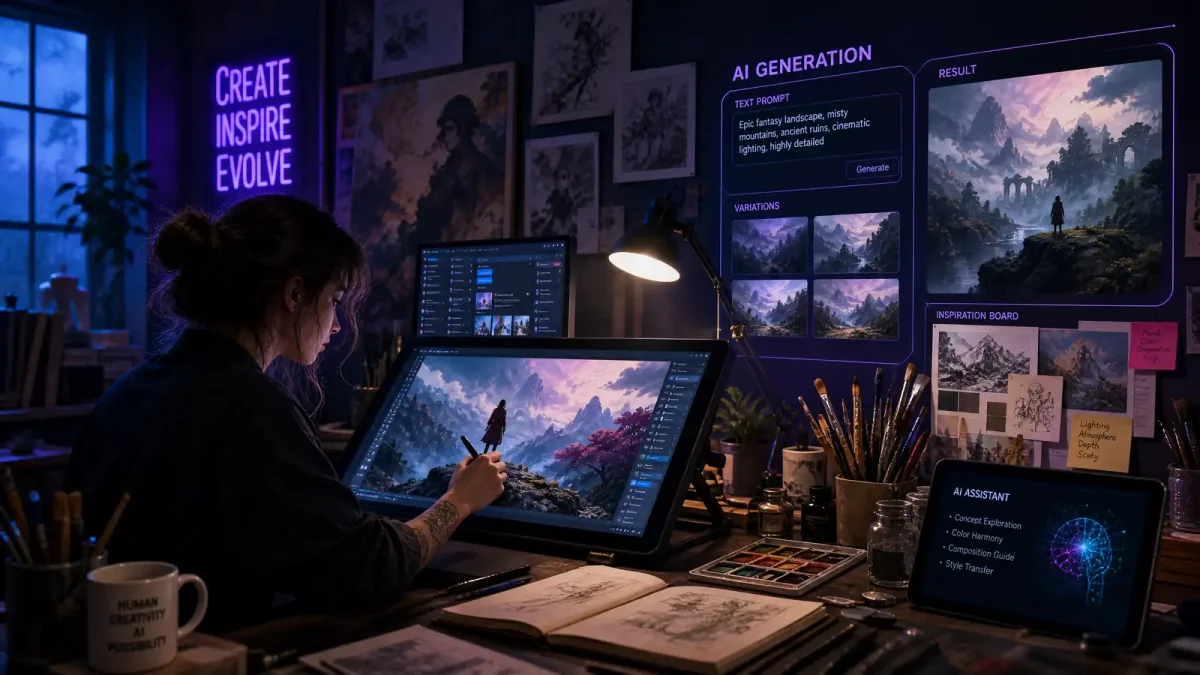
The AI art conversation has been stuck in a loop for two years. Either it’s “robots will replace artists” or “real art requires human hands.” Both positions miss the actual story, which is happening in the studios and workflows of artists who have quietly started using AI as one tool among many — not as a replacement for creativity, but as an accelerant for specific parts of the creative process.
Here’s what the landscape actually looks like in mid-2026, stripped of the marketing copy and the think pieces.
The Compositing Revolution
The most significant development in AI art tools this year isn’t a new model. It’s the maturation of compositing workflows — the ability to combine AI-generated elements with traditional digital painting in ways that are seamless enough to fool even experienced art directors.
Adobe Firefly’s integration into the Creative Cloud suite has made this accessible to millions of designers who never touched Stable Diffusion or ComfyUI. The difference between “AI art” and “art that used AI” has become indistinguishable at the production level, which is exactly what working artists needed.
What makes this interesting isn’t the technology itself. It’s what it does to the economics of creative work. A freelance illustrator who used to spend three days on background rendering can now generate base environments in minutes and spend those three days on the elements that actually differentiate their work — character design, composition, color choices. The AI handles the commodity work. The artist handles the art.
The Style Consistency Problem (And How It’s Being Solved)
For most of AI art’s history, generating a consistent style across multiple images was nearly impossible. You’d get five beautiful concept art pieces, and they’d all look like they were made by different artists. That’s useless for anyone building a visual identity, a game, or a book.
Midjourney’s style reference features and custom LoRA training pipelines have changed this. Artists can now feed a model a dozen reference images and get generations that match their established visual language. It’s not perfect — you still need to curate and refine — but it’s good enough that several indie game studios are using it as their primary concept art pipeline.
The artists who are succeeding with AI aren’t the ones who prompt the hardest. They’re the ones who treat AI output as raw material — a starting point that gets sculpted, painted over, composited, and refined until the final image carries their unmistakable mark.
The Ethics Conversation Has Moved Past “Is It Art?”
The debate about whether AI art is “real art” has largely exhausted itself. The conversation that matters now is about consent, compensation, and credit.
Artists whose work was used to train models without permission are filing lawsuits. Some platforms are implementing opt-out mechanisms. Others are building licensing frameworks that pay original artists when their styles are referenced. None of this is settled, but the direction is clear: the industry is moving toward a model where artists get compensated for the data they contribute.
The working artists I’ve talked to don’t care about the philosophical debate. They care about two things: can this tool help me deliver better work faster, and is it built on a foundation that respects my profession? The tools that answer yes to both are winning. The ones that don’t are losing market share.
What’s Actually Useful Right Now
If you’re an artist looking at AI tools in 2026, here’s the practical breakdown:
For concept art: Style-consistent generation platforms (Midjourney with style refs, custom-trained Stable Diffusion models) are genuinely useful for rapid iteration. You can explore ten visual directions in the time it used to take to sketch one.
For illustration: AI-assisted background and texture generation saves hours of repetitive work. The foreground — the part that matters — is still yours.
For graphic design: Adobe Firefly’s integration means you can generate and edit within your existing workflow without context-switching to a separate tool. That integration advantage matters more than raw model quality.
For photo editing: Generative fill and AI-powered retouching have become table stakes. Every major editing tool has them now. The differentiation is in speed and accuracy, not capability.
The Bottom Line
AI hasn’t replaced artists. It’s replaced certain tasks that artists used to do. The artists who are thriving are the ones who made peace with that distinction and restructured their workflows around it.
The tools that will matter in 2027 won’t be the ones that generate the prettiest images. They’ll be the ones that integrate most seamlessly into the messy, iterative, deeply human process of making art that means something.