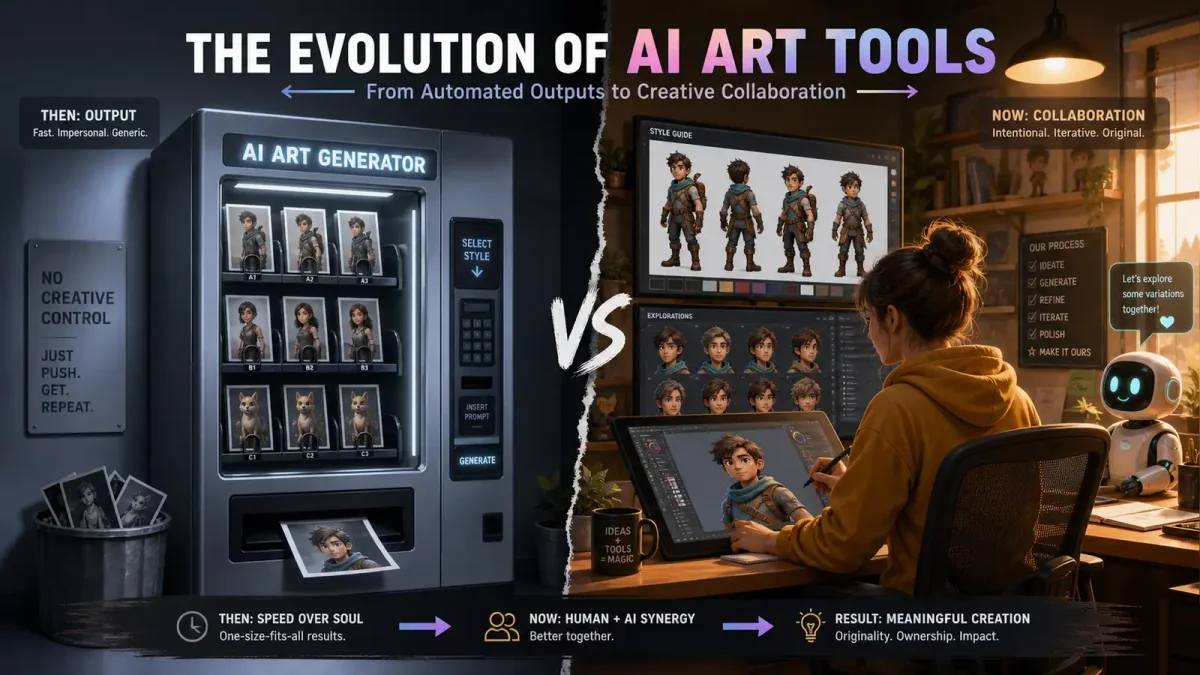
The first generation of AI art tools worked like vending machines. You typed a prompt, the machine spit out an image, and if you didn’t like it, you typed another prompt and started over. This worked well enough for casual experimentation — the kind of thing that made Midjourney and DALL-E famous. But for professional artists, game developers, and anyone trying to produce a coherent body of work, the vending machine model broke down fast.
Real creative work isn’t a series of disconnected one-shot requests. It’s iterative. Ideas evolve across dozens of versions. Art direction changes midway through a project. References accumulate. Assets need to look like they belong to the same world. The tools that artists actually use — Photoshop, Blender, Maya — are built around this reality. AI art tools, until very recently, were not.
That’s starting to change. A new wave of tools is replacing the single-prompt paradigm with something closer to a creative partnership: conversational interfaces, style consistency across asset sets, and workflows that understand iteration as the default, not an afterthought.
The problem with prompt-and-pray
The fundamental issue with prompt-based art generation isn’t the image quality. Models like Midjourney V7 and DALL-E 4 produce results that are technically impressive by almost any standard. The problem is the workflow.
An artist designing a character for a game doesn’t create one image and call it done. They produce turnarounds, expression sheets, outfit variations, and prop sets. Each asset has to match the others in style, proportion, and lighting. When the art director says “make the eyes slightly smaller and the jaw more angular,” the change needs to propagate across every version.
In a prompt-based tool, each of those variations is a separate generation with a separate prompt. The artist reconstructs the style description from scratch every time, tweaks wording, and hopes for consistency. The tool has no memory of previous generations, no concept of a project, and no way to apply a directional change across a set. It’s not that the results are bad. It’s that the process doesn’t map to how creative work actually happens.
This mismatch is what Meshy, a 3D asset generation platform, is trying to address with its newly announced 3D Agent. In an interview with 80.lv published July 21, the company laid out its case for why AI tools need to stop acting like vending machines and start acting like collaborators.
Meshy’s 3D Agent: what’s different
Meshy’s 3D Agent introduces a conversational interface to 3D asset creation. Instead of typing a prompt and receiving a single model, artists describe what they want in natural language, and the agent engages in a back-and-forth. It can brainstorm ideas, generate multiple variations of a concept, maintain style consistency across an entire set of assets, and export models directly into existing production pipelines like Unity and Unreal Engine.
The difference is mostly about state. The agent remembers what you’ve been working on. If you ask it to adjust the proportions of a character’s torso, it applies that change to the same model rather than generating a new one from scratch. If you need five variations of a sword for different character classes, it generates them as a set with a shared visual language.
This sounds obvious if you’ve spent any time in professional creative software. Of course the tool should remember what you’re working on. Of course changes should propagate. But AI art tools have been designed, until now, around the assumption that generation is the hard part and everything else is secondary. Meshy’s bet — and it’s a bet others in the space are increasingly making — is that the generation is table stakes and the workflow is where the value lives.
The technical lift behind this shift is nontrivial. Maintaining style consistency across multiple generations requires the model to encode a visual identity that persists across separate inference calls. It’s not just about using the same seed. It’s about understanding that “fantasy forest elf” for one asset and “fantasy forest elf archer” for another should share a material language, a lighting model, and proportional logic. Meshy’s approach uses a shared latent representation that anchors each generation in the same style space, so variations don’t drift into unrelated visual territory.
The timing is significant. Game development studios are under pressure to produce more content faster — a single AAA title can require thousands of unique 3D assets, many of them minor variations on a theme. Generative AI can compress timelines for asset creation, but only if the tool fits into the pipeline rather than forcing the pipeline to reorganize around the tool. Meshy’s export-to-engine feature is a recognition of this: the output isn’t an image for an artist to manually recreate in 3D. It’s a model ready to drop into production. For studios evaluating whether to integrate AI into their workflows, the distinction between “generates a nice image” and “generates a usable asset” is the difference between a toy and a tool.
The broader shift: from generators to partners
Meshy isn’t alone in this pivot. Across AI creative tools, the language is shifting from “generate” to “collaborate.” Adobe’s Firefly, integrated into Photoshop and Illustrator, frames its features as assists rather than replacements: generative fill extends an image you’re already working on, rather than creating one from nothing. You don’t prompt Firefly for “a forest scene.” You select the background of your existing composition and tell it “add trees here.” The context — the rest of the image, the lighting, the color grade — is already present. The AI fills in a gap rather than starting from zero.
Runway’s video tools have followed a similar arc. Early versions were essentially prompt-to-clip generators: type a description, get a few seconds of footage. The current versions emphasize refinement: extend a clip, modify a specific object within a scene, match the lighting and camera movement of existing footage. The prompt is still there, but it operates on top of something rather than generating from nothing.
Even Midjourney, the tool most associated with the prompt-and-pray model, has added features that acknowledge the limits of single-shot generation. Style references let users anchor new generations in the visual language of a previous image. Character consistency features attempt to keep facial features and proportions stable across multiple prompts. These are stopgap measures — less elegant than a truly stateful workflow — but they signal that Midjourney understands the problem even if its architecture wasn’t built to solve it.
The shift has implications for how these tools are adopted. A prompt-based tool is easy to demo — type a sentence, see a result in seconds — but hard to integrate into a real workflow. A conversational, stateful tool is harder to demo in a 30-second video but much easier to actually use for a project that spans days or weeks. The companies that figure out the second part will win the professional market. The ones stuck on the first part will own the hobbyist market, which is larger but far less sticky.
There’s a parallel here with how other creative software evolved. Photoshop didn’t win because it was the best at applying filters to single images. It won because it gave you layers, history states, non-destructive editing, and a workflow that supported going back and changing your mind. The AI art tools that survive will be the ones that build the equivalent of layers and history — not the ones with the fanciest single-generation output.
What this means for artists
The anxiety that AI will replace artists has been the dominant narrative for two years. The vending-machine model fed that anxiety directly: if all it takes is a prompt, what’s the artist for? The shift toward iterative, conversational tools reframes the question. These tools don’t eliminate the need for creative decision-making. They compress the execution time so that more decisions can be explored in the same window.
A character designer who can generate, evaluate, and discard 50 variations in an afternoon has more creative range than one who can sketch five. The judgment — which variation works, why it works, how it fits the project — is still human. The production is accelerated. The taste, the eye, the ability to say “that’s close but the silhouette needs to read better from a distance” — none of that is automated by a 3D Agent. What’s automated is the labor of building each variation from scratch.
Think about how concept art works in a game studio. An artist might spend two days thumbnailing 20 versions of an environment before the art director picks a direction. Then another three days refining the chosen concept. If an AI tool can generate those 20 thumbnails in an hour, the artist spends those two days on refinement instead, or explores 60 thumbnails instead of 20. The creative ceiling moves up. The floor — the minimum viable output — also moves up, which creates pressure on artists who don’t adapt. But the people who thrive will be the ones who treat the tool as a multiplier for their judgment, not a replacement for it.
There’s a related shift in who gets to participate. When AI art tools required elaborate prompt engineering — keyword stacking, negative prompts, parameter tuning — the barrier to entry was technical rather than creative. People who were good at writing prompts got good results. People with strong visual instincts but weak prompt-crafting skills did not. Conversational interfaces lower that barrier. If you can describe what you want in plain language and iterate through a conversation, the tool becomes accessible to a much wider range of artists, including people who think visually rather than textually.
This doesn’t mean AI won’t displace some roles. It already is. But the roles most at risk aren’t the ones making creative decisions. They’re the ones doing repetitive production tasks that sit between decisions — retopologizing models, generating LODs, creating minor prop variations. The tools that Meshy and others are building make those tasks faster. The question for artists isn’t whether to use AI. It’s whether the tools they use understand that creative work is a conversation, not a transaction. And increasingly, the answer to that question is the one that separates tools worth learning from tools worth ignoring.
Sources: