On July 27, Meta announced its AI assistant can now handle recurring tasks, prepare daily briefings, and manage multi-step projects without requiring a new prompt for each step. On July 28, xAI launched Build Mode inside Grok, turning a text description into a working, publishable app complete with its own domain and automated deployment pipeline. Two of the largest AI platforms shipped agentic features within 24 hours of each other, and the signal is unmistakable: the era of AI that waits for your next question is ending.
The pattern has been building for months. AI tools started as question-answer machines. Then they gained the ability to search the web, run code, and generate images. Each step made them more useful, but the interaction model stayed the same: you type something, the AI responds, you type again, the AI responds. Lather, rinse, repeat. What Grok Build Mode and Meta AI’s new task system share is a different assumption entirely — that the AI should be the one managing the workflow while you step back and review the results.
Grok Build Mode: From Prompt to Published App
xAI’s Build Mode is the more dramatic of the two launches. Describe an app in plain English and Grok writes the code, sets up the project structure, shows you a diff of what it changed, and publishes the result to a live URL. No toolchain installation. No manual git commits. The AI handles the scaffolding, the logic, the deployment.
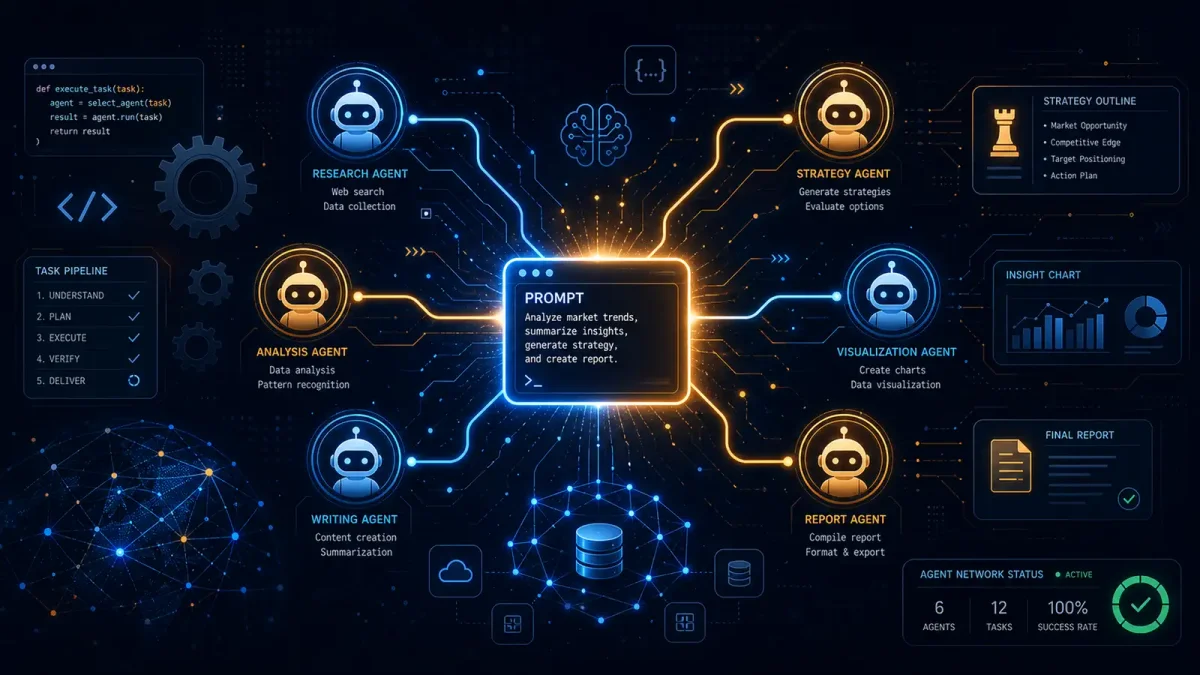
Under the hood, Grok uses a coding-specific model called grok-build-0.1 with a 256K context window. That is enough to hold an entire mid-sized codebase in memory while reasoning about changes. The really interesting architectural detail is what happens after the initial prompt: Grok can fan out up to eight parallel sub-agents, each working in an isolated Git worktree. One agent handles the frontend. Another sets up the backend routes. A third configures the database schema. They work simultaneously and merge results. This is not a chatbot with a code interpreter bolted on. It is a project manager that happens to be an AI.
The workflow is designed around review rather than trust. Grok proposes changes as clean diffs. You review, approve, or request revisions before anything goes live. xAI appears to have learned from earlier AI coding tools that generated code silently and left users debugging regressions they did not know existed. Build Mode shows you exactly what it intends to change before it changes it.
Publishing options cover the full spectrum: a free grok.me subdomain, a custom domain, or a GitHub export if you want to take the code and run it somewhere else. The API is priced at $1 per million input tokens and $2 per million output tokens. The subscription itself — SuperGrok Heavy — costs $300 a month. That is developer pricing, not consumer pricing, and it tells you who xAI thinks the audience is.
Meta AI: The Assistant That Remembers and Acts
Meta’s update is less flashy but arguably more relevant to how most people will encounter agentic AI. The Meta AI assistant, powered by the Muse Spark 1.1 model, can now handle tasks that span days or weeks without requiring a new instruction each time.
A user can ask for a weekly meal plan and get it. More importantly, they can ask the assistant to maintain that meal plan — updating it based on changing preferences, flagging when ingredients need to be bought, adjusting for schedule conflicts. The AI holds the context. It does not forget what you asked it to do last Tuesday.
Meta’s examples get more ambitious from there. Assemble a mood board and shopping list for a kitchen renovation. Build and adjust a half-marathon training plan over several months. Find suitable dates and restaurant options for a birthday dinner, accounting for everyone’s schedules. These are not one-shot prompts. They are ongoing projects that require the AI to track state, remember constraints, and push updates without being asked.
Meta described the update as “our next step toward personal superintelligence: an AI that knows your context, is there for you whenever you need it, and handles things so you don’t have to.” The phrase “personal superintelligence” is marketing, but the underlying capability — persistent context and autonomous task execution — is real and shipping now, initially through the Meta AI app and meta.ai, with WhatsApp integration planned for the coming weeks.
What Changed: Persistence and Parallelism
The technical jump between “AI that answers questions” and “AI that manages projects” comes down to two capabilities that were missing from earlier systems: persistence and parallelism.
Persistence means the AI remembers what it is doing across sessions. Traditional chatbots reset after each message. You can simulate persistence by feeding the entire conversation history back into the prompt, but that is expensive at scale and unreliable for complex, multi-day tasks. Meta’s system holds context natively. Grok’s sub-agents maintain state inside isolated Git worktrees. Both approaches solve the same problem: the AI needs to know what it already did before it can decide what to do next.
Parallelism is what makes Build Mode feel like a development team rather than a solo programmer. Eight sub-agents working simultaneously on different parts of a project is not a parlor trick. It is a meaningful throughput improvement over sequential generation. If each sub-agent takes 30 seconds to complete its task, running them in parallel means an 8-task project finishes in 30 seconds instead of four minutes. For long builds, the difference compounds.
Neither of these capabilities existed in consumer AI tools a year ago. A year ago, the state of the art was ChatGPT’s code interpreter, which ran Python in a sandbox and returned results. It was useful but serial — one task at a time, no memory between sessions, no ability to coordinate multiple workstreams. Grok’s sub-agents and Meta’s persistent context represent a different class of capability. The fact that they arrived in the same week from two different companies suggests a convergence point — a moment where the infrastructure to support agentic behavior became mature enough that multiple teams reached the same conclusion at roughly the same time.
The practical difference for users is the number of steps between intent and outcome. Old model: prompt, read, copy-paste, run, debug, prompt again, repeat. New model: prompt, review diff, approve. The number of manual steps collapses from six or seven to two. That is not an incremental improvement. It is a different category of product.
The Price of Autonomy
The pricing tells its own story. Grok Build Mode lives behind a $300 monthly subscription. Meta’s task features are rolling out to the free Meta AI app initially, but the company has been clear that advanced capabilities will eventually move behind a paid tier — Muse Spark 1.1 already has one.
This is not accidental. Autonomous agents consume far more compute than chatbots. Maintaining persistent context requires storing and processing long histories. Running parallel sub-agents multiplies the compute cost. A single Build Mode session might burn through hundreds of thousands of tokens just in planning and review before any code is generated — and at $1 per million input tokens, the cost is real but manageable for professional use. The unit economics of agentic AI are fundamentally different from the unit economics of chat, and the pricing reflects that.
For now, the early adopters paying $300 a month for Grok Build Mode are developers and small teams who can recoup that cost in saved engineering hours. If Meta eventually charges for task automation, the audience will be different — consumers who value time savings over money savings. The common thread is that autonomous AI is not going to be free, and the companies shipping it are not pretending otherwise. The free tier is the funnel, not the product.
What This Means for How We Use AI Tools
The most important shift is not technical. It is behavioral. For two years, the default interaction with AI has been: open a chat window, type a question, read the answer, repeat. That model is not going away, but it is no longer the only model.
The new model is: define an objective, set a cadence, let the AI handle the steps, review the output. You are not prompting. You are delegating. The AI is not a tool you wield. It is a worker you manage.
This raises questions that the industry has not fully answered. When an AI agent builds and publishes an app, who is responsible for bugs? Who owns the code? What happens when Meta’s AI assistant books the wrong restaurant for a birthday dinner — do you blame the AI, the restaurant, or yourself for not double-checking? These are not hypotheticals. They are operational questions that real users will encounter within weeks.
Grok’s diff-based review workflow is a partial answer: the AI proposes, the human approves. Meta’s approach is more autonomous — the assistant acts, and the user is expected to monitor. Neither model is wrong, but they reflect different philosophies about how much trust to place in an AI that operates without direct oversight.
The larger picture is that AI tools are crossing a threshold. They are moving from systems you interact with to systems that interact with the world on your behalf. Grok Build Mode and Meta AI’s task features are early implementations, rough around the edges and limited in scope. Build Mode currently requires a $300 subscription and targets developers. Meta’s task features are in limited markets and have not yet reached WhatsApp, where most of Meta’s AI users actually are. Both will expand, both will get cheaper, and both will face competitors launching similar capabilities within months.
But the direction is set. Your AI assistant is learning to handle things so you do not have to. The question is what “handle things” starts to mean once it is doing more than answering your questions. Booking appointments. Managing subscriptions. Monitoring your calendar and making decisions about what to prioritize. Each of these capabilities exists in prototype form somewhere. The difference between last week and this week is that two of the largest AI platforms decided the prototypes are ready to ship.