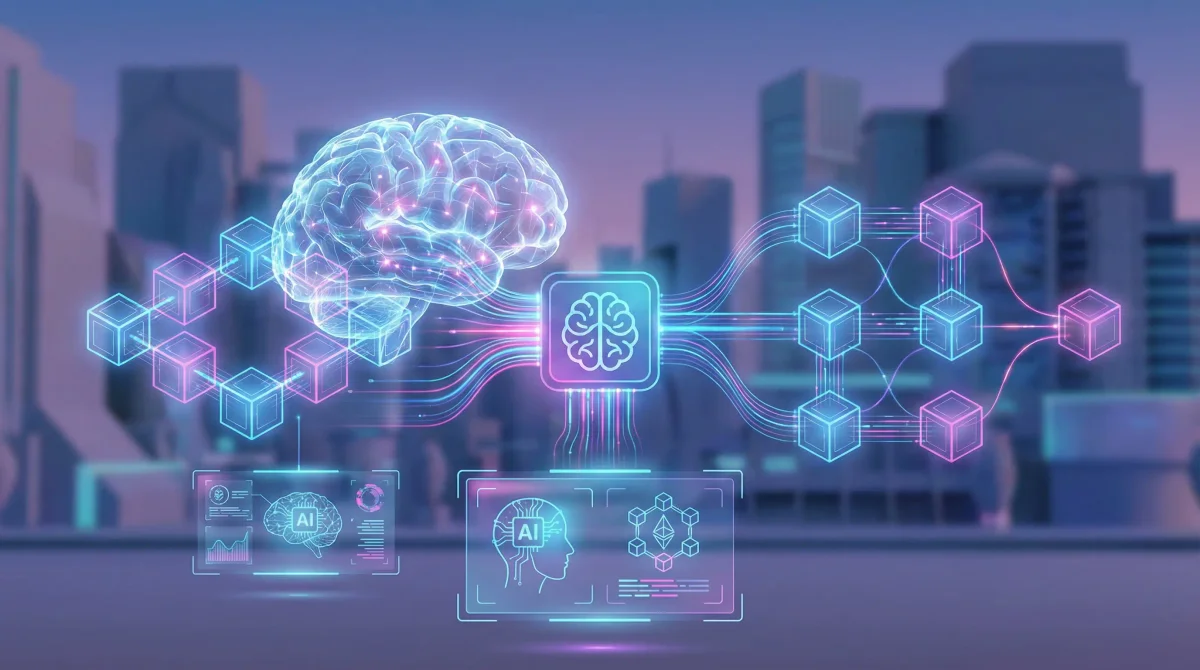
AI and Blockchain Convergence: 2026 Trends and Business Impact
Two technologies that spent years in separate corners are finally talking to each other. AI and blockchain are converging, and the combination is more useful than either one alone. This isn’t hype—businesses are using both together to solve real problems around trust, automation, and verification.
Why This Matters Now
For years, blockchain people and AI people didn’t have much to say to each other. Blockchain folks talked about decentralization and immutability. AI folks talked about neural networks and training data. But 2026 has made something clear: AI needs blockchain’s transparency, and blockchain needs AI’s intelligence.
The numbers are real. Grand View Research projects the blockchain market will grow from $31.28 billion in 2024 to $1.43 trillion by 2030—a 90.1% compound annual growth rate. That growth isn’t coming from crypto speculation. It’s coming from enterprises using blockchain and AI together to solve problems neither technology could handle alone.
The core issue is trust. When an AI agent takes actions on your behalf—negotiating contracts, executing purchases, managing workflows—how do you know what it did? How do you audit its decisions? How do you prove it stayed within policy? Blockchain answers these questions through immutable logs, transparent records, and verifiable credentials.
Autonomous AI Needs Accountability
Agentic AI is different from the AI you’re used to. Traditional AI makes recommendations. Agentic AI takes action. It can execute transactions, negotiate with suppliers, purchase services, and manage entire workflows without asking permission first.
That autonomy creates a problem: how do you trust a machine to act on your behalf?
In 2026, AI companies are integrating blockchain for exactly this reason. Every significant action an AI agent takes gets written to a ledger. Companies like UtopIQ call this a “trust layer for AI”—using blockchain-backed audit logs to ensure agents only access what they’re authorized to access.
Here’s a concrete example. An AI procurement agent negotiates with suppliers, compares prices, and executes purchase orders. Without blockchain, you have no verifiable record of how it made those decisions or whether it followed policy. With blockchain, every negotiation, every price comparison, every decision point is recorded permanently. You can audit it. Regulators can audit it. The record can’t be changed after the fact.
VanEck predicts AI agents will grow from about 10,000 to over 1 million by the end of 2025. That kind of growth demands verification infrastructure. The agent-to-agent (A2A) protocol is becoming the standard for how these systems communicate, coordinate tasks, and establish boundaries.
Tokenization: Making Assets Liquid
Tokenization is one of the clearest wins for the AI-blockchain combination. The idea is simple: take a physical asset—real estate, art, commodities, intellectual property—and represent ownership as digital tokens on a blockchain. Those tokens can be divided into fractions and traded.
AI makes this practical at scale. Machine learning algorithms analyze market data to price fractional ownership. Natural language processing extracts information from legal documents to automate the tokenization process. Predictive analytics assess risk and forecast returns.
The Depository Trust & Clearing Corporation announced in December 2025 that its DTC subsidiary would tokenize DTC-custodied assets. When one of the world’s largest financial infrastructure providers does this, it’s a signal. The rollout is expected in the second half of 2026.
Major investment firms have already tokenized billions of dollars in assets. This is changing equity trading. Traditional markets operate 9:30 AM to 4:00 PM, Monday through Friday. Tokenized assets trade 24/7. Real-world asset tokenization is scaling up in 2026, both in the U.S. and internationally.
Stablecoins: Payment Rails for Machines
AI agents need a way to pay for things. Traditional payment systems are too slow, too expensive, and too dependent on human intermediaries. Stablecoins—digital currencies pegged to stable assets like the U.S. dollar—are becoming the payment infrastructure for machine-to-machine transactions.
The U.S. GENIUS Act, passed in July 2025, created rules for stablecoins: how they’re issued, what reserves they must hold, consumer protections, anti-money laundering requirements. That regulatory clarity triggered a wave of launches. Traditional banks, fintechs, and tech companies are all issuing stablecoins now.
When an AI agent needs to purchase a service, commission work, or pay for digital content, stablecoins provide instant, low-cost settlement. Blockchain networks like Base and TON are running consumer applications where AI agents transact with each other and with businesses using stablecoins.
This is enabling “agentic commerce.” Walmart’s Sparky assistant compares products, filters reviews, and builds shopping carts without waiting for you to click through every step. As these systems get better and gain the ability to transact independently, stablecoins provide the infrastructure.
Supply Chain Transparency
Supply chains are complex. Products move through dozens of intermediaries before reaching consumers. Tracking provenance, verifying authenticity, and ensuring compliance are manual, error-prone processes.
AI and blockchain together automate this. Blockchain creates an immutable record of every transaction and handoff. AI analyzes that data to detect anomalies, predict delays, and optimize routing.
Walmart uses blockchain to track food products from farm to store. When contamination is detected, they can trace the source in seconds instead of days. AI models predict which products are at risk based on supplier patterns and environmental conditions.
The pharmaceutical industry uses similar systems to combat counterfeit drugs. Each package gets a unique identifier recorded on a blockchain. AI monitors distribution patterns to flag suspicious activity. The combination reduces fraud and protects patient safety.
Smart Contracts Get Smarter
Smart contracts are programs that execute automatically when conditions are met. They’re useful but limited—they can only respond to predefined rules.
AI makes smart contracts adaptive. Instead of rigid if-then logic, AI-powered contracts can interpret natural language, assess context, and make nuanced decisions.
Insurance is a clear use case. Traditional insurance claims require human review. An AI-powered smart contract can analyze photos of damage, cross-reference policy terms, and approve or deny claims automatically. Blockchain ensures the decision process is transparent and auditable.
Legal agreements are another application. AI can parse contract language, identify obligations, monitor compliance, and trigger payments when milestones are met. The blockchain record proves what happened and when.
Data Marketplaces
AI models need data to train. Companies have data but are reluctant to share it—privacy concerns, competitive advantage, regulatory constraints.
Blockchain enables secure data marketplaces. Data providers tokenize their datasets. AI developers purchase access without seeing the raw data. Computation happens in secure enclaves. Results are delivered, but the underlying data never leaves the provider’s control.
Ocean Protocol pioneered this model. Organizations can monetize data assets while maintaining privacy. AI developers get access to diverse training data. The blockchain records transactions and enforces usage rights.
This solves a real problem. Healthcare data is valuable for AI research but heavily regulated. Financial data is sensitive but useful for fraud detection. Blockchain-based data marketplaces let organizations share data safely while complying with regulations like GDPR and HIPAA.
Challenges and Limitations
The AI-blockchain convergence faces real obstacles.
Scalability: Blockchain networks process 10-100 transactions per second. AI applications need thousands. Layer-2 solutions and specialized chains are addressing this, but it’s still a bottleneck.
Energy consumption: Proof-of-work blockchains use significant energy. Proof-of-stake reduces this, but AI training also consumes substantial power. The combined footprint is a concern.
Complexity: Integrating AI and blockchain requires expertise in both domains. Few organizations have the necessary skills. The learning curve is steep.
Regulatory uncertainty: Rules are evolving. The GENIUS Act clarified stablecoin regulations, but many questions remain. Cross-border transactions, data privacy, and liability for AI decisions are still being worked out.
Cost: Blockchain transactions have fees. AI computation is expensive. For many use cases, the combined cost exceeds the benefit. The economics need to improve.
What’s Next
The AI-blockchain convergence is real, but it’s early. The infrastructure is being built. Standards are emerging. Use cases are being proven.
By late 2026, expect to see:
More enterprise adoption: Large companies are piloting AI-blockchain systems. Successful pilots will scale to production.
Better tools: Developer platforms are making it easier to build AI-blockchain applications. The complexity is being abstracted away.
Clearer regulations: Governments are establishing rules. Regulatory clarity will unlock institutional investment and mainstream adoption.
New business models: AI agents that own assets, negotiate contracts, and transact autonomously will create entirely new economic structures.
The question isn’t whether AI and blockchain will converge. They already are. The question is how fast the infrastructure can scale to support the applications being built on top of it.
For businesses, the opportunity is clear: use AI for intelligence and blockchain for trust. Together, they solve problems neither can address alone. The companies that figure this out first will have a significant advantage.