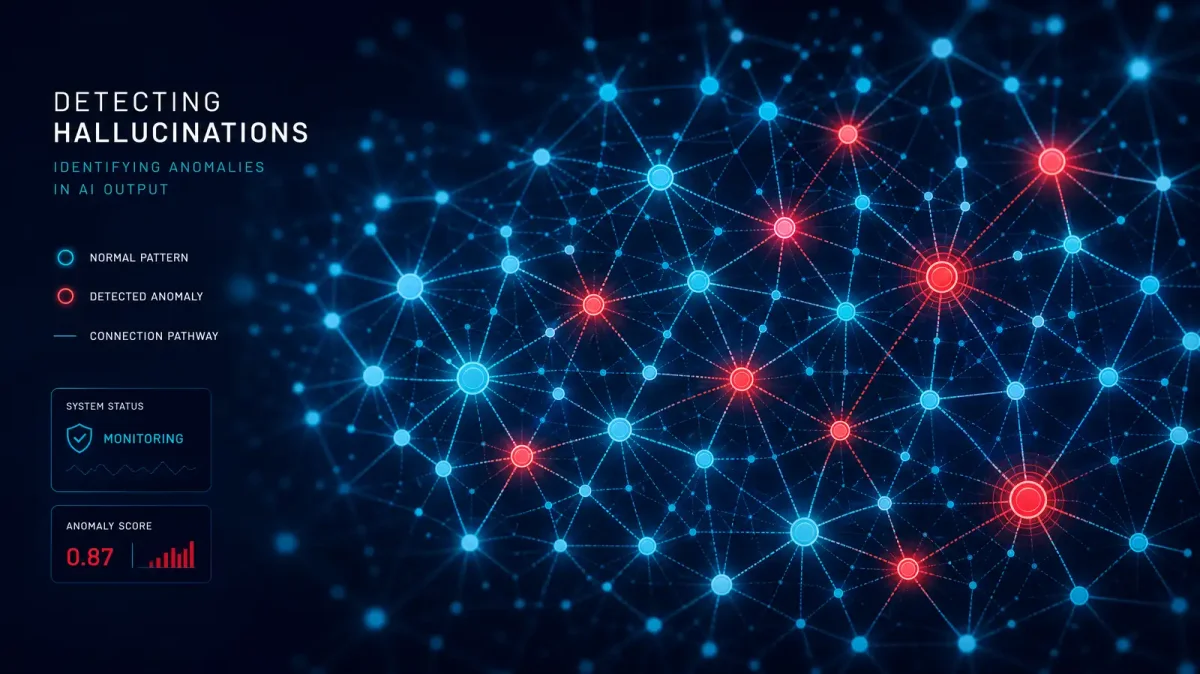
A cluster of research papers published at top AI conferences in 2026 is converging on a problem that has plagued large language models since their inception: how do you catch an LLM when it lies?
The answer, emerging from labs at Technion — Israel Institute of Technology in collaboration with NVIDIA — involves looking inside the model itself. Rather than relying on external fact-checking or human review, these systems monitor the LLM’s internal states in real time and flag outputs that are likely to contain errors.
Two Complementary Approaches Emerge
The research team, led by Dr. Haggai Maron of Technion’s Andrew and Erna Viterbi Faculty of Electrical and Computer Engineering, has pursued two parallel strategies for hallucination detection, each presented at a different premier conference this year.
CHARM: Reading Attention as Graphs
Work presented at ICLR 2026 reframes how researchers analyze attention mechanisms — the internal weighting system that determines which parts of an input an LLM focuses on when generating each token.
Previous approaches summarized attention using simple statistics: how much focus the model placed on input text versus its own generated text. The Technion team instead represents attention patterns as mathematical graphs, where words and tokens become nodes and attention strengths define the edges between them.
A graph neural network called CHARM processes these structures and produces predictions about whether individual tokens or entire responses are likely to contain hallucinations. The approach proved more precise than earlier methods, in some cases identifying specific sections of generated text where errors were most likely to occur.
LLM Output Signature: Detection Without Internal Access
A second study, presented at AAAI 2026, addresses a different deployment scenario: commercial AI systems where internal model states are simply not accessible to the end user.
This approach defines what the researchers call an “LLM Output Signature,” built from two components: the full probability distribution over all possible next tokens, and the specific probabilities assigned to the tokens the model actually chose to generate. By analyzing these signatures, the system can detect anomalies that correlate with hallucination — essentially spotting when the model generates text that it was not particularly confident about.
This method is especially relevant for organizations using third-party LLM APIs like OpenAI or Anthropic, where the internal architecture is a black box but the output probabilities may still be accessible through logprobs or similar interfaces.
A Shift in AI Interpretability Philosophy
What unites both approaches is a broader philosophical shift in how the AI research community thinks about interpretability. As the Technion team notes, the effort reflects a move away from trying to fully explain how models work — a goal that may be fundamentally intractable for systems with hundreds of billions of parameters — and toward building practical monitoring tools that flag problematic behavior as it happens.
This pragmatic turn has implications beyond research labs. Enterprises deploying LLMs in production environments need real-time quality assurance, not post-hoc analysis. Tools that can evaluate whether a generated response is likely to be accurate before it reaches an end user are increasingly seen as essential infrastructure.
Domain-Specific LLMs Face the Same Challenge
The hallucination problem extends to specialized models as well. A study published in npj Digital Medicine on June 19 introduced AI4Doctor, a clinical LLM built around electronic medical records and fine-tuned with input from practicing physicians. The researchers acknowledge that even domain-specific models struggle with complex diagnostic scenarios where the training data does not cover every edge case.
The implication is clear: hallucination detection tools like those developed at Technion will need to work across both general-purpose and domain-specific models. A clinical LLM that hallucinates a drug interaction is far more dangerous than a chatbot that invents a historical date.
What This Means for Enterprise AI
For organizations evaluating LLM deployments, the emergence of self-monitoring capabilities changes the risk calculus:
- API-based deployments can use LLM Output Signature analysis if the provider exposes probability data, adding a confidence layer without modifying the underlying model.
- Self-hosted deployments can integrate attention-based monitoring like CHARM directly into the inference pipeline.
- Regulated industries (healthcare, finance, legal) gain a practical tool for demonstrating due diligence in AI quality assurance.
The research is still early — none of these tools are production-hardened at scale yet. But the trajectory is clear: the next generation of LLM systems will not just generate text. They will evaluate their own output in real time, flagging uncertainty before users encounter errors.
That shift, if it delivers on its promise, may do more to build public trust in AI than any single accuracy benchmark ever could.