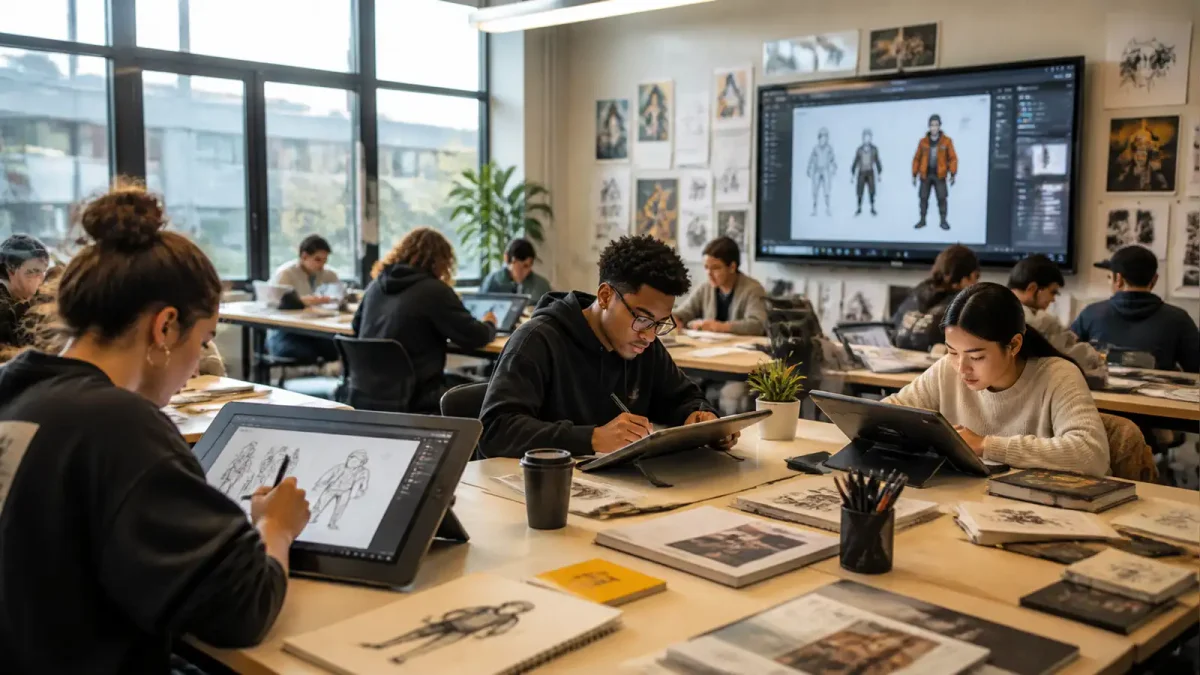
When Ry Fryar teaches Digital Art and A.I. at York College of Pennsylvania, he doesn’t start with the tools. He starts with the question: what do you want to say? The AI comes later, as a means to an end, not the end itself. “Without creativity, the results are common, therefore dull and fundamentally inexpert,” Fryar told Observer in July 2026.
This is the core tension art schools are grappling with right now. AI image generators have gone from novelty to standard tool in about three years. Students arrive at school already knowing how to generate images with Midjourney or DALL-E. Some have built entire portfolios on AI-generated work. Art programs can’t ignore this reality, but they also can’t let AI flatten the very creative thinking they exist to develop.
The result is a fundamental rethinking of how art is taught, what gets assessed, and what “creative authorship” actually means when a student can describe an image and have a machine render it in seconds.
The new curriculum: AI as tool, not shortcut
Schools that are getting this right share a common approach: they treat AI the way they treat any other tool in the studio. A camera doesn’t make you a photographer. A synthesizer doesn’t make you a musician. An AI image generator doesn’t make you an artist. The skill is in the judgment, the taste, the ability to direct the tool toward a specific creative vision.
At Parsons School of Design, associate dean Andrew Shea told Observer that the college isn’t teaching students to “push a button and get an answer.” Instead, the focus is on creative direction: understanding composition, color theory, narrative, and how to use AI to execute a vision rather than generate one at random.
York College’s approach goes further. Students learn to guide AI at a professional level, which means understanding prompt construction, iteration, and how to evaluate output against creative standards. They also study copyright law, ethics, and responsible AI use. The tool is in the curriculum, but it’s embedded in a framework of critical thinking and professional practice.
The University of Florida’s art education program frames the issue as “productive difficulty.” The idea is that learning happens when students struggle with a problem, not when they get an instant answer. AI threatens to remove that struggle, which sounds like a feature until you realize the struggle is where creative growth happens.
Assessment is changing too
If a student uses AI to generate 50 variations and selects the best one, how do you grade that? Traditional art assessment looks at technical skill: brushwork, composition, color mixing, material handling. AI-generated work doesn’t require those skills in the same way. Schools are developing new criteria.
The UF program now evaluates student work on four dimensions: iteration (how the work changed over the lesson), risk-taking (whether the student tried something new), reflection (can the student explain their decisions), and responsiveness (can they articulate the “how” and “why” of what they did). These criteria value process over product, which matters more than ever when the product can be generated in seconds.
This isn’t just an art school problem. Any field that involves creative output, from graphic design to marketing to content creation, is facing the same question: when AI can produce the output, what do we actually care about? The answer, increasingly, is the thinking that went into it.
What AI can’t teach
The Art of Education identified five skills that AI simply cannot develop in students: slowing down, persevering through difficulty, thinking critically about choices, developing personal voice, and building the tolerance for ambiguity that creative work demands. These aren’t soft skills. They’re the core skills of any creative practice.
AI accelerates the feedback loop. You can generate, evaluate, and regenerate in minutes instead of days. That speed is useful for iteration, but it can short-circuit the deep thinking that happens when you’re stuck with a problem for hours or days. The moment of frustration where you don’t know what to do next, and you have to sit with that uncertainty, is where creative breakthroughs happen. AI removes that moment, and with it, the growth that comes from it.
Art schools are recognizing this and building safeguards. Some programs limit AI use in foundational courses, requiring students to develop manual skills and creative thinking before they’re allowed to use generative tools. Others allow AI throughout but weight assessment heavily toward process documentation: sketchbooks, iteration logs, written reflections on creative decisions.
The industry is watching
Art schools aren’t just preparing students for personal expression. They’re preparing students for an industry that’s rapidly integrating AI into creative workflows. Advertising agencies, game studios, film production companies, and design firms all use AI tools now. Graduates who understand how to work with AI, not just use it, have a significant advantage.
But the industry also needs people who can do what AI can’t: make creative judgments, develop original concepts, understand cultural context, and direct a team toward a cohesive vision. These are the skills that art schools are doubling down on, even as they integrate AI into the curriculum.
The schools that figure this out first will produce graduates who are both technically fluent with AI tools and creatively rigorous in ways that AI cannot replicate. That’s the sweet spot, and it’s where art education is heading in 2026.
What this means for the rest of us
This moment in art education reflects a broader question about AI and human capability. When machines can produce competent output in seconds, what is the value of human skill? Art schools are answering this question in real time, and their answer is: the value is in the thinking, the taste, the judgment, and the creative vision that directs the tool.
The students who thrive in this new landscape won’t be the ones who generate the most images. They’ll be the ones who can articulate why they made specific creative choices, how their work evolved through iteration, and what their art says that a machine’s cannot. That’s a harder thing to teach, but it’s also a more important thing to learn.
Student perspectives: the generational divide
Not every student is excited about AI integration. Some art students feel ambivalent. They came to art school to develop their hands and their eyes, to learn to see the world through direct observation and translate that into physical or digital work. When a classmate generates a polished image in five minutes while they spent three days on a painting, the comparison feels unfair, even if the final products are evaluated differently.
Other students embrace AI as a natural extension of their practice. They see it as another tool in the kit, like a camera or Photoshop. For them, the question isn’t whether to use AI but how to use it well. These students tend to thrive in programs that provide structure and guidance rather than prohibition.
The most interesting student work comes from those who use AI deliberately, with clear creative intent. They generate images as starting points, then paint over them, recombine elements, or use them as references for entirely new compositions. This hybrid approach preserves the creative process while leveraging AI’s speed for exploration and iteration.
Faculty challenges: teaching what you didn’t learn
Art faculty face a unique challenge. Most working artists and art professors didn’t learn AI tools in school. They learned through years of manual practice, developing skills that took thousands of hours to refine. Teaching students to use tools you didn’t grow up with requires humility and adaptability.
The best faculty are honest about what they know and don’t know. They bring in guest speakers from industry who use AI daily. They create learning environments where experimentation is encouraged and failure is part of the process. They shift from being the sole authority in the room to being a guide who helps students navigate a rapidly changing landscape.
Some faculty resist AI integration entirely, arguing that it undermines the fundamental purpose of art education. This position has merit, but it also risks producing graduates who are unprepared for the industry they’re entering. The middle path, teaching AI as one tool among many while maintaining rigorous creative standards, is harder but more useful.
What comes next
Art education in 2026 is in a transitional period. The old model, where technical mastery was the primary measure of success, is giving way to a new model where creative thinking, conceptual development, and the ability to direct AI tools are equally important. This transition is messy, uneven, and full of disagreement.
The schools adapting fastest are the ones taking a principled approach: integrate AI, but don’t let it replace the hard work of learning to see, think, and create. The students who come out of these programs will be both AI-fluent and creatively rigorous, which is exactly what the industry needs.
The rest of the creative world is watching art schools to see how they handle this. If they get it right, they’ll produce a generation of creators who can do something no AI can: make art that matters because a human chose to make it.
The portfolio question
One of the most practical challenges is portfolio assessment. Graduate programs and employers want to see portfolios. But what does an AI-assisted portfolio demonstrate? If a student generated 200 images and selected 20 for their portfolio, the portfolio shows selection skill, not creation skill. Traditional portfolios demonstrated both.
Some programs now require portfolio submissions to include process documentation: sketches, iteration logs, written explanations of creative decisions, and evidence of how the work evolved. This shifts the portfolio from a showcase of final products to a narrative of creative process. It’s more work for students, but it’s also more honest about what they can actually do.
Industry hiring managers are split on this. Some care primarily about the final output and the creative judgment behind it. Others want to see evidence of hands-on skill and the ability to work through problems without AI shortcuts. The most competitive applicants, in practice, demonstrate both: they can use AI fluently and they can create without it.
International perspectives
Art schools outside the US are handling AI integration differently. Some European programs have been more cautious, emphasizing traditional craft and manual skills before introducing AI. Others, particularly in East Asia, have moved faster to integrate AI into curricula, reflecting the technology’s rapid adoption in commercial creative industries there.
This divergence creates interesting dynamics for international students and for the global creative industry. A graduate from a program that emphasized manual skills may bring different strengths than one from a program that focused on AI fluency. Both have value, and the industry needs both.
The global conversation about AI in art education is still early. The decisions art schools make in the next two to three years will shape how an entire generation of creators works with AI, and by extension, how AI-generated content looks and feels for the next decade.