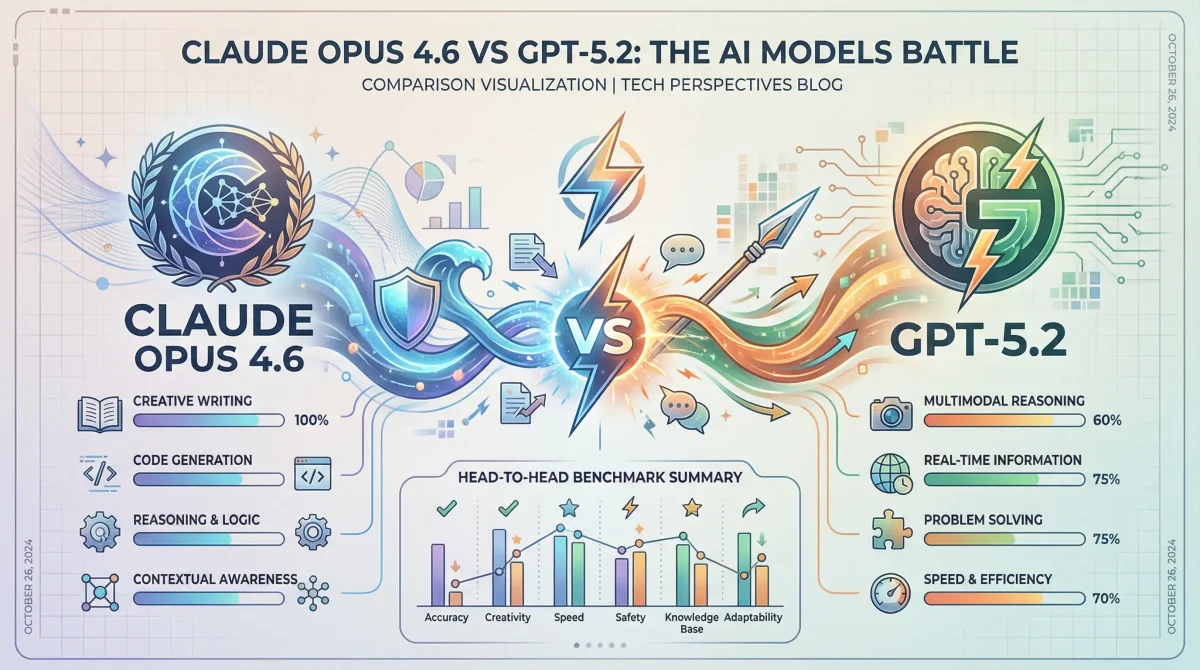
Claude Opus 4.6 vs GPT-5.2: The Ultimate 2026 Comparison
Anthropic released Claude Opus 4.6 on February 5, 2026, with a 1 million token context window and agent teams. OpenAI countered hours later with GPT-5.2 Pro. Both claim state-of-the-art performance. The benchmark data tells a more nuanced story.
This comparison covers what actually matters: where each model excels, where it falls short, and which one you should use for your specific needs.
The Big Picture
Claude Opus 4.6 beats GPT-5.2 Pro by 144 Elo points on GDPval-AA, a benchmark measuring knowledge work in finance, legal, and professional domains. That’s a significant gap. But GPT-5.2 Pro leads on other metrics, particularly mathematical reasoning and multi-language coding.
The choice isn’t obvious. It depends on what you’re building.
Context Windows: 1M vs 200K
Claude Opus 4.6 offers a 1 million token context window in beta. That’s 5x larger than GPT-5.2 Pro’s 200K limit. For reference, 1M tokens is roughly 750,000 words—about 10 full-length novels.
More interesting than the size is the retrieval accuracy. Claude Opus 4.6 scores 76% on MRCR v2 (8-needle, 1M context) versus 18.5% for Claude Sonnet 4.5. That’s a real improvement, not just a bigger buffer that forgets what it read.
GPT-5.2 Pro’s 200K context is still substantial—about 150,000 words. For most applications, that’s enough. The question is whether your use case needs more.
Use 1M context for:
- Analyzing entire codebases (large monorepos)
- Processing long legal documents or contracts
- Multi-document research and synthesis
- Long-running conversations with full history
200K context is sufficient for:
- Most coding tasks
- Standard document analysis
- Typical chatbot applications
- API integrations
Agent Teams: Claude’s Killer Feature
Claude Opus 4.6 introduces agent teams—multiple Claude Code agents working in parallel on complex tasks. This is a research preview feature, but it’s significant.
Instead of one agent handling everything sequentially, you can spawn specialized agents for different subtasks. One agent researches documentation, another writes code, a third runs tests. They coordinate through a shared task list and message each other.
GPT-5.2 doesn’t have an equivalent feature. You can build multi-agent systems with GPT-5.2, but it requires external orchestration. Claude’s agent teams are built into the model’s API.
The practical impact: tasks that would take 30 minutes with a single agent can complete in 10 minutes with three agents working in parallel. For complex workflows—like building a full-stack feature or refactoring a large codebase—this matters.
Benchmark Performance
Coding: Tight Race
SWE-bench Verified (real GitHub issues):
- Claude Opus 4.6: 80.8%
- GPT-5.2 Pro: 80.0%
The 0.8 point difference is negligible. Both models can handle real-world coding tasks at a professional level.
Terminal-Bench 2.0 (agentic coding):
- Claude Opus 4.6: SOTA (state-of-the-art)
- GPT-5.2 Pro: Second place
Claude’s lead here aligns with its agent-focused design. For tasks requiring multiple tool uses and complex workflows, Claude has an edge.
Aider Polyglot (multi-language editing):
- GPT-5.2 Pro: 88.0%
- Gemini 2.5 Pro: 83.1%
- Claude Opus 4.6: Not reported
GPT-5.2 Pro wins on multi-language code editing. If you work across Python, JavaScript, Go, Rust, and other languages regularly, GPT-5.2 Pro handles context switching better.
Knowledge Work: Claude Dominates
GDPval-AA (finance, legal, professional work):
- Claude Opus 4.6: +144 Elo vs GPT-5.2 Pro
This is the biggest performance gap in any benchmark. For knowledge work—analyzing financial reports, reviewing legal documents, synthesizing research—Claude Opus 4.6 is significantly better.
Humanity’s Last Exam (multidisciplinary reasoning):
- Claude Opus 4.6: SOTA
- GPT-5.2 Pro: Second place
Claude also leads on this comprehensive reasoning test covering 2,500 questions across multiple disciplines.
Information Retrieval: Claude Wins
BrowseComp (complex information retrieval):
- Claude Opus 4.6: SOTA
- GPT-5.2 Pro: Second place
For tasks requiring web research, document analysis, and information synthesis, Claude Opus 4.6 performs better. The 1M context window helps here—it can hold more source material while reasoning about it.
Mathematics: GPT-5.2 Edges Ahead
AIME 2025 (high school olympiad math):
- GPT-5.2 Pro: 100% (with tools)
- Claude Opus 4.6: Not reported
GPT-5.2 Pro achieves perfect performance on this benchmark. For mathematical reasoning and scientific computing, GPT-5.2 Pro has a slight edge.
Adaptive Thinking: Claude’s Smart Resource Allocation
Claude Opus 4.6 introduces “adaptive thinking”—the model decides when to use deep reasoning versus quick responses. You can also set effort levels: low, medium, high (default), or max.
This matters for cost optimization. Not every query needs maximum intelligence. Simple questions can use low effort, saving tokens and money. Complex problems get high or max effort automatically.
GPT-5.2 Pro has four reasoning configurations (high, medium, low, minimal) but you have to choose manually. Claude’s adaptive approach is more convenient.
Pricing: Similar Costs
Both models cost $5 per million input tokens and $25 per million output tokens for standard context. Claude Opus 4.6 charges premium pricing ($10/$37.50) beyond 200K tokens.
For most use cases, the costs are comparable. The 1M context premium only applies if you actually use it.
Real-World Performance
Benchmarks are useful but limited. Real-world performance depends on your specific use case.
Where Claude Opus 4.6 Excels
Agentic workflows: If you’re building systems that use tools, navigate interfaces, or complete multi-step tasks, Claude Opus 4.6 is the better choice. The agent teams feature and strong Terminal-Bench performance make it ideal for automation.
Knowledge work: Financial analysis, legal document review, research synthesis—Claude Opus 4.6’s 144 Elo lead on GDPval-AA is real. For professional services, it’s the clear winner.
Long documents: The 1M context window with 76% retrieval accuracy handles entire codebases, long contracts, and multi-document analysis better than GPT-5.2 Pro’s 200K limit.
Information retrieval: Web research, document analysis, and complex information synthesis favor Claude Opus 4.6.
Where GPT-5.2 Pro Excels
Mathematical reasoning: Perfect AIME 2025 performance and strong GPQA Diamond scores make GPT-5.2 Pro better for scientific computing and quantitative analysis.
Multi-language coding: The 88% Aider Polyglot score shows superior handling of polyglot codebases. If you regularly switch between Python, JavaScript, Go, and Rust, GPT-5.2 Pro handles it better.
Reliability: Sub-1% hallucination rates and 1.6% error rates on medical cases make GPT-5.2 Pro the safer choice for high-stakes applications where wrong answers have consequences.
Cost flexibility: Four reasoning configurations let you dial down intelligence (and cost) for simpler tasks. The minimal configuration uses 23x fewer tokens than high while maintaining GPT-4.1-level performance.
Which Model Should You Choose?
Choose Claude Opus 4.6 if:
- You’re building agents that use tools and complete multi-step workflows
- Your work involves financial analysis, legal documents, or professional services
- You need to analyze entire codebases or very long documents
- Information retrieval and research synthesis are core to your application
- You want agent teams for parallel task execution
Choose GPT-5.2 Pro if:
- Mathematical reasoning is central to your use case
- You work across multiple programming languages regularly
- Reliability and low hallucination rates are critical (healthcare, legal, finance)
- You want fine-grained control over reasoning effort and cost
- Your context needs fit within 200K tokens
The Bottom Line
Claude Opus 4.6 and GPT-5.2 Pro are both excellent models. The choice depends on your specific needs.
For agentic workflows, knowledge work, and long-context tasks, Claude Opus 4.6 is the better choice. The 1M context window, agent teams, and strong performance on professional work benchmarks make it ideal for complex automation and research tasks.
For mathematical reasoning, multi-language coding, and applications where reliability is paramount, GPT-5.2 Pro is the better choice. The perfect math scores, strong polyglot performance, and sub-1% hallucination rates make it ideal for scientific computing and high-stakes applications.
The 144 Elo gap on knowledge work is significant. If your application involves financial analysis, legal document review, or professional services, Claude Opus 4.6’s advantage is real and measurable.
Both models represent the state of the art in 2026. The question isn’t which is better overall—it’s which is better for your specific use case.