For the first half of the 2020s, enterprise AI was overwhelmingly a centralized story. Models lived in massive cloud data centers. Data was shipped from the edge — factories, retail stores, branch offices, mobile devices — to these centralized hubs for processing, and results were shipped back. It worked well enough for applications where latency did not matter and bandwidth was cheap. But it created structural bottlenecks that became increasingly apparent as AI workloads multiplied.
In 2026, the architecture is shifting. Edge AI — the practice of running AI inference and, increasingly, training directly on the devices and systems where data is generated — has moved from experimental pilots to mainstream enterprise deployment. The drivers are familiar: latency, bandwidth cost, privacy regulation, and resilience. But the implications go far beyond technical optimization. Edge AI is forcing a fundamental rethinking of how enterprise IT is structured.
From Cloud-Centralized to Distributed Intelligence
The traditional cloud-centric AI model made perfect sense when compute resources for machine learning were scarce and expensive. Training a large model required GPU clusters that only hyperscale providers could afford economically. Inference, too, was centralized because it was simpler to manage and update a single deployment than hundreds of distributed ones.
That calculus has changed on multiple fronts.
Hardware has become dramatically more capable at the edge. Modern edge processors from NVIDIA, Intel, Qualcomm, and a growing number of specialized chipmakers now deliver inference performance that rivals server-grade GPUs from just a few years ago, while consuming a fraction of the power. The NVIDIA Jetson Orin series, for example, delivers 275 TOPS of AI performance in a module that fits in the palm of your hand and runs on 60 watts. This is not a niche product; it is deployed in autonomous vehicles, industrial robots, and medical imaging devices worldwide.
Simultaneously, model optimization techniques have matured to the point where production-grade accuracy can be achieved with significantly reduced compute requirements. Quantization, pruning, knowledge distillation, and neural architecture search have collectively made it possible to deploy models that are 10 to 100 times smaller than their cloud counterparts while retaining 95 percent or more of their accuracy. This means that the models running on edge devices today are not toy approximations; they are serious inference engines.
The Latency Imperative
The most obvious driver of edge AI adoption is latency. In applications where decisions must be made in milliseconds — autonomous vehicle navigation, industrial safety systems, real-time quality inspection on manufacturing lines — the round-trip time to a cloud data center is simply unacceptable. A network round trip of even 50 milliseconds is an eternity for a robot arm that needs to stop when it detects a defect.
But latency is only the most visible manifestation of a deeper principle: the value of AI output is often a function of how quickly it is produced. In retail, a customer-facing AI assistant that takes three seconds to respond because it is querying a cloud API creates a fundamentally different experience than one that responds in 200 milliseconds from a local edge server. The difference is not just technical; it is experiential, and it affects adoption, satisfaction, and ultimately revenue.
Enterprises are discovering that edge AI is not just about making existing applications faster; it is about enabling entirely new applications that were not feasible under cloud-centric architectures. Real-time video analytics across hundreds of security cameras, continuous monitoring of industrial equipment for predictive maintenance, personalized experiences in physical retail spaces — all of these require processing that happens at or near the point of data generation.
Bandwidth Economics
The bandwidth argument for edge AI is equally compelling. A single manufacturing facility with 200 high-definition cameras streaming video at 30 frames per second generates approximately 2 terabytes of raw video data per day. Shipping all of that to the cloud for AI analysis is not just expensive; it is often impractical given network capacity constraints. Edge AI flips this equation: instead of sending raw data to the cloud and receiving processed results, the edge device processes the data locally and sends only the insights — a defect detected, an anomaly flagged, a count completed — back to the central system. The bandwidth reduction is typically two to three orders of magnitude.
This matters not only for cost but for feasibility. Many enterprise sites — remote mines, offshore platforms, rural agricultural operations — simply do not have the network connectivity to support continuous cloud streaming. Edge AI enables AI-powered operations in environments where cloud connectivity is intermittent or absent.
Privacy, Compliance, and Data Sovereignty
The regulatory landscape has become one of the strongest accelerants for edge AI adoption. GDPR, CCPA, and an expanding array of data protection regulations worldwide have created legal frameworks that make it increasingly difficult to move personal data across borders and between organizational boundaries. In healthcare, financial services, and government, the compliance burden of cloud-based AI processing can be prohibitive.
Edge AI offers a compelling alternative: process the data where it is created, extract the insights needed, and transmit only anonymized or aggregated results to central systems. The raw personal data never leaves the premises, dramatically reducing compliance risk. For healthcare providers deploying AI-powered diagnostic tools, this means patient data can be processed on-site without the legal complexity of cloud data transfer agreements. For financial institutions, it means fraud detection can happen at the branch level without exposing customer transaction data to external processors.
This regulatory dynamic is particularly important in the European Union, where the AI Act has created additional requirements around data handling and model transparency. Edge AI deployments, with their localized data processing and clearer data lineage, are better positioned to meet these requirements than centralized cloud alternatives.
The Hybrid Architecture
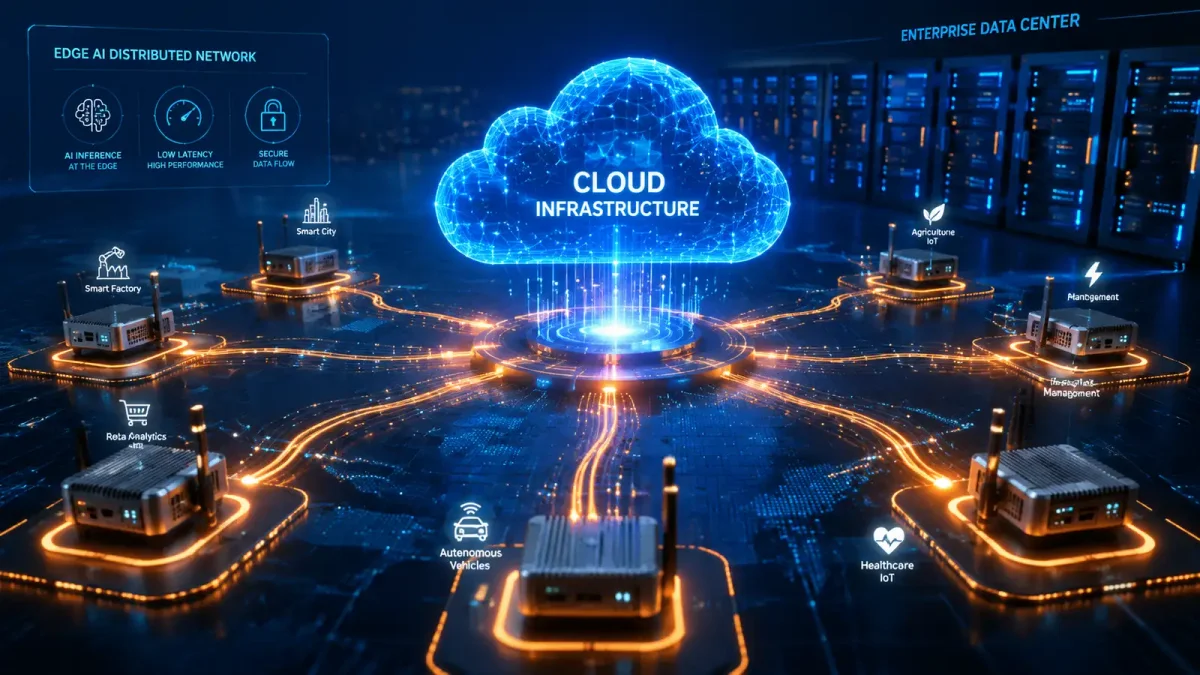
The most common enterprise architecture emerging in 2026 is not purely edge or purely cloud. It is hybrid: edge devices handle real-time inference and data filtering, while cloud infrastructure manages model training, orchestration, and global analytics. This division of labor plays to the strengths of each tier.
Edge devices excel at low-latency, high-frequency processing of local data. They can respond to events in milliseconds, filter out irrelevant data, and maintain operations during network outages. But they lack the compute power for model training, the storage capacity for large-scale data analysis, and the connectivity for cross-site coordination.
Cloud infrastructure excels at these complementary tasks. It aggregates data from thousands of edge nodes to train improved models, performs global analytics that reveal patterns invisible at the individual site level, and orchestrates model updates across the edge fleet. The cloud becomes the brain that trains and coordinates; the edge becomes the nervous system that senses and acts.
This hybrid model requires new management tooling — platforms that can deploy, monitor, and update models across thousands of heterogeneous edge devices while maintaining consistency and security. The emerging solutions in this space combine container orchestration (typically Kubernetes variants optimized for edge environments) with MLOps pipelines that automate the cycle of model training, testing, deployment, and monitoring across the cloud-edge boundary.
MLOps at the Edge
Operationalizing AI at the edge introduces challenges that cloud-centric MLOps tools were not designed to handle. Model deployment must account for intermittent connectivity, heterogeneous hardware, and the need for rollback capabilities when updates fail. Model monitoring must detect not just accuracy drift but hardware degradation and environmental changes that affect sensor data quality.
In 2026, the leading edge AI platforms have matured to address these challenges. Automated model compression pipelines take cloud-trained models and optimize them for specific edge hardware profiles, generating device-specific binaries that maximize performance within memory and power constraints. Over-the-air update systems ensure that models can be updated remotely, with A/B testing and gradual rollout capabilities that prevent a bad update from taking down an entire fleet simultaneously.
Federated learning has also emerged as a practical technique for edge model improvement. Instead of sending data to the cloud for training, edge devices train locally on their own data and share only model gradients — the mathematical adjustments learned from the data — with a central aggregator. The aggregator combines these gradients to produce an improved global model that is then redistributed to the edge. This approach improves model quality across the fleet without moving raw data, satisfying both performance and privacy requirements.
The Business Case
The business case for edge AI has evolved from proof-of-concept justification to standard capital expenditure planning. Enterprises that have deployed edge AI at scale report measurable returns across multiple dimensions.
Manufacturing companies using edge AI for quality inspection have reported defect detection rates that exceed human inspectors by 15 to 30 percent, with the additional advantage of consistency and the ability to operate continuously without fatigue. The return on investment typically materializes within six to twelve months through reduced waste, fewer customer returns, and lower inspection labor costs.
Retailers deploying edge AI for inventory management and customer analytics have achieved real-time visibility that was previously impossible. Smart shelf systems that use computer vision to monitor stock levels and trigger automatic reordering have reduced out-of-stock incidents by up to 40 percent in pilot deployments. The bandwidth savings alone — eliminating the need to send continuous video feeds to the cloud — justify the edge infrastructure investment for many retailers.
Healthcare organizations are deploying edge AI for clinical decision support at the point of care, where the combination of low latency and data privacy is essential. AI-powered imaging analysis running on local edge servers can provide radiologists with preliminary results in seconds rather than the minutes required for cloud processing, while keeping patient data within the hospital’s security perimeter.
The Road Ahead
Edge AI in 2026 is not a finished transformation; it is an active architectural shift that will continue to reshape enterprise IT for years to come. The next frontier is on-device training — the ability to adapt and personalize models at the edge without any cloud involvement. Early implementations in mobile devices and IoT sensors have demonstrated the feasibility of this approach, and enterprise-grade solutions are emerging.
The convergence of edge AI with 5G and, eventually, 6G networks will create new possibilities for distributed intelligence. Ultra-low-latency edge computing nodes positioned at cell tower sites will bring cloud-grade AI processing within meters of end users and devices, enabling applications that require both the intelligence of centralized models and the responsiveness of local processing.
For enterprise IT leaders, the message is clear: edge AI is no longer optional. Organizations that continue to treat AI as exclusively a cloud workload will find themselves at a competitive disadvantage in applications where latency, bandwidth, privacy, and resilience matter. The architectures being built today — hybrid, distributed, and intelligently partitioned between cloud and edge — will define the competitive landscape of enterprise technology for the next decade.
The edge is not just where data lives. It is increasingly where intelligence lives. And in 2026, enterprises that understand this are building the infrastructure to act on it.