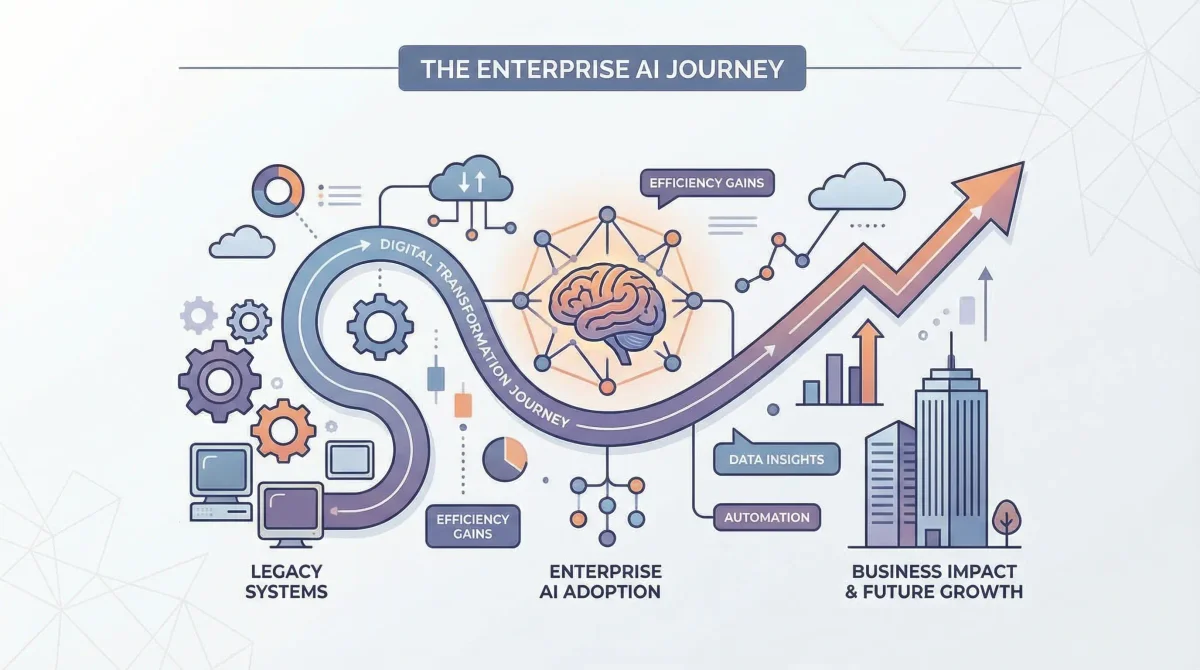
Enterprise AI Adoption 2026: From Experimentation to Impact
The question isn’t whether AI works anymore. It’s whether your organization can move from pilots to production at scale. In 2026, the gap between companies experimenting with AI and those deploying it successfully is widening.
This guide covers what separates successful AI adoption from failed pilots: implementation strategies, ROI measurement, common pitfalls, and real-world examples.
The Pilot Trap
Most enterprises are stuck in pilot purgatory. They run proof-of-concepts, get promising results, then struggle to scale. The pattern is familiar: a small team builds something impressive, executives get excited, then the project dies in production.
Why? Because pilots optimize for different things than production systems. Pilots prove technical feasibility. Production requires organizational change, data infrastructure, and sustained investment.
The companies succeeding in 2026 treat AI adoption as a transformation program, not a technology project.
The Five V’s Framework
Successful AI adoption follows a pattern. Call it the Five V’s: Vision, Value, Velocity, Validation, and Viability.
1. Vision: Strategic Clarity
Start with business outcomes, not technology. What specific problems are you solving? What metrics will improve?
Bad vision: “We need to use AI to stay competitive.”
Good vision: “Reduce customer service response time by 40% while maintaining quality scores above 4.5/5.”
The good vision is measurable, specific, and tied to business value. It guides technology choices instead of letting technology drive strategy.
2. Value: ROI from Day One
Don’t wait for perfect AI to deliver value. Start with quick wins that build momentum and fund larger initiatives.
Walmart’s approach is instructive. They didn’t try to transform everything at once. They started with inventory optimization—a clear problem with measurable impact. Success there funded expansion into customer service, supply chain, and merchandising.
Quick wins share common traits:
- Clear baseline metrics
- Measurable improvement
- Fast implementation (weeks, not months)
- Limited dependencies
- Visible to stakeholders
3. Velocity: Speed of Iteration
The faster you iterate, the faster you learn. Successful companies ship AI features weekly, not quarterly.
This requires infrastructure. You need:
- Automated testing for AI outputs
- Monitoring for model drift and performance
- Fast deployment pipelines
- Rollback capabilities
- A/B testing frameworks
Stripe ships AI features continuously. Their fraud detection models update multiple times per day based on new patterns. That velocity is only possible with strong infrastructure.
4. Validation: Continuous Measurement
AI systems degrade over time. Data distributions shift. User behavior changes. Models that worked last quarter might fail this quarter.
Successful companies monitor AI systems like they monitor production services:
- Accuracy metrics tracked in real-time
- Alerts for performance degradation
- Regular retraining schedules
- Human review of edge cases
- User feedback loops
5. Viability: Sustainable Operations
AI systems need ongoing care. Models require retraining. Data pipelines need maintenance. Monitoring systems need updates.
Budget for this. A common mistake is funding the initial build but not the ongoing operations. AI systems aren’t “set and forget”—they’re living systems that need continuous attention.
Real-World Case Studies
Case Study 1: Financial Services Firm
A major bank wanted to automate loan approvals. Their pilot showed 95% accuracy on historical data. Great, right?
Not quite. When they deployed to production, accuracy dropped to 78%. Why? The pilot used clean, historical data. Production had messy, real-time data with missing fields, inconsistent formats, and edge cases the model had never seen.
The fix required three months of data pipeline work before the AI could perform reliably. The lesson: test with production data, not sanitized datasets.
Case Study 2: Retail Chain
A retail chain deployed AI for demand forecasting. The model was technically sound, but store managers ignored its recommendations. They trusted their intuition over the algorithm.
The solution wasn’t better AI—it was better change management. The company:
- Showed managers how the AI made decisions
- Let them override recommendations with explanations
- Tracked accuracy of human vs. AI decisions
- Gradually built trust through transparency
After six months, managers were following AI recommendations 85% of the time. The AI was the same. The adoption process changed.
Case Study 3: Manufacturing Company
A manufacturer used AI for predictive maintenance. The pilot saved $2M in avoided downtime. Executives wanted to scale to all facilities.
The problem: each facility had different equipment, different data systems, and different maintenance practices. The pilot’s model didn’t transfer.
The solution: build a platform, not a model. They created infrastructure for data collection, model training, and deployment that could adapt to each facility. The first facility took six months. The tenth took two weeks.
Case Study 4: Healthcare Provider
A hospital deployed AI for patient triage. The model was accurate, but nurses found it slow and disruptive to their workflow. Adoption stalled.
The fix: integrate AI into existing systems instead of creating new interfaces. The AI ran in the background, flagging high-risk patients in the existing EMR system. Nurses didn’t need to learn new tools or change their workflow.
Adoption went from 30% to 95% after the integration.
Common Pitfalls
Pitfall 1: Technology-First Thinking
Starting with “we need to use GPT-5” instead of “we need to reduce customer service costs” leads to solutions looking for problems.
Fix: Start with business problems. Let the problem dictate the technology, not the other way around.
Pitfall 2: Ignoring Data Quality
AI is only as good as its training data. Garbage in, garbage out isn’t just a saying—it’s the primary reason AI projects fail.
Fix: Invest in data infrastructure before investing in AI. Clean data, consistent formats, and reliable pipelines are prerequisites, not nice-to-haves.
Pitfall 3: Underestimating Change Management
Technical success doesn’t guarantee adoption. If users don’t trust or understand the AI, they won’t use it.
Fix: Involve end users early. Show them how the AI works. Let them provide feedback. Build trust through transparency.
Pitfall 4: Lack of Governance
Without clear ownership, AI projects drift. Who decides when to retrain models? Who monitors performance? Who handles edge cases?
Fix: Establish clear roles and responsibilities. Assign owners for each AI system. Create escalation paths for issues.
Pitfall 5: Unrealistic Expectations
AI won’t solve every problem. Some tasks are too complex, too subjective, or too dependent on context that AI can’t access.
Fix: Be honest about limitations. Set realistic expectations. Celebrate incremental improvements instead of demanding perfection.
Measuring ROI
AI ROI is tricky. Some benefits are obvious (reduced costs, increased revenue). Others are harder to quantify (improved customer satisfaction, faster decision-making).
Track both:
Hard metrics:
- Cost savings (reduced labor, lower error rates)
- Revenue increase (better recommendations, improved conversion)
- Efficiency gains (faster processing, higher throughput)
- Error reduction (fewer mistakes, better accuracy)
Soft metrics:
- Employee satisfaction (less tedious work)
- Customer satisfaction (better service)
- Decision quality (more informed choices)
- Competitive advantage (faster innovation)
The key is establishing baselines before deployment. You can’t measure improvement without knowing where you started.
The Agentic AI Shift
2026 is the year of agentic AI—systems that take actions, not just make recommendations. This changes the adoption playbook.
Traditional AI: “Here’s a prediction. You decide what to do.”
Agentic AI: “I’ve analyzed the situation and taken action. Here’s what I did.”
This requires new governance frameworks. When AI agents can execute transactions, negotiate contracts, or modify systems, you need:
- Clear authorization boundaries
- Audit trails for all actions
- Rollback capabilities
- Human oversight for high-stakes decisions
- Liability frameworks
Companies like Anthropic and OpenAI are building these capabilities into their models. The infrastructure for safe, reliable agentic AI is maturing. But organizational readiness lags behind technical capability.
Physical AI: The Next Frontier
Physical AI—robots and autonomous systems in the real world—is moving from research labs to production environments.
Warehouses are the proving ground. Amazon, Walmart, and logistics companies are deploying robots that navigate warehouses, pick items, and coordinate with human workers. The ROI is clear: faster fulfillment, lower labor costs, 24/7 operations.
Manufacturing is next. Factories are deploying AI-powered robots for assembly, quality control, and maintenance. These systems adapt to new products faster than traditional automation.
The adoption pattern mirrors software AI: start with constrained environments (warehouses, factories), prove ROI, then expand to more complex settings (retail stores, hospitals, construction sites).
Building the Right Team
AI adoption requires new skills. You need:
AI/ML Engineers: Build and train models Data Engineers: Create data pipelines and infrastructure MLOps Engineers: Deploy and monitor AI systems Product Managers: Define use cases and measure impact Change Management Specialists: Drive adoption and training
Don’t expect to hire all these roles immediately. Start with a small, cross-functional team. Bring in consultants for specialized skills. Build internal capability over time.
The 12-18 Month Roadmap
Successful AI adoption follows a predictable path:
Months 1-3: Foundation
- Identify high-value use cases
- Assess data readiness
- Build initial team
- Run first pilot
Months 4-6: Validation
- Deploy pilot to production
- Measure impact
- Iterate based on feedback
- Build MLOps infrastructure
Months 7-9: Scale
- Expand to additional use cases
- Standardize deployment processes
- Grow team
- Establish governance
Months 10-12: Optimization
- Improve model performance
- Reduce operational costs
- Automate retraining
- Expand to new domains
Months 13-18: Transformation
- AI embedded in core processes
- Self-service AI tools for teams
- Continuous innovation
- Competitive advantage established
The Bottom Line
AI adoption in 2026 isn’t about technology—it’s about execution. The models work. The infrastructure exists. The question is whether your organization can move from pilots to production.
Success requires:
- Clear vision tied to business outcomes
- Quick wins that build momentum
- Fast iteration and continuous learning
- Rigorous measurement and monitoring
- Sustainable operations and governance
The companies that figure this out will have a significant advantage. The ones that don’t will be stuck running pilots while competitors deploy AI at scale.
The window for experimentation is closing. 2026 is the year to move from pilots to production. The question is: will your organization make the leap?