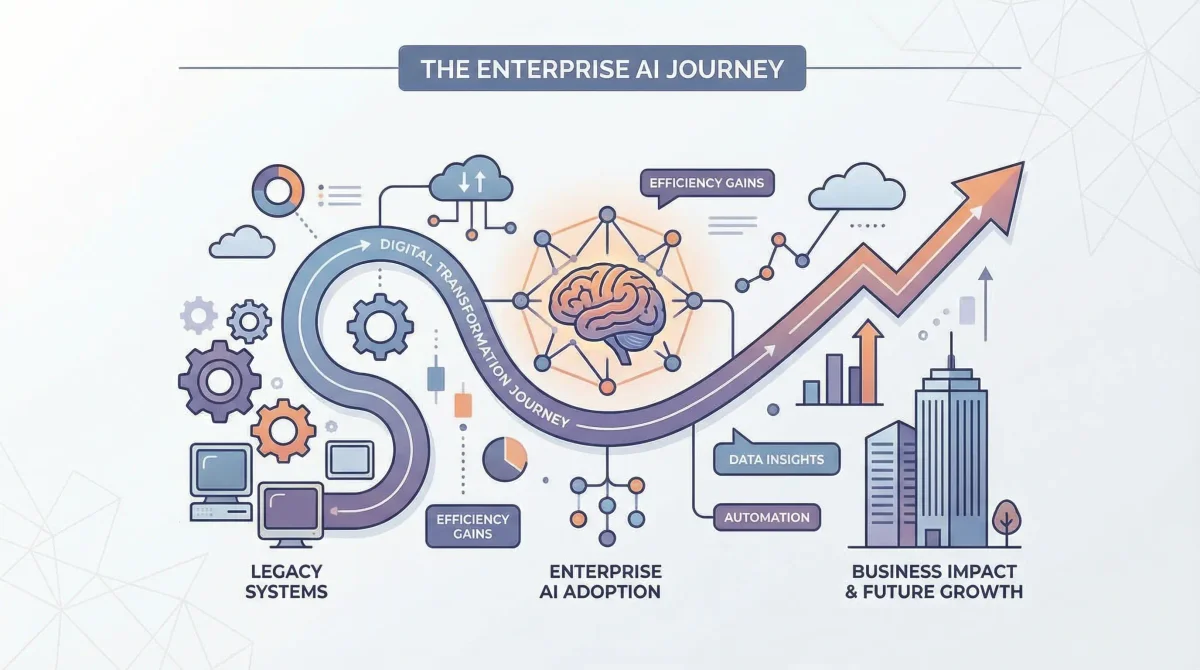
Enterprise AI Adoption 2026: From Experimentation to Impact
The era of perpetual AI pilots is over. After years of proof-of-concepts, sandbox experiments, and boardroom presentations promising transformative potential, enterprise leaders are demanding something different: measurable impact. The question is no longer “Can AI work?” but rather “How do we make AI work at scale?”
This shift represents a fundamental inflection point in enterprise technology adoption. Organizations that successfully navigate this transition—from experimentation to production-grade deployment—will establish competitive advantages that reshape their industries. Those that remain stuck in pilot purgatory risk falling irreversibly behind.
The End of the Pilot Era
Recent data reveals a dramatic acceleration in enterprise AI maturity. Worker access to AI tools rose by 50% in 2025 alone, and the number of companies with at least 40% of their AI projects in production is set to double within six months. More telling, 65% of enterprise AI projects moved from concept to production in 2025, with some launching in as little as 45 days.
Yet this progress masks a deeper challenge. While two-thirds of organizations report productivity and efficiency gains from AI adoption, only 34% are truly reimagining their businesses. The majority remain focused on optimizing existing processes rather than fundamentally transforming how they create value.
This gap between incremental improvement and transformative impact defines the current moment. Organizations face a critical choice: continue treating AI as a productivity tool, or embrace it as a catalyst for business model innovation.
Why Most AI Initiatives Fail to Scale
The journey from pilot to production exposes organizational weaknesses that remain hidden during experimentation. Three factors consistently derail scaling efforts:
The “Thousand Flowers” Trap
Many organizations adopt a “let a thousand flowers bloom” approach to AI adoption. While this creates the appearance of progress, scattered experiments rarely deliver meaningful ROI. Resources drain into projects that never reach production, and the organization develops initiative fatigue without building genuine capability.
The alternative is what leading practitioners call “cultivated bouquets”—a deliberate strategy focusing on 5-7 high-impact use cases tightly aligned with core business goals. This focused approach concentrates resources where they can generate the greatest return and builds organizational competence through repeated success.
The Skills Gap Reality
According to enterprise leaders, insufficient worker skills represent the biggest barrier to integrating AI into existing workflows. Yet most organizations respond with surface-level solutions. Fifty-three percent focus on educating the broader workforce to raise overall AI fluency, while far fewer redesign roles, workflows, and career paths.
This approach treats symptoms rather than causes. The most successful organizations don’t just train employees to use AI tools—they fundamentally reimagine jobs to seamlessly combine human strengths and AI capabilities. They create new roles like AI operations managers, human-AI interaction specialists, and quality stewards that signal a structural shift in how work is organized.
The Data Foundation Problem
There is no AI strategy without a data strategy. Legacy data architectures cannot power real-time, autonomous AI systems. Organizations need unified, governed, and secure data foundations that can support both current applications and future capabilities.
Yet many enterprises treat data modernization as a parallel initiative rather than a prerequisite for AI success. This creates a fundamental mismatch between AI ambitions and organizational readiness, ensuring that even well-designed AI solutions cannot deliver their full potential.
A Framework for Scaling AI to Production
Successful organizations follow structured approaches that address both technical and organizational challenges. The Five V’s Framework, proven across more than one thousand enterprise implementations, provides a roadmap:
1. Value: Target High-Impact Opportunities
Start by working backwards from your most pressing business challenges. Collaborate across technical and business teams to identify opportunities where AI can deliver meaningful ROI. This focused approach directs resources where they’ll have the greatest impact.
The key is specificity. Rather than pursuing generic goals like “improve customer service,” target concrete outcomes like “reduce average resolution time for complex support tickets by 40% while maintaining customer satisfaction scores above 4.5.”
2. Visualize: Define Clear Success Metrics
Translate potential benefits into measurable performance indicators that address both technical aspects and business outcomes. Establish baseline metrics using historical data, then define success criteria that align with strategic objectives.
This dual focus ensures you track not just AI system performance, but actual business impact. A model with 95% accuracy means nothing if it doesn’t improve decision-making, reduce costs, or enhance customer experience.
3. Validate: Test Against Real-World Conditions
Effective validation creates alignment between vision and execution. It requires systematic integration testing, stress testing for expected loads, verification of compliance requirements, and gathering end-user feedback.
Security specialists should shape core architecture from day one. Industry subject matter experts must define operational processes and decision logic that guide prompt design and model refinement. Change management strategies need integration early to ensure alignment and adoption.
One environmental agency created an intelligent document processing solution that reduced processing time by 85% and evaluation costs by 99%. This success came from comprehensive validation that addressed technical performance, regulatory compliance, and user workflows simultaneously.
4. Verify: Build Production-Ready Systems
Moving from pilot to production demands more than proof of concept—it requires scalable solutions that integrate with existing systems and deliver consistent value. This critical stage establishes the foundation for sustainable success.
Production-ready AI solutions require robust governance structures, comprehensive change management, and operational readiness assessments. Architectural decisions must balance scale, reliability, and operability, with security and compliance woven into the solution’s fabric.
Importantly, this often involves practical trade-offs. A simpler solution aligned to existing team capabilities may prove more valuable than a complex one requiring specialized expertise. Meeting strict latency requirements might necessitate choosing a streamlined model over a more sophisticated one.
5. Venture: Secure Long-Term Success
Long-term success requires mindful resource planning across people, processes, and funding. Map the full journey from implementation through sustained organizational adoption.
Financial viability starts with understanding total cost of ownership—from initial development through deployment, integration, training, and ongoing operations. Promising projects stall mid-implementation due to insufficient resource planning. Success requires strategic budget allocation across all phases, with clear ROI milestones and flexibility to scale.
Implementation Strategies That Work
Leading organizations share common approaches to AI implementation that transcend industry boundaries:
Start with Business Outcomes, Not Technology
The most successful AI initiatives begin with clear business problems, not available technologies. They ask “What do we need AI to do?” rather than “What can AI do?”
This outcome-focused approach ensures AI investments align with strategic priorities and deliver measurable value. It also helps organizations avoid the trap of implementing AI for its own sake—a surprisingly common mistake that wastes resources and erodes stakeholder confidence.
Adopt a Portfolio Approach
Treat AI initiatives as an investment portfolio where diversification drives risk management and value creation. Balance quick wins that deliver value within months, strategic initiatives that drive longer-term transformation, and moonshot projects that could revolutionize your business.
This portfolio approach manages risk while maintaining momentum. Quick wins build organizational confidence and secure continued investment. Strategic initiatives develop core capabilities. Moonshot projects position the organization for future opportunities.
Create a Culture of Safe Experimentation
Organizations thrive with AI when teams can innovate boldly. In rapidly evolving fields, the cost of inaction often exceeds the risk of calculated experiments.
Capture insights systematically across projects. Technical challenges reveal capability gaps. Data issues expose information needs. Organizational readiness concerns illuminate broader transformation requirements. All of these shape future initiatives and accelerate organizational learning.
Leverage the Incumbent Advantage
Established enterprises hold what new entrants cannot easily replicate: customer bases, proprietary data, and brand trust. Used wisely, these strengths become enduring sources of differentiation and growth.
Data emerges as the defining source of competitive advantage. In a world where models are only as strong as the data they train on, organizations must guard their data as both an asset and a differentiator. The right data, curated and governed with intent, is not just an enabler—it’s a source of lasting edge.
Common Pitfalls and How to Avoid Them
Even well-intentioned AI initiatives encounter predictable obstacles. Understanding these pitfalls helps organizations navigate around them:
Pitfall 1: Delegating AI Strategy to Technical Teams
Enterprises where senior leadership actively shapes AI governance achieve significantly greater business value than those delegating the work to technical teams alone. AI strategy is a business imperative, not a technology project.
Solution: Establish executive sponsorship with clear accountability. Ensure AI governance integrates with existing risk and oversight structures rather than creating parallel “shadow” functions.
Pitfall 2: Optimizing Instead of Reimagining
Most organizations use AI to optimize existing processes rather than reimagine what’s possible. This captures incremental value but misses transformative opportunities.
Solution: Periodically step back and ask “If we were building this business from scratch today, how would we design it with AI capabilities?” This blank-sheet thinking reveals opportunities that incremental optimization obscures.
Pitfall 3: Underestimating Change Management
Technical implementation often succeeds while organizational adoption fails. The best AI solution delivers no value if people don’t use it or trust it.
Solution: Integrate change management from project inception. Involve end users in design and validation. Create clear communication about how AI augments rather than replaces human capabilities. Measure and address trust and engagement continuously.
Pitfall 4: Ignoring the Ecosystem
Organizations that try to build everything in-house move too slowly and miss opportunities for strategic partnerships. The question isn’t whether to build or buy—it’s how to orchestrate an ecosystem that accelerates innovation.
Solution: Develop a clear strategy for when to build and when to partner. Recognize that collaboration with startups, scale-ups, and strategic partners accelerates both innovation and impact. The power of AI is unlocked when organizations deliberately design ecosystem plays that extend beyond enterprise boundaries.
Real-World Impact: Case Studies
Case Study 1: NFL’s Media Intelligence System
The National Football League partnered with AWS to create a generative AI-powered solution that obtains statistical game insights within 30 seconds. This helps their media and production teams locate video content six times faster.
The impact extends beyond efficiency. Faster content discovery enables more engaging broadcasts, better highlights packages, and richer storytelling. The system transformed a bottleneck in content production into a competitive advantage in fan engagement.
Case Study 2: Enterprise Sales Intelligence
A major technology company deployed a qualification layer on their AI platform to automate the triage of thousands of leads. Sales teams now spend their time closing deals rather than sorting prospects.
The result: a 14% increase in lead-to-opportunity conversion in just six weeks. More importantly, the system freed senior sales professionals to focus on relationship-building and strategic accounts—activities that directly drive revenue but were previously crowded out by administrative work.
Case Study 3: Global Marketing Localization
A global technology company uses AI to localize marketing campaigns across 50+ languages and 150 countries. They now produce global-ready assets 60% faster while actually increasing brand consistency.
This capability transformed their go-to-market strategy. Products can launch simultaneously in all markets rather than rolling out sequentially. Local teams can respond to market opportunities in real-time rather than waiting for centralized creative development.
Case Study 4: Supply Chain Resilience
An enterprise deployed an AI agent that turned supply chain assessments—which previously took weeks—into a near-instant process. They achieved a 14x increase in vetting capacity, protecting global operations from disruption.
During a recent supply chain crisis, this capability proved invaluable. The organization identified alternative suppliers and rerouted production within hours rather than weeks, maintaining customer commitments while competitors struggled with shortages.
Measuring ROI: Beyond Efficiency Gains
While productivity improvements dominate early AI benefits, leading organizations are achieving broader impact:
Achieved Benefits (Current State):
- Improving productivity and efficiency: 66% of organizations
- Enhancing insights and decision-making: 53%
- Reducing costs: 40%
- Enhancing client/customer relationships: 38%
- Improving products/services and fostering innovation: 20%
- Increasing revenue: 20%
Aspirational Benefits (Future State):
- Revenue growth: 74% of organizations hope to grow revenue through AI initiatives
This gap between current and aspirational benefits reveals the opportunity ahead. Organizations that successfully move from efficiency gains to revenue growth will capture disproportionate value from their AI investments.
The key is shifting focus from task automation to business model innovation. AI that reduces report generation time from hours to minutes delivers incremental value. AI that enables entirely new products, services, or customer experiences delivers transformative value.
The Agentic AI Revolution
The next wave of enterprise AI centers on autonomous agents that reason, adapt, and execute complex decision-making without constant human oversight. Agentic AI usage is poised to rise sharply over the next two years, with applications spanning:
Customer Support: AI agents handle common transactions like rebooking flights or rerouting shipments, freeing human agents for complex matters requiring empathy and judgment.
Knowledge Management: Agents automatically capture meeting actions from video conferences, draft communications to remind participants of commitments, and track follow-through.
Product Development: Agents support new product initiatives by finding optimal balances between competing objectives like cost and time-to-market.
Cybersecurity: Agents extract intelligence from tens of thousands of threat reports monthly, reducing time to operationalize threat intelligence by 96%.
However, governance lags behind adoption. Only one in five companies has a mature model for governance of autonomous AI agents. As these systems handle more consequential decisions, organizations must define where humans remain in control, how automated decisions are audited, and which records of system behavior should be retained.
Physical AI: The Next Frontier
More than half of companies report at least limited use of physical AI today, and that figure is set to reach 80% within two years. Common applications include:
- Collaborative robots (cobots) on assembly lines
- Inspection drones with automated response capabilities
- Robotic picking arms in warehouses
- Autonomous forklifts and material handling systems
Physical AI extends AI capabilities beyond software into devices, machinery, and edge locations. This requires organizations to evaluate whether their technology foundations can support real-time processing, edge computing, and the unique security requirements of physical systems.
Adoption is especially advanced in manufacturing, logistics, and defense, where robotics and autonomous vehicles are already reshaping operations. As capabilities mature and costs decline, physical AI will expand into retail, healthcare, agriculture, and other sectors.
Building AI-Ready Organizations
Technical capabilities alone don’t ensure AI success. Organizations must develop complementary capabilities across multiple dimensions:
Leadership and Governance
AI leadership is less about mastering technology and more about mastering the mindset—one that understands context, makes deliberate choices, and leads responsibly through uncertainty.
True AI leadership requires the ability to define, navigate, and rally: defining a clear vision for where the organization is headed, navigating uncertainty with discipline and judgment, and rallying the enterprise behind a shared sense of purpose.
Data and Infrastructure
Legacy data architectures cannot power real-time, autonomous AI. Organizations need modular, cloud-native platforms that securely connect, govern, and integrate all data types. They must break down silos with domain-owned data products and embed privacy, sovereignty, and security-by-design.
A unified, trusted data strategy is indispensable. Forward-thinking organizations converge operational, experiential, and external data flows and invest in evolving platforms that anticipate needs of emerging AI capabilities.
Talent and Culture
The most successful organizations don’t just train employees to use AI—they reimagine jobs to seamlessly combine human strengths and AI capabilities. They create complementary working partnerships where combined output exceeds what either could achieve alone.
This requires moving beyond education to fundamental workforce redesign. Roles, skills, and career paths must be rebuilt, not simply adjusted. Organizations must redesign work holistically rather than layering AI onto legacy processes.
Ecosystem Partnerships
No organization can build all required AI capabilities in-house. Success depends on clear strategies for when to build and when to partner, recognizing that collaboration with startups, scale-ups, and strategic partners accelerates both innovation and impact.
The winners will be those who build organizations that harness the combined strengths of internal capabilities and external partnerships, creating ecosystem advantages that extend beyond enterprise boundaries.
Looking Ahead: The Next 12-18 Months
The next 12-18 months present a pivotal opportunity for organizations to harness AI to solve previously intractable problems, establish competitive advantages, and explore entirely new frontiers of business possibility.
Several trends will shape this period:
From Experimentation to Standardization: Organizations will move from custom-built solutions to standardized platforms and practices. This will accelerate deployment while reducing costs and risks.
From Narrow Applications to Integrated Systems: AI will evolve from point solutions addressing specific tasks to integrated systems that orchestrate complex workflows across multiple functions.
From Human-in-the-Loop to Human-on-the-Loop: As AI systems prove their reliability, human oversight will shift from approving every decision to monitoring system performance and handling exceptions.
From Efficiency to Innovation: The focus will shift from using AI to do existing things better to using AI to do entirely new things that weren’t previously possible.
Organizations that successfully navigate these transitions will define what’s possible within their industries and beyond. Those that remain stuck in experimentation will find themselves increasingly unable to compete.
Conclusion: The Time to Act Is Now
The era of AI experimentation is over. The organizations that will thrive in the next decade are those that move decisively from pilots to production, from efficiency gains to business model innovation, from scattered experiments to strategic focus.
This transition requires more than technical capability. It demands leadership that can define vision and rally organizations, data foundations that enable real-time intelligence, talent strategies that reimagine work, and ecosystem partnerships that accelerate innovation.
The good news: the playbooks exist. Organizations across industries have proven that AI can deliver transformative impact when implemented with discipline, focus, and strategic intent. The frameworks, best practices, and lessons learned from these pioneers provide a roadmap for others to follow.
The question is no longer whether AI will transform your industry—it’s whether your organization will lead that transformation or be disrupted by it. The time to act is now. The organizations that move decisively today won’t just improve their margins; they will rewrite the rules of their industries.
Intelligence creates opportunity, but wisdom sustains it. As organizations race to deploy AI, the true measure of leadership will be how responsibly they do it—turning technology into trust, data into differentiation, and innovation into lasting impact.