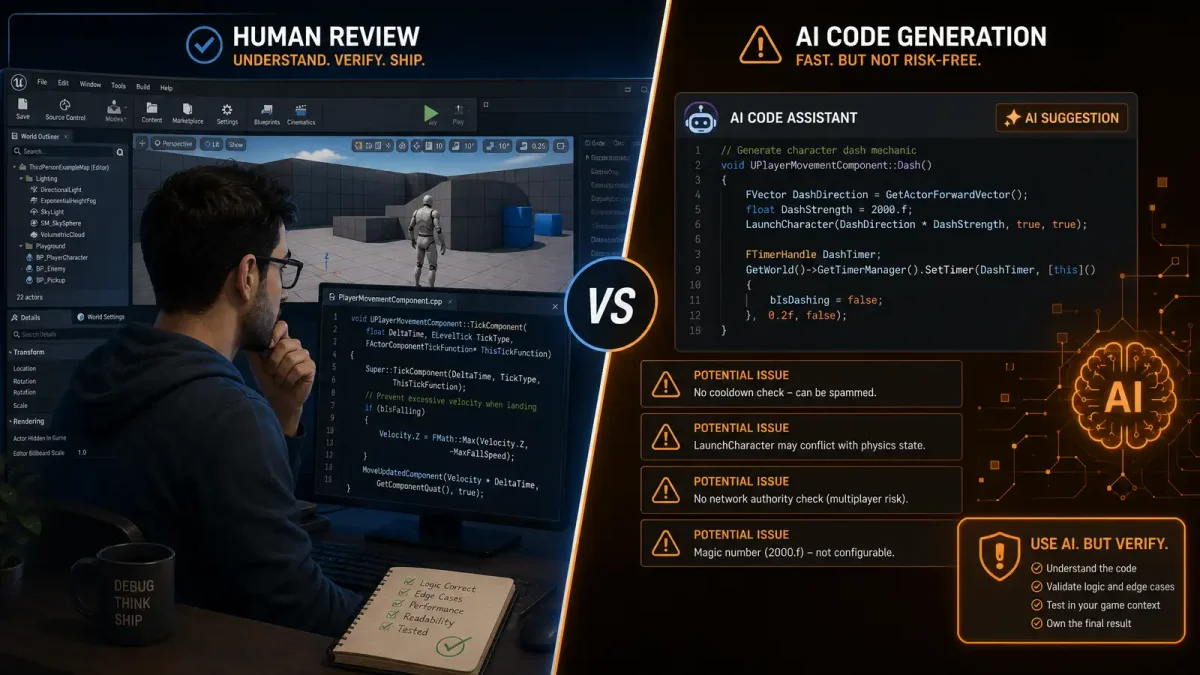
The Godot Foundation announced on June 30 that it would no longer accept AI-generated code contributions to the open-source game engine. The new policy explicitly bans “autonomous AI agent use or vibe coding” and prohibits AI from generating “substantial pieces of code” in pull requests. AI assistance for “menial things — like code completion, regex, or find and replace” is still allowed. AI-generated text in human-to-human communication, including issue comments and code reviews, is banned outright.
The announcement didn’t come out of nowhere. Godot’s maintainers said the policy change was a direct response to a rising volume of low-quality, AI-generated pull requests that were burning reviewer time without producing mergeable code. The Foundation also noted that all pull requests must now be reviewed and approved by a human — a requirement that sounds obvious but has become newly necessary in an era when some contributors are submitting code they didn’t write and may not fully understand.
The reaction has been telling. In forums and social media threads, developers have split into roughly three camps: those who see the ban as a necessary defense of code quality, those who see it as Luddite gatekeeping that will slow the engine’s development, and a surprisingly large third group that’s simply exhausted by the whole conversation.
The Vibe Coding Problem
The term “vibe coding” — coined in early 2025 to describe the practice of prompting an AI to generate code and accepting the output without thorough review — has become a flashpoint. Proponents argue that it democratizes software development and accelerates prototyping. Critics point out that it produces code that passes superficial tests but fails under edge cases, introduces subtle bugs that human reviewers miss because they assume the contributor understood the code they submitted, and shifts the debugging burden onto maintainers who never asked for it.
Godot’s situation is particularly acute because the engine attracts contributors with a wide range of experience levels. A professional graphics programmer submitting a shader optimization is unlikely to rely on AI-generated code. A hobbyist trying to fix their first bug, given access to a code-generation tool, might submit a patch that looks plausible but breaks three other systems. The maintainers’ time is finite, and AI-generated contributions were consuming a disproportionate share of it.
The Foundation’s distinction between “substantial code” and “menial assistance” is an attempt to draw a practical line rather than a philosophical one. They’re not anti-AI — they’re anti-noise. The policy essentially says: if you used AI to format your code or suggest a regex pattern, fine. If the AI wrote the logic and you’re submitting it as your own contribution, that’s not fine.
The Broader Developer Sentiment
Godot isn’t alone. Several other open-source projects, including parts of the Linux kernel community and the Debian project, have debated similar policies in recent months. But the Godot announcement landed with particular force because the engine’s community skews young and technically diverse — exactly the demographic most likely to embrace AI coding tools.
A Business Insider feature published the same week captured the broader mood among software engineers. The piece described a profession in the middle of an identity crisis: some developers describe AI coding assistants as the most significant productivity boost of their careers, while others worry that delegating too much to AI is deskilling the workforce and producing a generation of engineers who can prompt but can’t debug.
The tension isn’t just about productivity. It’s about confidence, identity, and the changing definition of what it means to be a software engineer. If an AI can generate 80% of the code for a feature, what exactly is the engineer contributing? The remaining 20% — architecture decisions, edge-case reasoning, testing strategy, integration work — is the hard part. But it’s also the part that’s invisible to managers who measure productivity in lines of code.
What the Godot Policy Actually Changes
In practice, the policy doesn’t change much for experienced contributors who already review their own code carefully. It targets a specific behavior — submitting AI-generated code without understanding it — that was already considered bad practice in most engineering cultures. What’s new is that it’s now enforceable: a pull request that smells AI-generated can be rejected on policy grounds, not just quality grounds.
For the broader AI tools landscape, Godot’s move is a data point in a larger conversation about where the lines should be drawn. The coding assistant market — GitHub Copilot, Cursor, Claude Code, and dozens of others — continues to grow at breakneck speed, and no one seriously expects AI-generated code to stop entering codebases. The question is about visibility and accountability. If a contributor uses AI, should they disclose it? If a codebase accumulates AI-generated code over time, who’s responsible for the bugs?
Godot’s answer is clear: the human who submits the pull request is responsible, and if they can’t stand behind the code they’re submitting, it doesn’t belong in the engine. It’s a position that sounds conservative but is actually the logical endpoint of treating code generation tools the same way we treat any other automation: the operator is accountable for the output.