The gap between what your brain thinks and what your fingers can type has been shrinking for years. Invasive brain implants have let paralyzed patients type at reasonable speeds. But those require surgery — drilling into the skull, threading electrodes into brain tissue, accepting the risk of infection and rejection. For the other 99.9% of humans, the barrier between thought and text remained intact.
Meta’s FAIR research team just took a significant chip out of that barrier. Their new system, Brain2Qwerty v2, uses magnetoencephalography — MEG, a helmet-like scanner that detects the magnetic fields generated by your brain’s electrical activity — to reconstruct sentences as you type them. No surgery. No implants. Just a scanner and a deep learning model.
What Brain2Qwerty Actually Does
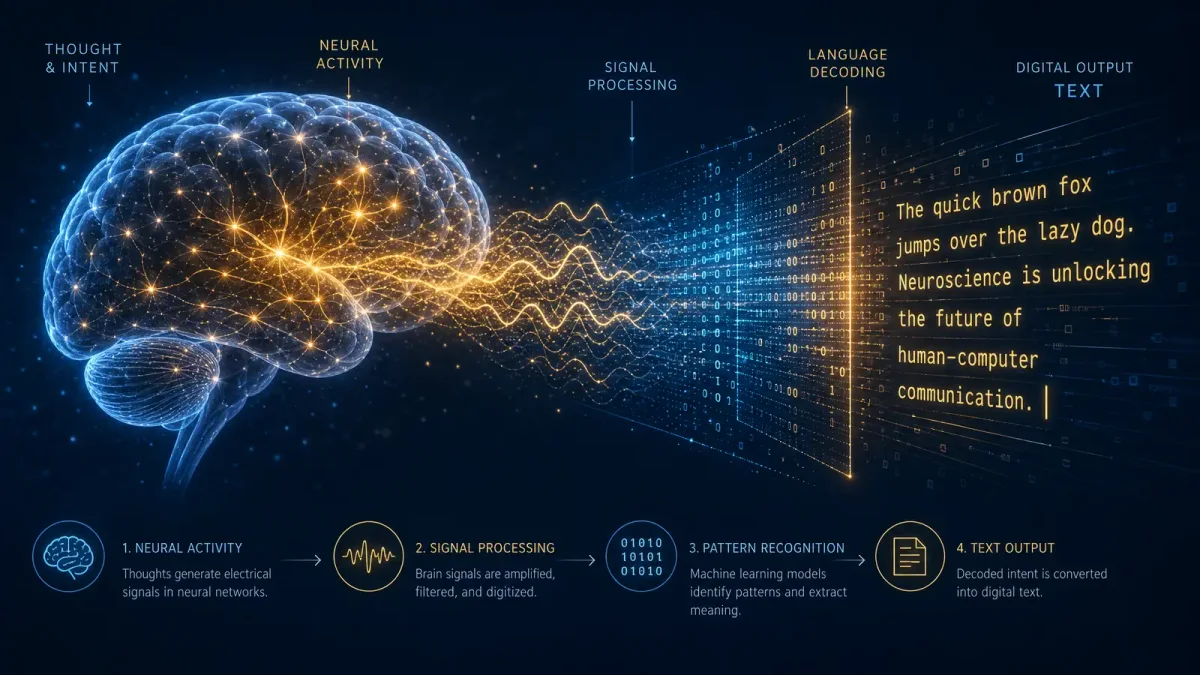
The setup is conceptually simple. A participant sits inside an MEG scanner and types sentences on a keyboard. The scanner records the magnetic fields produced by their brain activity. Brain2Qwerty v2 — an end-to-end deep learning pipeline — translates those MEG signals into the text the person was typing.
The results are striking. Across participants, the model achieves an average word accuracy of 61%. The best subject hit 78% accuracy — meaning only 22% of the words they typed were decoded incorrectly. For a non-invasive system, that’s a massive leap. Comparable invasive implants haven’t been far ahead of this, and they come with surgical overhead that makes them viable for only a tiny patient population.
The architecture is what makes it work. Earlier approaches tried to decode individual letters or phonemes — watching for the neural signatures of planned finger movements, essentially trying to read the motor cortex’s output. Brain2Qwerty v2 takes a different route. It processes the MEG signal holistically through a transformer-based architecture similar to those used in large language models, learning to map patterns of brain activity directly to sequences of words.
Why MEG Matters
Most non-invasive brain reading to date has used fMRI or EEG. fMRI measures blood flow — a slow, indirect signal. EEG measures electrical activity at the scalp, but the skull smears the signal so badly that spatial resolution is poor. MEG sits in a sweet spot: it detects magnetic fields, which pass through the skull essentially undistorted, giving you both decent spatial resolution and millisecond-level temporal precision.
The catch is that MEG scanners are expensive, rare, and require magnetically shielded rooms. You’re not going to wear one at your desk. But the point of Brain2Qwerty isn’t to ship a consumer product tomorrow. It’s to demonstrate that the signal is there — that non-invasive brain reading can be good enough that we should take it seriously.
What This Means for LLM Research
This is where things get interesting for the AI community. Brain2Qwerty v2 isn’t just a neuroscience paper. It’s built on the same transformer architecture that powers GPT, Claude, and every other major language model. The success of the approach suggests something that neuroscientists and AI researchers have been circling for years: the brain processes language in ways that are structurally similar to how large language models do.
If that’s true — and Brain2Qwerty v2’s performance is a strong piece of evidence — then improvements in LLM architecture feed back into brain-computer interfaces, and vice versa. A better understanding of how the brain encodes language could lead to more efficient AI architectures. Better AI architectures could lead to more accurate brain decoders. The loop closes.
Meta’s FAIR lab is explicitly positioning this work as a contribution to both fields. The paper isn’t just “we decoded some brain signals.” It’s “we used deep learning to decode brain signals, and here’s what that tells us about both brains and deep learning.”
The Privacy Elephant in the Room
Any technology that reads thoughts — even crudely, even with consent — raises hard questions. Brain2Qwerty v2 only works when a participant is actively typing inside an MEG scanner. It can’t read passive thoughts, can’t be deployed remotely, and requires willing cooperation. The current system is about as invasive as getting an MRI.
But the trajectory is clear. If accuracy keeps improving at this rate, and if MEG hardware follows the miniaturization curve that other imaging technologies have, the ethical questions shift from “can we?” to “should we?” A future version of this technology could, in theory, be deployed in settings where consent is murky — law enforcement interrogations, employment screening, security checkpoints.
Meta’s researchers are aware of this. Their paper explicitly discusses the privacy implications and emphasizes that the system requires active participation — you have to be trying to type for it to work. But the history of technology suggests that safeguards designed for one generation of hardware don’t always survive the next.
The Bottom Line
Brain2Qwerty v2 is a research milestone, not a product announcement. But it’s the kind of milestone that changes the conversation. A few years ago, the idea of decoding sentences from non-invasive brain recordings at 78% accuracy would have sounded like science fiction. Now it’s a preprint.
The gap between brain and keyboard is closing. Whether that’s exciting or terrifying depends on what you think happens when it closes completely. Either way, Meta just made it smaller.