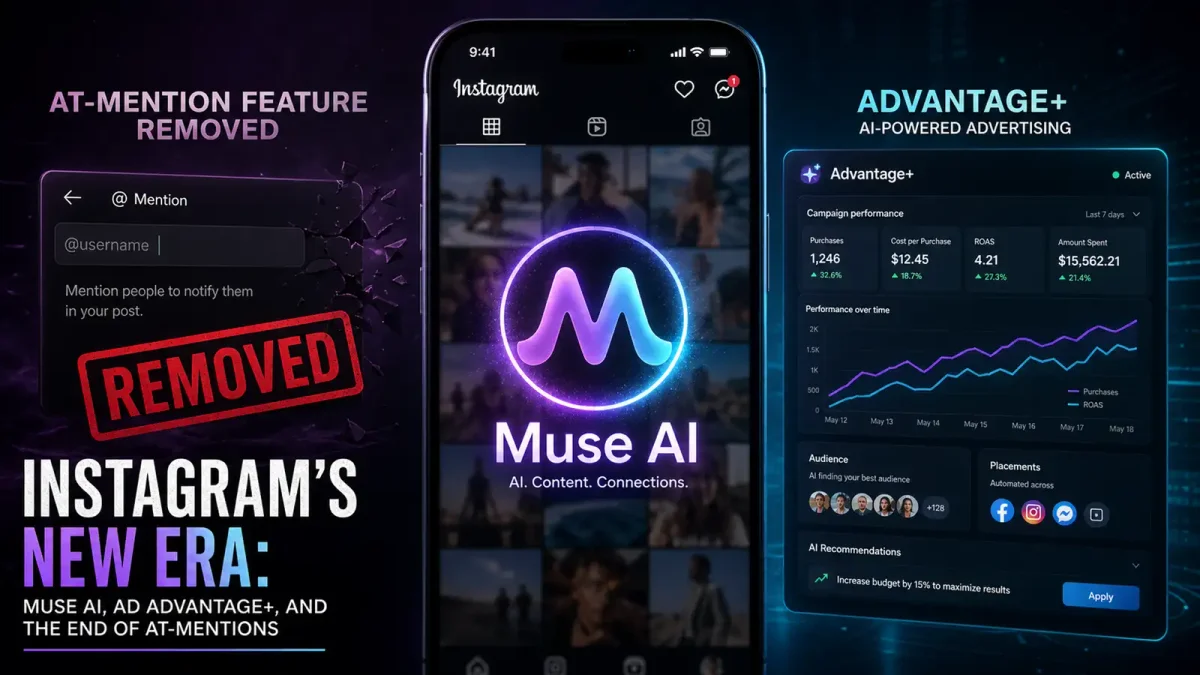
Last Tuesday, Meta released Muse Image, the first image generation model from Meta Superintelligence Labs. By Friday evening, the company had already pulled its most controversial feature: the ability for anyone to @-mention a public Instagram account and pull that person’s photos into AI-generated images, with no notification and an opt-in default.
The weekend coverage declared it a retreat, a win for consent, a sign that organized pushback works. It was all of those things. But it was also a distraction from the part of the announcement that did not get pulled, that nobody is protesting, and that will quietly reshape how millions of businesses create advertising for the foreseeable future.
Here is the uncomfortable reality: Meta lost a three-day PR battle over a consumer feature. It is quietly winning a much larger war over the automated production of commercial creative. And the group that won — organized Hollywood talent with agents, unions, and press leverage — is not the group that actually needs the protection.
What happened
Muse Image launched with a viral consumer hook buried near the bottom of Meta’s announcement: type “@instagramusername” into the prompt field, and the model would generate images featuring that person’s publicly posted photos. No consent mechanism. No notification. No opt-out process unless you proactively dug into your settings after the fact.
The backlash was immediate and unusually unified. CAA, the talent agency that represents much of Hollywood, condemned the feature within 24 hours. SAG-AFTRA followed. Media outlets published opt-out guides. The narrative solidified around a simple take: Meta was letting strangers generate AI images of you using your own Instagram photos without asking.
Meta’s response on Friday was swift. The company said it “missed the mark” and removed the @-mention feature entirely. Total lifespan: roughly 72 hours.
What did not get pulled
One sentence in Tuesday’s original announcement received almost no attention during the controversy, and it is still happening. In the coming weeks, Meta said, advertisers and agencies will be able to access Muse Image through Advantage+ creative, Meta’s automated ad platform.
Advantage+ is already the engine behind a large and growing share of Meta’s ad revenue. It automates targeting, bidding, and placement. What it has not automated until now is creative production — the images and copy that actually appear in ads. Muse Image changes that.
Advertisers will be able to generate unlimited creative variations — different backgrounds, different product angles, different lifestyle contexts — at no additional cost beyond their existing ad spend. A small business that previously paid a freelance designer $200 for three product photos can now generate fifty variations in minutes, test them all, and let Meta’s optimization engine pick the winners.
This is the part of Muse Image that actually matters to Meta’s business. The @-mention feature was a consumer acquisition play — get people talking, get them generating, get them hooked. The ad integration is the revenue play. One got pulled. The other is moving forward on schedule.
Why consent for consumers but not for creators
The asymmetry is hard to miss. Hollywood actors, represented by powerful unions and agencies, got Meta to reverse course in three days. Small advertisers, freelance designers, and independent photographers — the people whose work will be directly displaced or devalued by automated creative generation — have no equivalent leverage. There is no union for freelance graphic designers. There is no CAA for the person who shoots product photos for Etsy sellers.
The result is a two-tier system of AI accountability. If you are famous and organized, your image is now protected from Muse Image’s consumer-facing tools. If you are a working creative whose portfolio has been scraped into the training data and whose clients are about to receive an automated alternative to hiring you, the feature that affects you is not the @-mention. It is the Advantage+ integration. And that one is still shipping.
The bigger picture for AI art
The Muse Image episode is not really about one feature on one platform. It is about the speed at which AI image generation is moving from a consumer novelty to an industrial tool — and the mismatch between how fast the technology moves and how slowly the protections catch up.
Three years ago, AI image generation was DALL-E making surrealist paintings of astronauts riding horses. Last year, it was Midjourney producing photorealistic images that won art competitions. This year, it is Meta embedding an image generation model directly into the world’s largest advertising platform, where the economic incentive to use it is immediate and measurable: every dollar saved on creative production is a dollar of margin.
The technical leap matters too. Muse Image is the first model from Meta’s Superintelligence Labs branding — a signal that Meta views generative media not as a side project but as a core AI capability on par with its language models. The model was trained on what Meta describes as “publicly available data,” a phrase that almost certainly includes the billions of images uploaded to Instagram and Facebook over the past decade. The same data that powers the @-mention feature powers the ad generator. The ethics of one are the ethics of the other, even if only one generated headlines.
Adobe Firefly offers an instructive comparison. Firefly was positioned from day one as “commercially safe” — trained on licensed content and public domain material, with an indemnification clause for enterprise customers. That positioning allowed Adobe to integrate Firefly into Photoshop, Illustrator, and Express without triggering the kind of backlash Meta just faced. Meta’s approach — launch first, apologize later, keep the enterprise part — is the opposite. It is faster and riskier, and it works as long as the enterprise integration stays quiet while the consumer controversy burns out.
Google’s Performance Max campaigns have been quietly generating AI ad creative for over a year, using models trained on the same data that powers Google Images and YouTube thumbnails. OpenAI’s DALL-E API powers hundreds of marketing startups. The infrastructure for AI-generated advertising is being built across every major platform simultaneously, and the consumer-facing features that trigger public debate are the tip of an iceberg that is already mostly underwater.
What this means for working creatives
The freelance designer who shoots product photos for small businesses is the constituency most affected by the Advantage+ integration, and also the one with the least ability to push back. There is no union for freelance designers. There is no collective bargaining mechanism that can negotiate with Meta over the terms under which AI-generated creative competes with human-made creative.
The economic math is straightforward. A small clothing brand running Meta ads might spend $500 per month on creative — product photos, lifestyle shots, seasonal variations. If Muse Image through Advantage+ can generate comparable variations at zero marginal cost, that $500 either stays in the brand’s pocket or gets redirected into ad spend that benefits Meta. Either way, it does not go to the designer.
The @-mention feature was a consumer-facing red herring. The real displacement of creative labor is happening in the ad dashboard, where nobody is watching and the only stakeholder is the advertiser who just found out they can get fifty product shots for free.
What to watch
Meta is not the only company building this, and the timeline is accelerating. Google has been integrating AI-generated assets into Performance Max campaigns for over a year, and early data suggests that campaigns using AI-generated creative see 15-20% higher click-through rates — not because the creative is better, necessarily, but because the system can test hundreds of variations and optimize toward what works. Adobe Firefly is embedded in Creative Cloud with an explicit “commercially safe” positioning that makes it attractive to enterprise customers who cannot afford legal ambiguity around training data. OpenAI’s DALL-E API is being used by thousands of startups that build marketing tools on top of it, creating a secondary ecosystem of AI creative tools that Meta’s native integration could eventually make redundant.
The pattern across all of these is the same: a consumer launch that generates attention (and sometimes backlash), followed by a quiet enterprise integration that generates revenue. The entertainment comes first; the economics come second. By the time the public conversation catches up to the second phase, the infrastructure is already in place and the economic incentives — for both the platform and its advertisers — are locked in.
For AI artists and creators watching this space, the Muse Image story is a reminder that the most important developments are often not the ones making headlines. The feature that gets pulled is news. The feature that ships without anyone noticing — the one that lets millions of businesses replace human-made creative with machine-generated alternatives at zero marginal cost — is the future. And that future arrived last week while everyone was looking at the @-mention button.
The question now is whether the regulatory and labor responses that worked for Hollywood actors can be adapted for the much larger, much less organized population of creative workers who do not have agents, unions, or press leverage. If they cannot, the story of Muse Image will not be about the feature Meta pulled. It will be about the one it didn’t.
Source: Forbes (July 11, 2026).