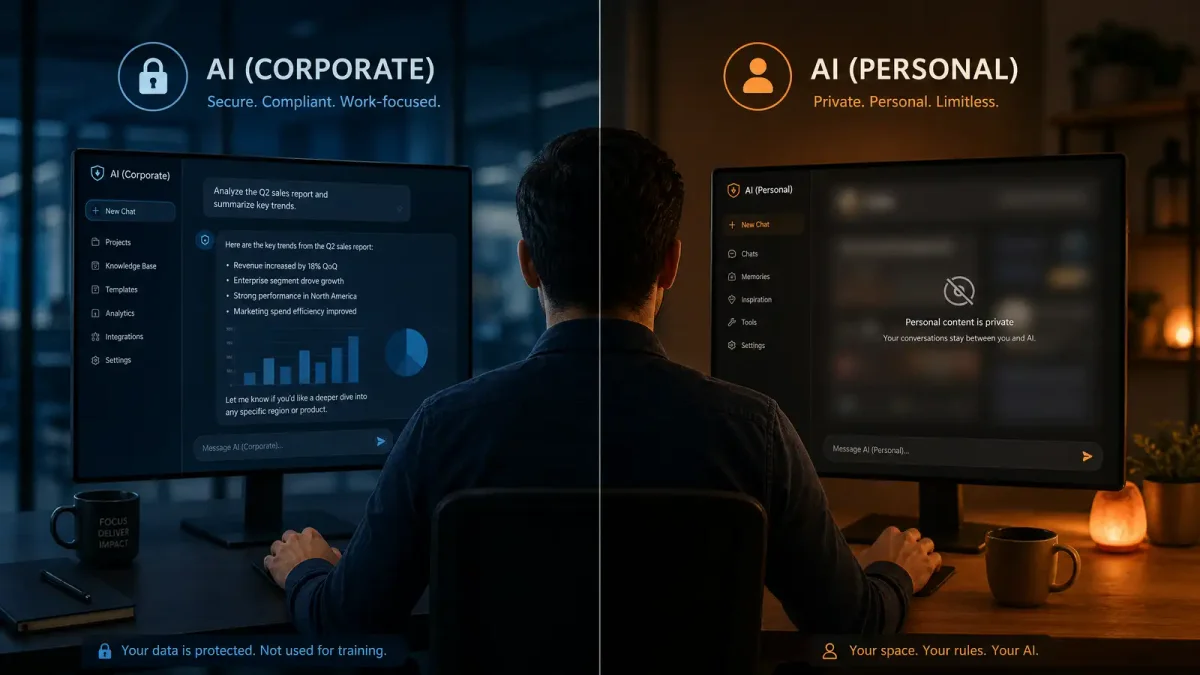
86% of employees use AI tools at least once a week for work. That sounds like a corporate IT success story — until you read the rest of the numbers. Nearly half of those workers are using tools their employer has never approved. Most of them are free consumer versions. And a significant chunk can’t even tell you whether their company has an AI policy at all.
This is the “shadow AI” problem, and it’s the enterprise tech story of 2026.
The Split Nobody Talked About
The 2026 BlackFog study mapped a divide that most organizations didn’t know existed. Workers separate their AI usage into two tracks: the sanctioned tools IT rolled out (usually a paid enterprise license for ChatGPT or Claude), and the personal tools they use for everything else.
The split isn’t malicious. People bring their real questions — the messy, unfinished, politically sensitive ones — to personal AI because they don’t trust the work version with them. Free consumer AI feels private. Corporate AI doesn’t.
The problem is that free versions lack the enterprise protections that paid licenses include. Data handling, content filtering, audit trails — none of that exists when someone pastes a contract into a free web interface.
The Governance Gap
Forbes highlighted a related issue in June 2026: the Zcash auditing crisis exposed how thin the regulatory framework is for AI-assisted risk assessment. When companies use AI tools to evaluate financial exposure or compliance risk, there’s no standardized way to audit whether those tools are making accurate calls.
The accounting profession hasn’t caught up. AI-driven code assurance and global regulatory collaboration are still in the discussion phase. Meanwhile, employees are running sensitive work through tools with zero oversight.
What Organizations Are Getting Wrong
Most enterprise AI strategies focus on the wrong thing. They pick a platform, train staff on it, and assume adoption equals compliance. The BlackFog data suggests that assumption is backwards.
Workers who already use AI at home don’t stop using it when they get to the office. They just add the work tool to their stack. The real question isn’t which AI to buy — it’s how to create a framework where people use AI transparently without feeling monitored.
Some organizations are experimenting with internal AI tool registries, where employees can request approval for new tools through a lightweight process instead of a formal procurement cycle. Others are building evaluation criteria specifically for AI tools — data retention policies, content filtering, model transparency — and making those criteria public so workers know what gets approved and why.
The Specialized Tool Trend
One development worth watching: the rise of specialized AI platforms built for specific industries. Turbo Law raised $3.8 million in June 2026 for an AI litigation platform that processed millions of legal documents in its first year, with over 1,800 active matters. That’s a workflow engine designed for one profession, not a generalist chatbot that happens to know legal terms.
Specialized tools have a built-in governance advantage: they process domain-specific data under controlled conditions, with clear data handling agreements. General consumer tools don’t.
What Needs to Happen
Organizations that want to close the shadow AI gap should focus on three things:
Make it easy to request new tools. If approval takes weeks, workers will use the free version. If it takes a day, they’ll ask first.
Publish clear evaluation criteria. Workers should know what makes an AI tool acceptable — data handling, model transparency, compliance certifications — before they start looking for alternatives.
Train people on risk, not just usage. Most employees don’t understand the data handling differences between free and paid AI tools. That’s a training gap, not a compliance problem.
The shadow AI problem isn’t going away. The question is whether organizations build a framework that acknowledges how people actually use these tools, or keep pretending a single corporate license solves everything.