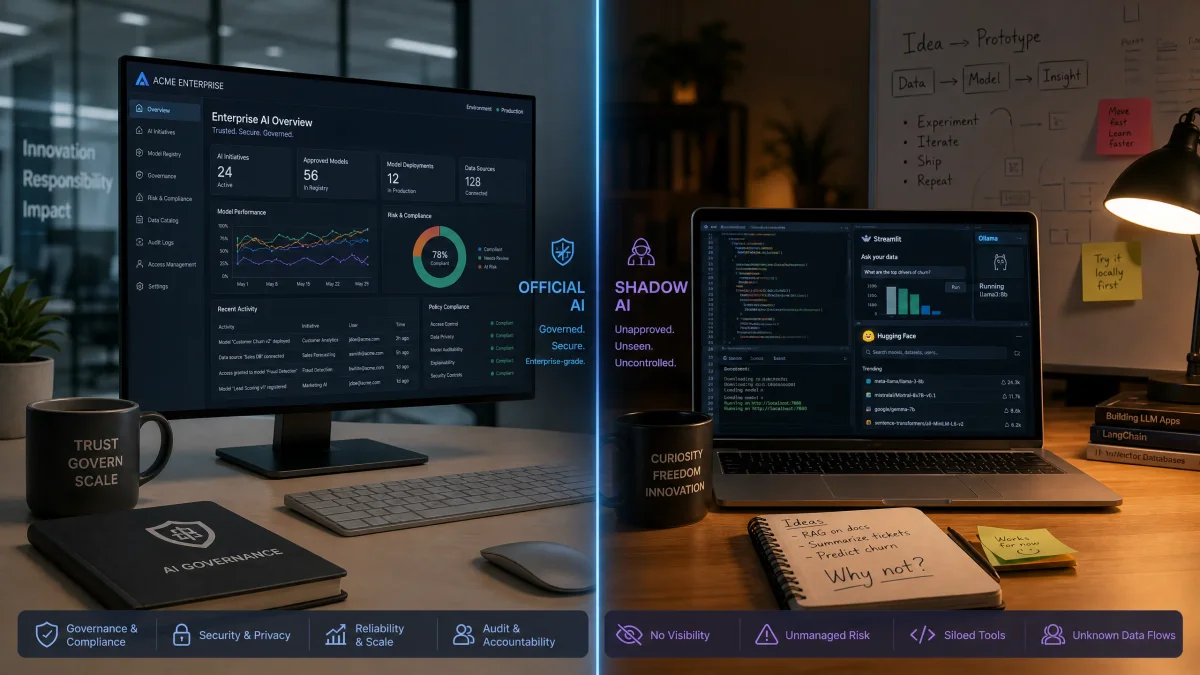
Shadow AI in 2026: Why Employees Are Running Two AI Tools and Only One Is Managed
There’s a quiet revolution happening inside enterprises right now, and most IT departments don’t fully understand its scope. According to a 2026 BlackFog study, 86% of employees now use AI tools at least weekly for work. That figure alone would be unremarkable — it simply confirms what every workplace has been saying about AI adoption. But the second part of the finding tells a very different story: nearly half of those employees are using AI tools their employer hasn’t sanctioned.
This is the shadow AI problem. And it’s reshaping how organizations need to think about AI tool procurement, governance, and security in 2026.
The Two-AI Reality
The core insight is uncomfortable for any organization that believes it has a managed AI strategy: people are using two AIs, not one. During the workday, they interact with whatever tool the company has officially deployed — often an enterprise-grade platform with data protections, usage logging, and compliance controls. But after hours, on personal devices, those same people are asking completely different questions to completely different AI systems.
This isn’t a simple case of people preferring one tool over another. The distinction is structural. The “work AI” gets the polished, professional prompts — the ones people feel comfortable having on a corporate audit trail. The “personal AI” gets the raw, exploratory, genuinely curious questions. The unguarded ones. The ones where people are actually trying to figure things out rather than demonstrating they already know.
When a large share of employees can’t even say whether their organization has implemented AI at all, it becomes clear that part of the workforce has simply filled the gap themselves — with free, unsanctioned tools that offer none of the enterprise protections their organizations assume are in place.
Why Shadow AI Exists
The persistence of shadow AI isn’t primarily about rebellion or negligence. It’s about friction and capability gaps.
Speed of access. Free AI tools are available instantly. Enterprise procurement cycles can take months. When someone needs help drafting a report, analyzing data, or brainstorming solutions, they’re not going to wait for an IT ticket to be resolved. They’re going to open a browser and start typing.
Capability mismatch. Organizations often deploy a single enterprise AI platform — maybe one LLM interface, maybe a licensed productivity suite with built-in AI features. But the AI tool landscape is moving so fast that no single platform covers every use case. Specialized tools for code generation, image creation, legal research, or financial analysis often outperform generalist platforms at their specific tasks.
Cost barriers. The most capable AI tools often come with subscription costs. When organizations haven’t budgeted for them, employees reach for free alternatives — which typically come with weaker privacy guarantees and no enterprise service level agreements.
The Security and Governance Problem
The security implications are substantial. When employees process sensitive company data through free AI tools, that data flows through systems with no contractual data protection, no audit logging, and no way to verify whether the information is being used to train models or stored beyond the session.
The problem extends beyond data leakage. Consider what happens when an organization’s AI-driven decisions are partially informed by outputs from tools IT doesn’t even know exist. If a financial analyst uses an unsanctioned AI to model risk scenarios, the results may carry biases or errors that no one has validated. If a developer uses an unapproved code-generation tool, the output may introduce vulnerabilities that bypass code review processes.
This is where the broader AI governance gap becomes visible. The Zcash incident in June 2026 exposed a regulatory vacuum in auditing standards for AI tools used in financial risk assessment. The accounting profession is only beginning to recognize that the lack of standardized benchmarks for AI auditing tools represents an existential risk — both for the enterprises deploying these systems and for the audit profession trying to develop the expertise needed to evaluate them.
The Agentic AI Complication
Shadow AI is about to get more complicated. AI systems in 2026 are rapidly evolving from passive question-answering tools into autonomous agents that can execute multi-step workflows — processing payments, managing supply chain orders, drafting legal documents, and coordinating across systems with minimal human oversight.
When employees start bringing personal AI agents into enterprise workflows, the stakes multiply. A passive tool that summarizes a document is one thing. An autonomous agent that has permission to act on company systems, make decisions within defined parameters, and communicate with other agents is something entirely different.
The payments industry is already grappling with this transition. Discussions at EBAday 2026 centered on whether organizations should treat AI agents as black boxes — trusting them to operate within boundaries without visibility into decision-making — or whether they should establish trusted contracts that define exactly what agents can and cannot do. That same tension plays out in every enterprise considering agentic AI deployment.
What Organizations Actually Need
The answer isn’t to ban all unsanctioned AI tools. That approach has failed with every technology category it’s been applied to — personal email, cloud storage, mobile apps, and now AI. The shadow IT playbook doesn’t work because it treats symptoms rather than causes.
Instead, effective enterprise AI tool strategy in 2026 requires several things:
Visibility before control. Organizations need to understand which AI tools employees are already using, why they’re using them, and what problems those tools are solving. Only then can procurement and security teams build policies that address real needs rather than imagined ones.
A tiered tool approval framework. Not every AI tool requires the same level of vetting. A framework that categorizes tools by data sensitivity, integration depth, and autonomy level allows organizations to approve low-risk tools quickly while reserving deeper evaluation for higher-risk categories.
Investment in specialized tools. The success of specialized AI platforms — like Turbo Law, which raised $3.8 million in seed funding to serve defense litigation teams and is already active on over 1,800 matters — demonstrates that vertical-specific AI tools deliver value that generalist platforms can’t match. Organizations need to budget for specialized tools in their domains, not just enterprise generalists.
Infrastructure for AI agent management. As the YC Spring 2026 Demo Day made clear, there’s growing demand for platforms that can run and manage dozens of code agents simultaneously, test them in digital twin environments, and secure their operations. Enterprises adopting agentic AI will need similar infrastructure.
Clear data handling policies. Employees need to know exactly which categories of data are safe to process through which tools. Vague guidelines lead to over-caution (which drives shadow usage) or under-caution (which creates real risk).
The Bottom Line
Shadow AI isn’t a problem to be solved — it’s a signal to be read. The fact that nearly half of employees are using unsanctioned AI tools tells us that current enterprise AI offerings aren’t meeting workforce needs. The organizations that will get the most value from AI in 2026 won’t be the ones that lock down their toolchains the tightest. They’ll be the ones that build AI tool strategies flexible enough to channel employee experimentation into productive, secure, and governed outcomes.
The two-AI reality is here. The question isn’t whether to acknowledge it — it’s whether to manage it well before someone else does.