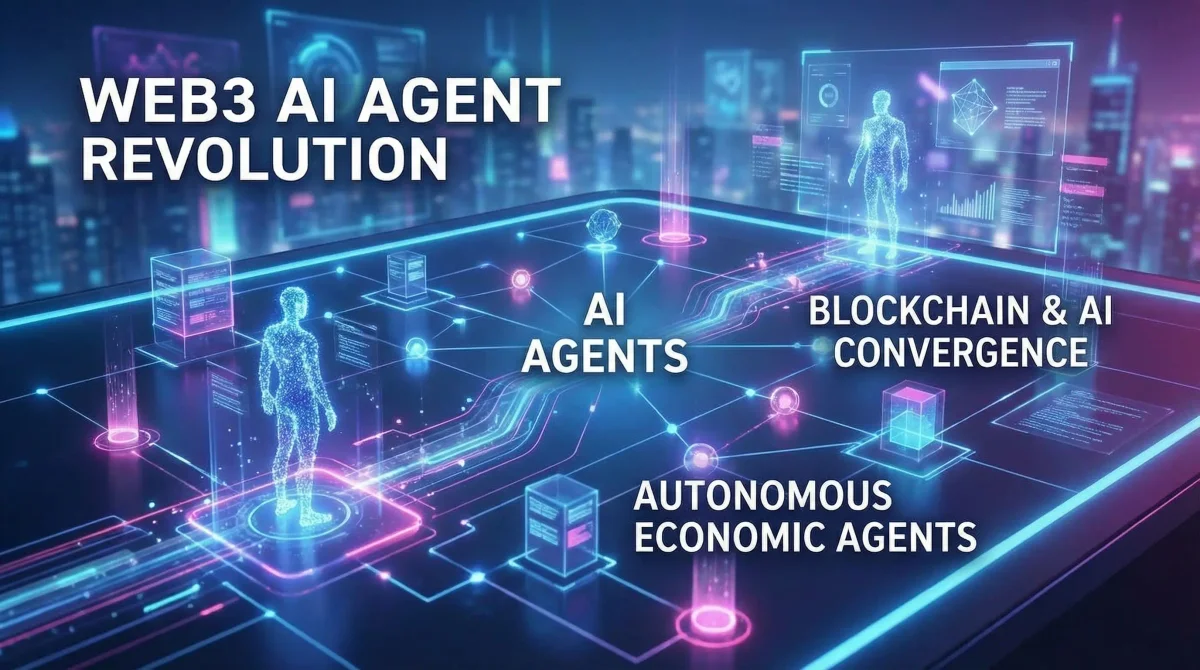
The $4.3B Web3 AI Agent Revolution: Market Analysis 2026
By late 2025, over 550 AI agent crypto projects had launched with a combined market cap of $4.34 billion. Daily trading volume sits above $1.09 billion. These aren’t just speculative tokens—though plenty of those exist too. What’s happening is weirder: machines are starting to coordinate value without asking humans for permission.
The sector raised $1.39 billion in 2025 despite crypto’s broader struggles. 282 projects secured venture funding. The global AI agents market is projected to hit $10.9 billion in 2026, up from $7.8 billion in 2025. The question isn’t whether this matters. It’s whether the infrastructure can actually deliver on what the pitch decks promise.
Why AI Agents Need Blockchain: The Autonomy Problem
OpenAI’s GPT models can write trading strategies all day. They can’t hold money. Google’s AI can analyze markets but can’t execute a single transaction without a human clicking “confirm.” Centralized AI lives in walled gardens where every action needs approval and payment rails that take days to settle.
Here’s the problem: an AI agent managing a DeFi portfolio needs to monitor yield rates across 50 protocols, shift funds automatically, and execute trades based on real-time conditions. To do this autonomously, it needs to:
- Pay for API calls to price feeds in real-time
- Execute transactions across multiple blockchains
- Prove its identity to smart contracts
- Establish trust with other agents
- Settle value instantly across borders
Traditional AI infrastructure can’t do any of this. Blockchain solves it with programmable money, cryptographic identity, and trustless coordination. An AI agent with a wallet address can operate 24/7, pay for resources on-demand, and participate in markets without revealing who owns it.
This is why the crypto-AI sector keeps attracting capital even while mainstream AI dominates headlines. The infrastructure being built enables something centralized systems can’t replicate: truly autonomous economic agents. Whether that’s valuable or just technically interesting is still an open question.
Market Landscape: Explosive Growth Amid Infrastructure Challenges
From just over 100 projects in early 2024, the sector exploded to 550+ by October 2025. The $4.34 billion market cap isn’t all speculation—there’s real infrastructure development happening across multiple layers.
The Artificial Superintelligence Alliance: A $2B+ Consolidation
The biggest move of 2025 was the merger of Fetch.ai, SingularityNET, and Ocean Protocol into the Artificial Superintelligence Alliance. This created a comprehensive ecosystem:
Fetch.ai’s uAgents Framework: Autonomous agents for supply chain, finance, and smart cities. These agents negotiate prices, execute transactions, and coordinate workflows without human intervention.
SingularityNET’s AI Marketplace: A decentralized platform where agents discover, purchase, and monetize AI capabilities. This creates a liquid market for AI services that traditional platforms can’t match.
Ocean Protocol’s Data Layer: Tokenized data exchange for AI training on private datasets. This solves a real problem—accessing quality training data without compromising privacy or ownership.
The alliance launched ASI-1 Mini, the first Web3-native large language model, and announced ASI Chain, a blockchain optimized for agent-to-agent transactions. Their Agentverse marketplace hosts thousands of monetized AI agents generating revenue for developers. Whether this proves economic viability or just demonstrates that people will pay for novel tech remains to be seen.
Investment and Adoption Metrics
The financial data shows institutional interest despite crypto volatility:
- $1.39 billion raised by AI agent projects in 2025 YTD (9.4% increase over 2024)
- 282 crypto-AI projects secured venture funding
- 17,124 agents launched on Virtuals Protocol alone
- 57% of enterprises run AI agents in production (according to G2’s survey)
- 80% report measurable economic impact
The most striking claim: algorithmic trading systems are projected to manage 89% of global trading volume by 2025, with GPT-4 and GPT-5 powered bots outperforming human traders by 15-25% during high volatility. I’m skeptical of that 89% figure—it’s unclear whether that includes traditional algorithmic trading or just AI-powered systems. But the directional trend is real.
Payment Infrastructure: The x402 Protocol and Enterprise Integration
The x402 protocol, finalized in 2025, became the decentralized payment standard for AI agents. Google Cloud, AWS, and Anthropic integrated support within months. That’s fast adoption for a crypto standard.
Traditional payment rails require human verification for every transaction, bank accounts tied to legal entities, and batch settlement taking 1-3 business days. An AI agent executing 10,000 microtransactions per day across 50 countries can’t operate under these constraints.
Blockchain-based payments enable:
- Settlement in seconds instead of days
- Programmable payment rules (pay X if Y condition is met)
- Global access without intermediaries
- Micropayments measured in fractions of a cent
- Cryptographic proof of payment without revealing sensitive information
Visa launched the Trusted Agent Protocol for recognizing and transacting with approved AI agents. PayPal partnered with OpenAI to enable instant checkout in ChatGPT via the Agent Checkout Protocol. These moves signal that traditional finance sees blockchain as necessary plumbing for the AI economy, not a separate stack.
By 2026, most major crypto wallets are expected to support natural language transaction execution. Users will say “maximize my yield across Aave, Compound, and Morpho” and their agent will execute the strategy autonomously. Whether users will trust this enough to actually use it is another question.
Identity and Trust: The ERC-8004 Standard
For AI agents to participate in economic activity at scale, they need verifiable identity and reputation. The ERC-8004 standard, finalized in August 2025, established three registries:
Identity Registry: Cryptographic verification that an agent is who it claims to be.
Reputation Registry: On-chain scoring based on past behavior and outcomes.
Validation Registry: Third-party attestations and certifications.
This creates a “Know Your Agent” (KYA) framework parallel to KYC for humans. An agent with a high reputation score can access better lending rates in DeFi. An agent with verified identity can participate in governance. An agent without attestations might be restricted to sandboxed environments.
The NTT DOCOMO and Accenture Universal Wallet Infrastructure (UWI) extends this further, creating interoperable wallets that hold identity, data, and money together. For users, this means a single interface managing both human and agent credentials.
Real-World Use Cases: Where Agents Create Value Today
Beyond the hype, AI agents are delivering measurable business value in several sectors:
DeFi Automation and Yield Optimization
Fetch.ai’s autonomous agents manage liquidity pools, execute trading strategies, and rebalance portfolios automatically. An agent can transfer USDC between pools whenever better yields appear, with some strategies claiming 50-80% annualized returns in optimal conditions.
That 50-80% figure needs context—it’s likely cherry-picked from the best-performing strategies during favorable market conditions. But the core capability is real: these agents monitor markets 24/7, react in milliseconds, and execute across multiple protocols simultaneously. Human traders can’t match that coordination speed.
Supply Chain and Logistics Optimization
Fetch.ai’s agents optimize supply chain operations in real-time, reportedly reducing coordination costs by 30-50% compared to human-managed logistics. An agent representing a shipping container can negotiate prices with port authorities, pay for customs clearance, and update tracking systems—all autonomously.
Pilot programs in smart city initiatives show agents coordinating traffic management, energy distribution, and resource allocation. An agent managing a building’s energy consumption can purchase surplus solar power from neighboring buildings via microtransactions, optimizing costs based on real-time supply and demand.
Data Marketplaces and AI Training
Ocean Protocol enables tokenized data trading where AI agents purchase datasets for training, pay providers automatically, and prove provenance cryptographically. This creates liquidity for previously illiquid data assets while preserving privacy.
Agents can negotiate data access terms, verify quality through sampling, and coordinate multi-party computation for privacy-preserving AI training—all autonomously. The implications extend beyond simple transactions.
Prediction Markets and Information Aggregation
AI agents contributed 30% of trades on Polymarket in late 2025. These agents aggregate information from thousands of sources, identify arbitrage opportunities, and execute trades at machine speed. Their participation improves market efficiency and price discovery while generating returns for operators.
DAO Governance and Decision Intelligence
Voter fatigue and limited data context plague DAO governance. AI agents help by analyzing proposals against historical voting patterns and economic performance data, simulating outcomes to model financial impacts, and highlighting governance risks like voting power concentration.
Agents don’t replace human participation but provide decision support for faster, more informed governance.
Infrastructure Gaps: The Scalability Challenge
Despite progress, the crypto-AI sector faces structural challenges that mainstream AI doesn’t:
Computational Mismatch
Blockchain infrastructure isn’t optimized for high-frequency, low-latency AI workloads. Commercial AI services handle thousands of queries per second. Public blockchains typically support 10-100 transactions per second. This mismatch creates bottlenecks.
Decentralized AI networks can’t yet match the speed, scale, and efficiency of centralized infrastructure. AI training requires GPU clusters with ultra-low latency interconnects. Distributed compute introduces communication overhead that slows training by 10-100x compared to centralized alternatives.
Capital and Liquidity Constraints
The crypto-AI sector is largely retail-funded. Mainstream AI benefits from institutional venture funding (billions from Sequoia, a16z, Microsoft), government support, corporate R&D budgets (Google, Meta, Amazon spend $50B+ annually), and regulatory clarity enabling enterprise adoption.
The divergence is stark. Nvidia’s market cap grew $1 trillion in 2023-2024. Crypto-AI tokens collectively shed 40% from peak valuations. The sector faces liquidity challenges amid risk-off sentiment and broader crypto market corrections.
Integration and Governance Challenges
Enterprise surveys reveal that 46% of organizations cite integration with existing systems as their primary challenge in deploying AI agents. Another 42% flag data quality issues. 40% cite security concerns. These aren’t edge cases—these are majorities.
Gartner warns that over 40% of agentic AI projects risk cancellation by 2027 if governance, observability, and ROI clarity aren’t established. Human-in-the-loop oversight remains standard not because the technology isn’t capable, but because trust infrastructure hasn’t caught up.
The 2026 Outlook: Convergence or Divergence?
The fundamental question is whether Web3 AI will converge with mainstream AI as essential infrastructure or remain a parallel ecosystem serving niche use cases.
The Case for Convergence
By late 2026, the boundaries between AI, blockchains, and payments may blur. One layer provides decisions (AI), another ensures directives are genuine (blockchain), and the third settles value exchange (crypto payments). Digital wallets will hold identity, data, and money together in unified interfaces.
Enterprise adoption is accelerating. Google Cloud’s integration with x402, Visa’s Trusted Agent Protocol, and PayPal’s Agent Checkout signal that traditional players see blockchain as essential plumbing for the AI economy.
The infrastructure being built today—payment standards, identity frameworks, reputation systems—solves problems that centralized systems can’t address without recreating the same mechanisms in proprietary form.
The Case for Divergence
Mainstream AI may solve payments and coordination without blockchain. OpenAI could integrate Stripe for micropayments. Google could build proprietary agent identity systems. The regulatory moat around stablecoins and crypto infrastructure may prevent mainstream adoption.
The 40% token decline while Nvidia gained $1 trillion suggests markets see crypto-AI as speculative rather than foundational. If decentralized infrastructure can’t achieve comparable performance and scale, developers will default to centralized alternatives with better user experience and reliability.
The Regulatory Wild Card
The GENIUS Act, MiCA, and other 2026 regulations could either legitimize crypto-AI infrastructure (enabling institutional capital) or strangle it with compliance costs that only centralized players can afford. Regulatory clarity is the single biggest variable determining whether this sector reaches mainstream adoption or remains niche.
Investment Implications: Infrastructure Over Speculation
For investors and builders, the data suggests focusing on infrastructure rather than speculative tokens:
Payment and Settlement Layers: Projects building rails for agent-to-agent transactions, like x402 implementations and stablecoin infrastructure optimized for microtransactions.
Identity and Reputation Systems: Implementations of ERC-8004 and similar standards that enable trust without centralization.
Compute and Data Layers: Decentralized compute networks that can achieve performance comparable to centralized alternatives, and data marketplaces that preserve privacy while enabling AI training.
Developer Tools and Frameworks: Platforms like AutoGen and the ASI Alliance’s Agentverse that reduce the complexity of building and deploying autonomous agents.
The companies succeeding aren’t those with the most sophisticated models. They’re those that solved integration, governance, and measurement first. The bottleneck was never intelligence. It was plumbing.
Conclusion: The Race to Build Autonomous Economies
The Web3 AI agent sector is a $4.3 billion bet that the future of AI is decentralized, autonomous, and economically sovereign. Over 282 projects secured funding in 2025 to build this vision, creating payment standards, identity frameworks, and coordination layers that don’t exist in centralized AI.
The challenges are real. Scalability gaps, capital constraints, and regulatory uncertainty threaten to relegate crypto-AI to niche use cases. But the core value proposition—AI agents that can pay, prove identity, and coordinate trustlessly—can’t be replicated without blockchain infrastructure.
By late 2026, we’ll know whether crypto-AI converges with mainstream AI as essential plumbing or diverges as a parallel ecosystem. The answer will determine whether autonomous agent economies become a trillion-dollar market or remain an ambitious experiment.
The race is on. The winners will be those building real infrastructure for machine-scale coordination, not just tokens and hype. The $4.3 billion market cap is just the beginning. Whether the infrastructure can scale to match the ambition is the real question.