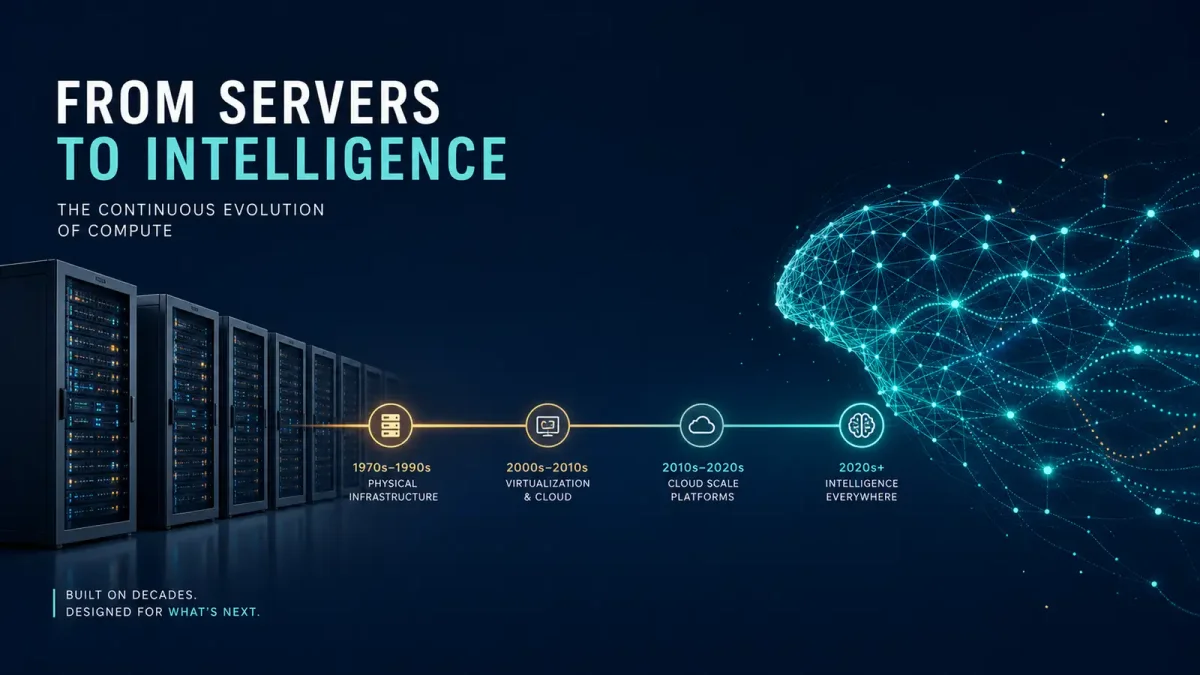
In 2024 and 2025, enterprises ran AI proof-of-concepts. Hundreds of them. Every department had a chatbot project, a document summariser, a predictive model trained on internal data that was going to change everything. The demos looked great in board presentations. The slides were convincing. The actual deployment into production workflows — the part where AI stops being a demo and starts being infrastructure — mostly did not happen.
In 2026, the conversation has shifted. The question is no longer “can AI do this?” The question is “how do we make AI do this at scale, across the organisation, without creating a compliance nightmare or blowing the budget?” The pattern is familiar to anyone who lived through the cloud adoption wave a decade ago. The technology is different. The mistakes are the same.
Sanjay Dandeker, a principal consultant at Cortex Reply, recently laid out the parallel in a piece for Consultancy.uk, and the comparison holds up better than most tech analogies. When cloud computing arrived, early adopters ran pilot projects, got excited about scalability and reduced infrastructure costs, and then hit a wall. Experimentation alone did not create sustainable value. The organisations that actually unlocked cloud’s potential did it by building foundations first: security guardrails, architectural patterns, governance frameworks, and teams that knew what they were doing. The cloud evolved from isolated experiments into a strategic platform only after those foundations were in place.
AI, Dandeker argues, is at exactly the same inflection point. The POCs worked. Everyone knows the technology can automate routine tasks and surface predictive insights. The new questions are harder: How do you integrate AI without creating new risks? What security controls do you need? How do you maintain quality once models are in production? These are not model-building questions. They are organisational questions. And they are the same questions cloud adoption forced organisations to answer, just with different buzzwords attached.
Security: The Guardrails Have to Come First
When cloud adoption accelerated, security stopped being a checkbox at the end of a project and became integral to every architecture conversation. The thinking had to evolve because cloud introduced risks that on-premise infrastructure did not — data moving between regions, access controls that spanned multiple services, monitoring that had to cover what you could no longer physically see.
AI raises the same category of problem with higher stakes. A misconfigured cloud bucket leaks data. A poorly governed AI model leaks data, produces biased outputs, and potentially violates regulations that are still being written. Responsible AI adoption requires governance frameworks that address data privacy, model risk, bias mitigation, and regulatory compliance at the same time, not sequentially. Dandeker’s core point is that establishing these guardrails early lets teams innovate without exposing the business to downside risk. Wait until something goes wrong, and the ensuing clampdown kills momentum across every AI initiative, not just the one that failed.
Standardisation: Stop Reinventing the Wheel
The cloud winners were the organisations that standardised fast. They built templates for infrastructure provisioning, defined deployment patterns that every team used, and created cost management practices that prevented individual project leads from running up surprise bills. These patterns provided consistency, reduced technical debt, and let teams ship faster because they were not designing the plumbing from scratch every time.
AI adoption needs the same discipline. Common use cases — document processing pipelines, customer-facing conversational interfaces, analytics augmentation — benefit from reusable workflows and integration patterns. If every team that wants to deploy an internal chatbot builds its own RAG pipeline from scratch, the organisation is burning engineering time on solved problems. The enterprise that standardises these patterns first moves faster and spends less, which is the same dynamic that separated cloud leaders from cloud laggards.
People: Technology Alone Does Not Drive Transformation
Cloud adoption produced a clear finding that some organisations still have not internalised: training matters more than tooling. The companies that succeeded invested in certification programmes, built internal communities of practice, and taught engineers and business leaders not just how cloud worked but how it changed the way they thought about building and delivering solutions.
AI makes this lesson more urgent, not less. Teams need to understand how to work with AI outputs — how to evaluate them critically, when to trust them, when to override. The people who understand an organisation’s daily processes best are also the people best positioned to identify which parts of those processes would actually benefit from AI. Dandeker calls this out explicitly: educating people on recognising AI use cases is as critical as training them on the tools. A model doing something nobody needs is not a win, no matter how technically impressive the demo looks.
Governance: Who Decides What Gets Built
Cloud adoption forced a rethink of decision-making. Centralised governance, cross-functional oversight, and well-defined operating models stopped being optional once multiple teams could spin up resources independently. AI forces the same rethink with more urgency because the cost of getting it wrong is not just a surprise AWS bill — it is biased outputs, regulatory exposure, and processes that break in subtle ways that take months to notice.
The governance questions Dandeker raises are specific: Who decides which AI use cases the organisation pursues? How are those efforts prioritised across departments? How is impact measured after deployment? And once models are in production, who owns the ongoing operational work — performance monitoring, accuracy drift detection, cost optimisation, reliability? If the answers live in a slide deck that nobody references after the quarterly review, the governance framework exists on paper only. The organisations that get this right treat AI governance as an operational function, not a compliance exercise.
One practical model that has emerged from early enterprise AI adopters is the AI Centre of Excellence, a cross-functional team that owns standards, reviews use cases, and provides shared infrastructure. It sits between the IT organisation and the business units, answering the “who decides” question with a structure that has both technical authority and business accountability. The model is not new — cloud Centres of Excellence did the same job a decade ago — but it is effective for the same reason: it prevents every department from building its own incompatible stack while still letting teams move at their own speed within agreed guardrails.
Another concrete pattern is the AI use case pipeline. Rather than letting individual executives champion pet projects, mature organisations build a structured process for intake, evaluation, and prioritisation. A use case comes in with a defined business metric, an estimated technical effort, and a risk assessment. A cross-functional committee scores it against strategic priorities and available capacity. Approved projects get standardised templates and access to shared infrastructure. Rejected projects get a clear reason, not silence. The process is boring on purpose — it takes the politics and the hype out of resource allocation and replaces both with criteria that everyone agreed to in advance.
The Cloud Lesson That Applies to Everything
Cloud adoption taught one lesson that is worth stating plainly because organisations keep ignoring it: moving fast does not beat moving deliberately if the fast mover has no foundation. The cloud leaders were rarely the first to run a pilot. They were the ones who invested in the boring infrastructure work early — security, patterns, training, governance — so that when the technology was ready for enterprise scale, the organisation was too.
AI in 2026 is in the same position. The POCs are done. The question is whether the organisation has the scaffolding to turn those isolated successes into an enterprise capability. The cloud experience says the answer depends almost entirely on whether leadership treats AI adoption as a technology programme or a strategic transformation. Technology programmes buy tools and run pilots. Strategic transformations build the foundations first and scale with intent.
Dandeker’s conclusion is blunt on this point: “Just as cloud became the backbone of digital transformation, AI will become the backbone of modern decision making, automation, and insight.” The opportunity now is to skip the part where enterprises spend three years learning lessons that were already available in 2026.
The alternative — the path most organisations took with cloud and are at risk of repeating with AI — is a portfolio of successful POCs that never become anything more. The chatbot demo that impressed the board in Q2 sits unused by Q4 because nobody built the integration layer that connects it to actual business systems. The predictive analytics model that identified churn risk with 85 percent accuracy never reached a customer-facing team because the governance process for model deployment was not defined. These are not technology failures. They are organisational failures that the technology gets blamed for. Cloud adoption generated a generation’s worth of case studies on exactly this pattern — from the insurance company that ran Kubernetes in dev for two years without a production deployment plan to the retailer whose cloud migration stalled because the finance team never approved the new cost model. AI adoption in 2026 has the chance to use those case studies instead of creating brand new ones with the same underlying problem.