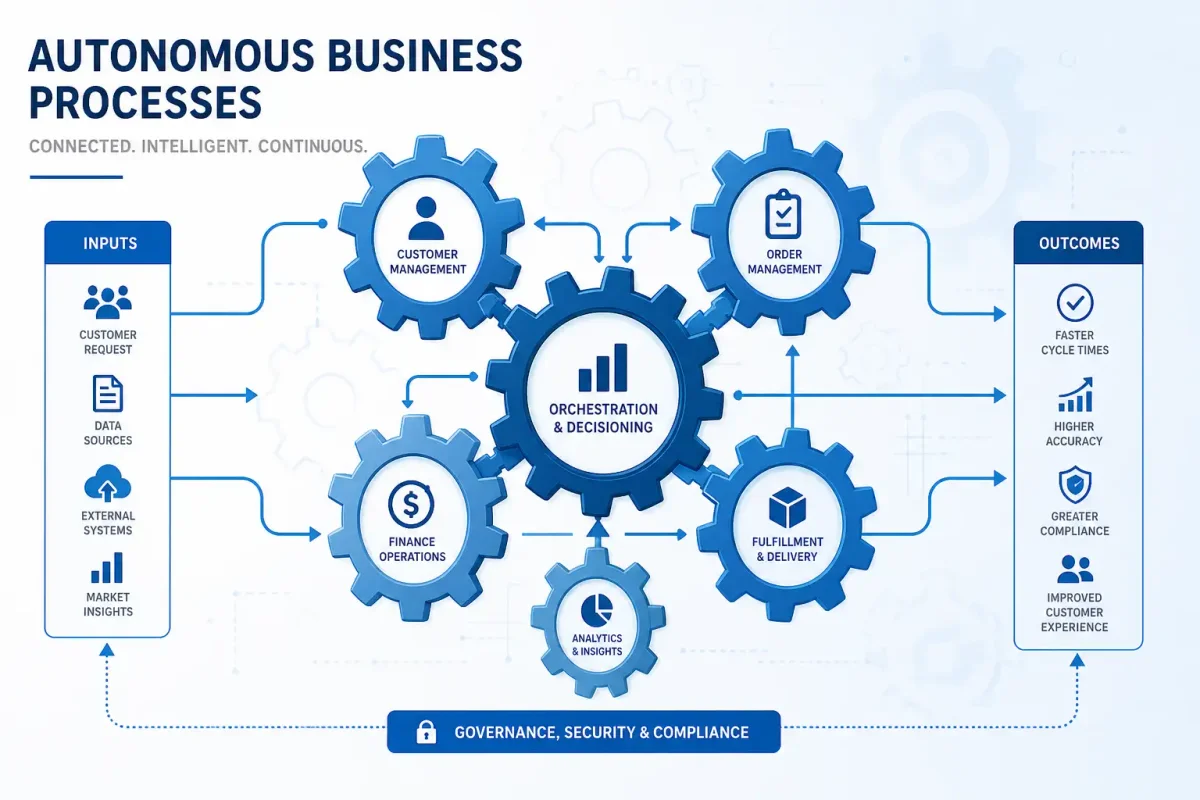
The generative AI era is barely two years old, but the enterprise conversation has already gone through three distinct phases. Phase one was wonder — ChatGPT’s launch in late 2024 triggered a gold rush of experimentation, with every department spinning up proof-of-concepts. Phase two was disappointment — most of those pilots stalled when teams realized that a clever chatbot doesn’t automatically integrate with SAP, doesn’t understand your data schema, and certainly doesn’t know which expense reports need a VP’s signature. We are now deep into phase three: the agentic turn.
Agentic AI isn’t just a new product category. It represents a fundamental architectural shift in how enterprises deploy machine intelligence. Instead of AI as a tool you pick up and put down — ask a question, get an answer, repeat — agentic systems operate continuously. They observe business events, make decisions within policy guardrails, call APIs, update records, escalate exceptions to humans, and log every action for audit. They are not copilots. They are operators.
The Execution Gap Is Real, and It’s Wide
Before getting to what’s working, it’s worth sitting with the numbers on what isn’t. According to ETR’s 2026 enterprise technology survey, the gap between AI adoption ambition and actual production deployment is the widest it’s ever been for any enterprise technology wave. Tommaso Maria Ricci, who runs an enterprise AI advisory practice, calls it bluntly: “the widest gap in the history of enterprise technology adoption.”
What’s driving that gap? Three recurring failure modes keep surfacing. First, data readiness — most organizations discover mid-project that the data they need is siloed across six systems, inconsistently labeled, and missing historical context. Second, governance paralysis — legal and compliance teams, burned by early generative AI’s hallucination problem, impose approval processes so slow that projects lose momentum before reaching production. Third, the integration tax — connecting an AI system to a twenty-year-old ERP running on an AS/400 in a closet nobody remembers isn’t just difficult, it’s something most vendors still don’t have a clean answer for.
Gartner’s latest forecast projects that by 2028, a significant share of enterprise applications will embed task-specific AI agents. But the consultancies are careful to add a caveat that industry insiders have been saying for months: without disciplined data and governance practices, a substantial portion of these initiatives will fail to deliver measurable business value. The gap between shipping an AI feature and realizing ROI is where most 2026 deployments are currently living.
What Agentic Actually Means in Production
Strip away the marketing and agentic AI comes down to a simple loop: sense, decide, act, learn. An agent monitors a trigger — an invoice arriving, a support ticket being filed, a sensor crossing a threshold. It evaluates the situation against its policy constraints and available tools. It takes action: routing the invoice to the correct approval chain, drafting and sending a response from the knowledge base, flagging the anomaly for human review. Then it logs what happened and updates its context for the next cycle.
The difference from traditional RPA is the reasoning layer. A classic RPA bot follows a script — if field X equals Y, do Z. An agent can handle ambiguity. It can read the free-text notes on an invoice that say “this PO was changed verbally, use account code 4500 instead” and adjust its routing accordingly. It can spot that three seemingly unrelated support tickets all reference the same upstream outage and correlate them before a human even notices the pattern.
SS&C Blue Prism, the company that more or less invented enterprise RPA, now frames its entire roadmap around what it calls “agentic automation.” The firm claims over $200 million in internal savings from applying its own technology stack — a number that, while self-reported, is large enough that even a heavily discounted version of it suggests real operational impact. Blue Prism holds a Gartner Magic Quadrant Leader position in RPA and is betting that the convergence of traditional automation with LLM-powered reasoning is the next major platform battle.
The Tool Landscape: Five Names Worth Knowing
The agentic AI tool market is fragmenting fast, and the division lines are becoming clearer. There are roughly three tiers.
The low-code no-code tier is where most adoption is happening right now. Zapier, the decade-old automation platform, has leaned hard into AI agents — its pitch is that non-technical business users can build agents that watch for Gmail triggers, cross-reference data in Airtable, draft responses, and route approvals without writing a line of code. Make (formerly Integromat) competes in the same visual-builder space with a slightly steeper learning curve but more sophisticated branching logic. Both are seeing adoption inside operations, marketing, and HR teams that need to automate multi-step workflows but can’t wait for IT to provision a development environment.
The developer-oriented tier is where things get more interesting technically. n8n, an open-source workflow automation engine, has gained traction among teams that want self-hosted infrastructure and full control over their automation logic. Its node-based editor gives engineers the flexibility to wire together LLM calls, API integrations, and custom code in ways that closed platforms don’t. Vellum, meanwhile, focuses specifically on the prompt-engineering and model-orchestration layer — it’s less about connecting to Salesforce and more about managing the chain of reasoning that happens between a user’s request and the final output. Both tools are seeing uptake in mid-market tech companies and engineering-forward enterprise teams.
The enterprise platform tier is where the big money is moving. Sana Labs has positioned itself as an “AI operating system” — LLM-agnostic architecture that sits on top of existing enterprise systems, ingests company data, and provides a unified governance layer while letting teams choose which model (OpenAI, Anthropic, open-source, etc.) powers each specific workflow. Its integration with Workday gives it a foothold in HR and finance automation that competitors lack. Lindy, a newer entrant, targets accessibility with a no-code builder that abstracts away the complexity of prompt chains and API orchestration.
The through-line across all three tiers is the same: none of these tools are selling AI for AI’s sake. They’re selling the ability to connect AI reasoning to the systems where work actually happens — email, CRM, ERP, HRIS, support desk. The winners are being chosen not on model quality but on integration depth.
Governance Isn’t Optional Anymore
If there is one lesson the enterprise market learned in 2025, it’s that governance can’t be retrofitted. Early generative AI deployments treated guardrails as an afterthought — ship the chatbot, then figure out what it shouldn’t say. That approach led to some genuinely embarrassing incidents, including a widely circulated case of an internal HR chatbot at a Fortune 500 company confidently inventing parental leave policies that didn’t exist.
The governance conversation in mid-2026 has matured considerably. Stellium Consulting’s annual AI trends report identifies governance platforms as “non-negotiable,” pointing to the growing regulatory pressure from the EU AI Act’s phased implementation and the expectation that similar frameworks will emerge in North America within the next eighteen months. The vendors that are winning enterprise deals — Sana, Blue Prism, and increasingly the major cloud platforms — all emphasize logging, access control, human-in-the-loop escalation paths, and explainability features as first-class product capabilities, not optional add-ons.
The governance requirement is also driving architectural decisions. Companies that might have defaulted to a single-model, single-vendor approach are instead adopting LLM-agnostic architectures that let them swap models based on the sensitivity of the task. A customer-facing agent handling routine order status queries might run on a fast, low-cost model. An agent making recommendations about loan modifications runs on a different model with a different audit trail and a mandatory human approval step. Hybrid architectures — mixing cloud, on-premise, and edge deployment — are becoming the norm rather than the exception.
What’s Actually Working in the Field
The most illuminating case studies from the first half of 2026 aren’t the flashy ones. Nobody is replacing their entire workforce with agents, and the companies that claimed they would are conspicuously quiet now. What’s working is narrower and more concrete.
Insurance claims processing is a standout. Several major carriers have deployed agentic systems that intake claims, pull policy data, cross-reference with third-party databases for fraud indicators, and either auto-adjudicate straightforward claims or package everything a human adjuster needs into a single dashboard. The time from claim filing to resolution is down 40-60% in some deployments, and the accuracy — measured by successful audit pass rates — has actually improved because the agents don’t skip steps when they’re overwhelmed, which human processors occasionally do.
Supply chain exception handling is another bright spot. Rather than trying to predict every possible disruption, companies are deploying agents that monitor procurement systems, shipping APIs, and weather feeds simultaneously, then flag and respond to anomalies within minutes instead of days. One manufacturer reduced its average response time to a supplier shipment delay from 72 hours to under four hours by automating the detection, escalation, and recommended-action workflow through a multi-agent system built on n8n and a fine-tuned LLM.
IT operations and service management is perhaps the most natural fit. ServiceNow and its competitors have been embedding agentic capabilities throughout their platforms, and the early results suggest that Level 1 support — password resets, access requests, software provisioning — can be handled almost entirely by agents with well-defined policies. The human IT staff that used to spend Monday mornings resetting passwords are now handling the genuinely hard problems that actually need their expertise. Whether that translates to headcount reductions or just a better quality of work depends on the company, but the operational improvement is real either way.
The Road Ahead
The agentic enterprise is not a destination — it’s a trajectory that most large organizations are already on whether they’ve named it or not. The platforms are maturing, the governance frameworks are hardening, and the integration points are multiplying. The question for the second half of 2026 is less about whether agentic architectures will become the default and more about which organizations can close the execution gap before their competitors do.
The companies that are succeeding share a few traits. They started with narrow, high-frequency processes rather than trying to boil the ocean. They invested in data quality and governance before deploying agents, not after. They built internal literacy — not by sending everyone to prompt engineering workshops, but by establishing clear frameworks for what agents can and cannot do, and what humans need to review. And they treated agentic AI as an operations transformation rather than a technology project, which meant bringing process owners, compliance teams, and frontline workers into the design conversation from day one.
The hype cycle is flattening. The real work is beginning.