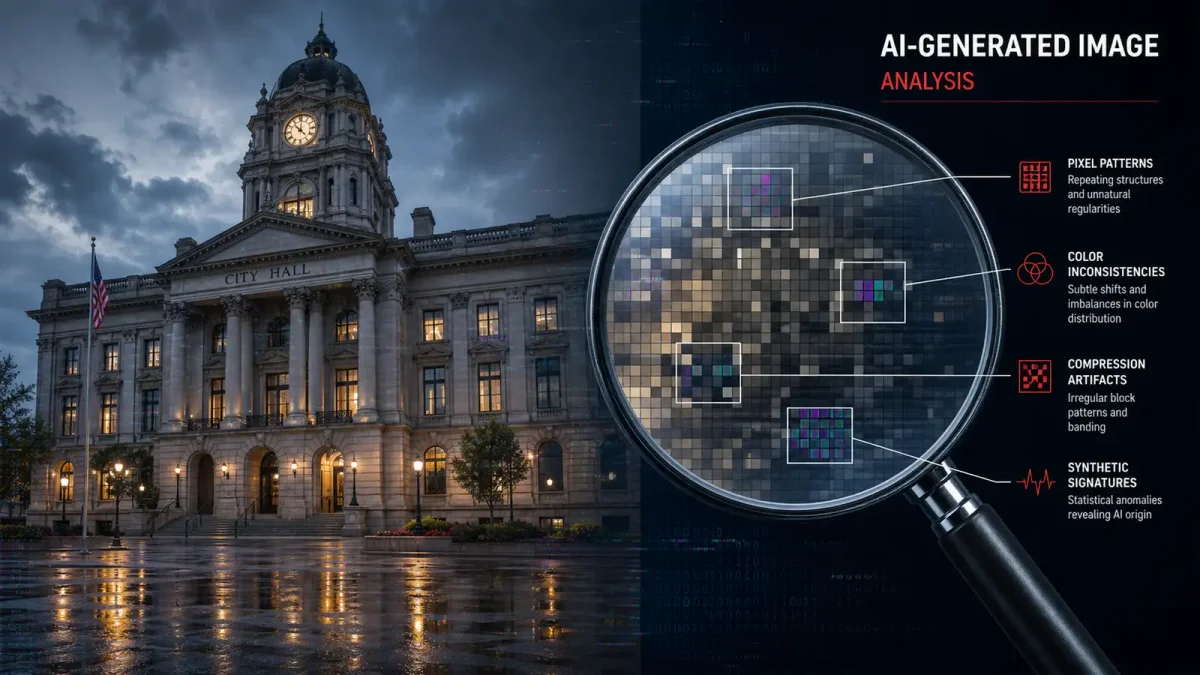
Twice in six days, Spokane city officials were fooled by AI-generated images submitted through official channels. The images, which appeared to show municipal infrastructure projects, passed through initial review before someone noticed the telltale artifacts: hands with too many fingers, text that looked like it came from a parallel alphabet, shadows that didn’t match any light source in the frame. The Spokane incidents, reported by The Spokesman-Review on July 21, weren’t sophisticated attacks. They were closer to pranks. But they landed because the default assumption in most institutional workflows is still that an image is real until proven fake.
That assumption stopped being safe about two years ago. The tools are too good now, and the gap between what generators can produce and what detectors can reliably catch is widening, not closing.
The Spokane Pattern
The Spokane incidents follow a pattern that’s becoming familiar in local government and small organizations: someone submits an image through a public-facing portal. The reviewer, who is not a forensic image analyst, glances at it and moves on. The image looks plausible enough — a building here, some landscaping there, nothing that screams “generated.” It’s only later, when someone looks closer or runs it through a detector, that the artifacts become obvious.
This isn’t a failure of policy so much as a failure of intuition. Most people still operate on the visual equivalent of “I know it when I see it.” But Midjourney v7, released in early 2026, and DALL-E 4, launched in May, produce images that cross that threshold for the majority of viewers on the majority of subjects. Architectural renderings, product mockups, landscapes, portraits with neutral expressions — these are solved problems. The models still struggle with complex hand positions, text rendering, and scenes with multiple interacting light sources, but those failure modes are becoming edge cases rather than reliable tells.
The Spokane images slipped through because they depicted exactly the kind of scene that current models handle well: static infrastructure in even lighting. No hands. No text beyond a few blurry signs. No reason for a busy city employee to look twice.
The Detection Problem Nobody Has Solved
Snopes published a guide on July 19 titled “How to Spot AI Images: A Fact-Checker’s Guide.” It’s a useful document. It tells readers to check hands, check text, check reflections, check for inconsistent shadows. It also acknowledges, in quieter language, that these heuristics are becoming less reliable every month.
The underlying problem is mathematical. AI image detection tools — Hive, AI or Not, SynthID — work by looking for statistical patterns in pixel distributions that are characteristic of specific generator architectures. But these patterns shift every time a model gets updated. A detector trained on Midjourney v6.1 output may be blind to Midjourney v7. The generators are moving targets, and the detectors are always playing catch-up.
This asymmetry is structural, not temporary. Building a good generator requires training a model on millions of images, which costs millions of dollars in compute. Building a good detector requires training on the output of every generator you want to catch, which means the detector’s training set is always at least one generation behind. By the time a detector is reliable against last month’s Midjourney, this month’s Midjourney is already producing images with different statistical fingerprints.
Worse, post-processing — cropping, compression, adding a filter, screenshotting — can erase the very artifacts detectors look for. An image that passes through Instagram’s compression pipeline is much harder to flag than the raw output from a generator. And most images that enter institutional workflows have been through some form of post-processing.
The practical consequence is that detection alone cannot solve the Spokane problem. Any detection-based solution is a temporary patch that will degrade as generators improve. The only durable approach is provenance — knowing where an image came from, not guessing based on how it looks.
The Coalition for Content Provenance and Authenticity (C2PA) has been pushing a different approach: instead of detecting fakes after the fact, attach cryptographically signed metadata to images at the point of creation. Adobe, Microsoft, Nikon, and Leica have all adopted C2PA credentials. A photo taken on a recent Leica camera carries a signature that says, in effect, “This sensor captured these photons at this time in this location.” An image generated by Adobe Firefly carries a signature that says, in effect, “An AI made this.”
The problem is that C2PA only works if the entire pipeline supports it. A signed image uploaded to Twitter loses its credentials in the compression step. A screenshot of a signed image is a new, unsigned image. And most importantly, bad actors have no incentive to attach provenance metadata to images they’re using deceptively. C2PA is a solution for honest actors who want to prove their images are real. It does nothing about dishonest actors who want their fakes to pass.
SIGGRAPH’s Different Conversation
While city governments are scrambling to spot fakes, the computer graphics industry is having a very different conversation. SIGGRAPH 2026, which wrapped up its call for content in July, framed AI explicitly as a “creative partner” across research, art, and industry. The language is notable: not a tool, not an assistant, but a partner.
This reflects a real shift in how professional artists and studios are integrating AI into their workflows. Concept artists at major game studios use AI to generate dozens of mood variations in minutes, then hand-paint over the ones they like. VFX teams use AI for rotoscoping and clean-up tasks that used to take days. Independent artists train custom models on their own work to generate variations they then curate and refine.
Adobe’s Project Indigo, which got an experimental AI Playground feature in mid-July, is pushing this further. The playground lets users chain multiple generation steps — text-to-image, image-to-image, inpainting, style transfer — in a single non-destructive workflow. It’s designed for artists who want AI in the loop but don’t want the loop to spit out a finished product they had no hand in shaping.
The SIGGRAPH program this year reflects this integration at every level. Technical papers cover neural radiance fields for real-time scene reconstruction. The art gallery features works where the AI contribution is disclosed alongside the human contribution — not hidden in a footnote but presented as co-crediting. NVIDIA’s keynote focused on “agentic and physical AI” for simulation, emphasizing that the most important AI graphics applications aren’t about generating final images but about building interactive worlds that respond to user input in real time. These are tools for makers, not replacement for them.
The creative partner framing is more honest than the “AI will replace artists” panic of 2023 or the “AI is just a tool” deflection of 2024. It acknowledges that something different is happening: the machine is contributing ideas, not just executing instructions. A concept artist who asks an AI for “a steampunk airship in the style of Moebius” gets back something they wouldn’t have drawn themselves. They might use 10% of it. But that 10% changed the direction of the piece. That’s not a tool. That’s not a replacement. It’s something in between.
The Two Futures
The Spokane incident and the SIGGRAPH framing point to two diverging futures for AI imagery. In one, AI images are a threat to be detected, blocked, and regulated — a pollution of the information ecosystem. In the other, they’re a creative accelerant — a way for artists to explore more ideas, faster, with more unexpected results.
Both futures are happening simultaneously, and they’re not really in conflict. The same technology that can generate a photorealistic fake of a municipal building can also generate a hundred concept variations that help an art director find the right visual language for a film. The difference isn’t the capability. It’s the context and the intent.
This duality shows up in the tools themselves. Adobe Firefly, which powers the generative features in Photoshop and the new Project Indigo playground, is trained exclusively on licensed and public domain images. It won’t generate images of public figures or copyrighted characters. DALL-E 4, by contrast, is trained on a broader dataset and has fewer guardrails around what it will depict. Both tools produce technically excellent images. One is designed for creative professionals who need to prove their work is commercially safe. The other is designed for general users who want maximum creative freedom. Same underlying technology, two completely different deployment philosophies.
What connects both futures is the need for better infrastructure around provenance. Whether an image was made by a camera or a prompt doesn’t determine its value or its honesty. What matters is that the viewer can tell which it was. A SIGGRAPH demo reel composed partly of AI-assisted work should carry that information transparently. A city planning document should flag submitted images that fail provenance checks.
Adobe’s broader push toward what it calls “content authenticity” — making C2PA visible to end users through a “CR” icon on images with verified credentials — is a step in this direction. But it’s a small step. The icon only appears in Adobe apps. Most platforms don’t display it. Most users don’t know what it means. And none of it helps with the Spokane problem, because the people submitting fake infrastructure photos aren’t going to voluntarily flag them as AI-generated.
The Spokane incidents are a preview of a problem that’s going to get worse before it gets better. The generators will keep improving. The detection tools will keep chasing. And the default assumption — that an image is real until someone proves otherwise — will need to flip, probably sooner than most institutions are ready for.
In the meantime, the practical advice for anyone who handles images in a professional context is straightforward and unsatisfying: verify provenance when you can, use detection tools as a rough filter rather than a final judgment, and treat any unsourced image with the same skepticism you’d apply to an unsourced quote. The technology to solve this problem definitively doesn’t exist yet. It may never exist in the form we’re hoping for. The institutions that adapt fastest will be the ones that stop waiting for a technical fix and start building processes that assume fakery is possible by default.