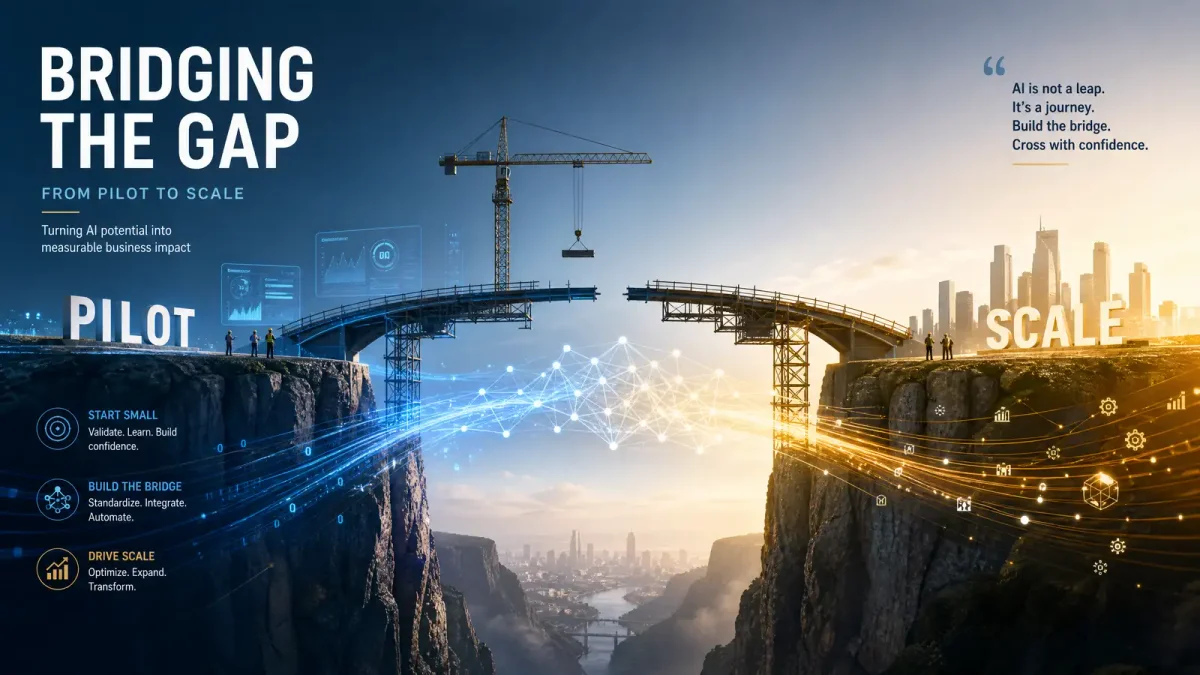
The AI Transformation Gap: Why Enterprise Digital Initiatives Stall Between Pilot and Scale in 2026
The past two years have been a masterclass in ambition and frustration for enterprise leaders. Nearly every major corporation has run AI pilots — chatbots that answer employee questions, models that draft marketing copy, agents that triage support tickets. The pilots work. The reports are encouraging. And yet, a quiet crisis is unfolding: most of these initiatives never make it past the proof-of-concept stage.
Welcome to the AI transformation gap of 2026.
Industry data paints a stark picture. A recent Strategy& study found that only about one-third of companies have successfully moved beyond centralized AI experimentation to embed AI capabilities directly into their product teams and business units. Meanwhile, Gartner projects that organizations without formal AI governance will face three times higher regulatory penalties by 2027 than those with established frameworks. And here is the uncomfortable truth: as of early 2026, only 31 percent of enterprises have deployed AI ethics tools, compared to 74 percent that have adopted revenue-generating AI.
In other words, most companies are sprinting toward AI adoption without building the guardrails, the organizational structure, or the talent pipeline needed to sustain it at scale.
This article examines why the gap exists, what it costs, and what the companies that are actually bridging it are doing differently.
The Scale-Up Stall: Why Pilots Do Not Become Production
The lifecycle of an enterprise AI initiative in 2026 follows a familiar pattern. A department identifies a use case, secures budget, partners with a vendor or builds internally, and delivers a working prototype. Leadership is impressed. A case study is written. And then — nothing. The project enters what consultants politely call a “sustain phase” and what engineers call a graveyard.
There are three primary reasons for this stall.
First, the centralized AI trap. Many organizations have created Center of Excellence teams — small groups of data scientists and ML engineers who build models for various departments. This structure works beautifully for pilots but collapses under the weight of scale. When every AI request must pass through a single team, throughput becomes the bottleneck. Business units grow impatient, and the backlog becomes insurmountable.
Second, the integration gap. A model running in a Jupyter notebook is a far cry from a model embedded in a supply-chain management system, integrated with ERP data, monitored for drift, and governed by compliance requirements. The distance between prototype and production is where most AI initiatives perish.
Third, the change management deficit. Technology is the easy part. Getting a 10,000-person organization to actually use a new AI tool in their daily workflow — to trust its outputs, to adapt their processes around it, to stop doing things the old way — is a human challenge that no algorithm can solve.
The ROI Reckoning: From Innovation Narratives to Measurable Returns
In 2024 and 2025, AI investment was fueled by possibility. The question was “What could AI do?” In 2026, the question has shifted to “What is AI doing for our bottom line?” and executives are no longer satisfied with inspirational answers.
Global Market Insights reported in May 2026 that the AI market has entered a defining phase characterized by a shift from speculative experimentation to large-scale implementation with measurable returns. Enterprises are prioritizing AI systems capable of reducing operational costs, improving productivity, accelerating decision-making, and streamlining workflows.
This is not a bad thing. Demand for ROI is healthy and necessary. But it creates a catch-22 for transformation teams. To prove ROI, you need production-grade deployments at meaningful scale. But to achieve production-grade deployments at scale, you need the organizational infrastructure that many companies have not yet built. The result is a cycle of underinvestment in foundational capabilities and overinvestment in quick-win pilots that never compound into systemic change.
The companies that are breaking this cycle are treating AI as operational infrastructure rather than a standalone technology initiative. They are integrating AI directly into finance, legal, cybersecurity, customer service, and operational systems — not as separate projects, but as embedded capabilities within existing workflows.
The Governance Gap: Running Fast Without Guardrails
Perhaps the most alarming gap between adoption and readiness is governance. The data tells a story of two parallel tracks moving at very different speeds.
On one track, revenue-generating AI adoption has exceeded 74 percent of enterprises. On the other track, only 31 percent have deployed AI ethics tools. The gap between these two numbers represents real risk — regulatory, reputational, and operational.
The EU AI Act is not a hypothetical future regulation anymore. It is active, and companies operating in or selling to European markets are already subject to its requirements. Model risk assessment, bias testing, explainability standards, and data governance are no longer optional best practices. They are legal obligations.
Yet many enterprises are still treating AI governance as an afterthought — something to address “once the models are working.” This backwards approach is creating exactly the kind of compliance debt that Gartner warned about. Organizations that delay governance are not saving time; they are accruing liability.
The companies that are getting this right are building governance into their AI lifecycle from day one. They are establishing model registries, implementing automated bias detection, creating audit trails for AI-driven decisions, and ensuring that compliance teams are embedded in AI project teams from the start rather than brought in for a review at the end.
The Legacy Tax: Old Systems Blocking New Capabilities
Here is a number that should keep every CIO awake: enterprises spend an average of 40 percent of their IT budgets simply maintaining legacy systems. That is 40 cents of every dollar going toward keeping old infrastructure running rather than funding innovation.
This legacy tax is one of the most significant and least discussed barriers to AI transformation. You cannot run modern AI workloads on systems designed before cloud computing existed. You cannot build real-time predictive analytics on batch-processed data warehouses that update overnight. You cannot deploy agentic AI workflows on monolithic architectures where every change requires a full regression test cycle.
The good news is that 2026 has brought real progress in AI-driven software modernization. Intelligent agents can now analyze millions of lines of legacy code — COBOL, Java 6, old C++ systems — map functional boundaries, and autonomously extract clean microservices. AI transpilation tools can convert legacy applications into cloud-native Python or Node.js structures while ensuring that the new code follows modern security standards and design patterns.
Industry data shows that organizations using advanced AI-driven modernization tools have reduced their cloud migration and refactoring timelines by up to 50 percent compared to traditional manual methods. The legacy tax is not going away, but the bill is finally getting smaller.
The Talent Bottleneck: Upskilling at Enterprise Scale
Technology infrastructure is necessary but insufficient. The human infrastructure — the workforce that will use, manage, and govern AI systems — is equally critical and equally underprepared.
A digital transformation strategy blueprint from Heimdall Partner recommends a concrete target: 70 percent of staff completing digital skills certification by the end of 2026. That is a bar most organizations will not reach.
The challenge is not just technical literacy. It is change management capability. It is the ability of middle managers to lead teams through AI-enabled process changes. It is the capacity of frontline workers to interact with AI tools effectively and to know when to trust an AI recommendation and when to override it. It is the judgment of senior leaders to allocate AI investment toward high-impact use cases rather than flashy but low-value experiments.
The organizations that are winning the talent race are taking a dual approach. They are investing in structured upskilling programs — not one-off training sessions, but continuous learning paths that cover data literacy, AI fluency, product management, and cybersecurity across the entire workforce. And they are embedding AI expertise directly into business units rather than isolating it in centralized teams, so that AI capability grows organically within every department rather than being dispensed from above.
Seven Moves That Actually Work
Based on analysis of enterprises that have successfully bridged the AI transformation gap, seven patterns emerge consistently.
One: Anchor AI in business strategy, not technology strategy. The most successful AI initiatives start with a business outcome — reduce customer churn by 15 percent, cut order processing time in half, eliminate 80 percent of manual data entry — not with a technology choice. The technology serves the outcome, not the other way around.
Two: Build a coherent enterprise change narrative. AI transformation is not an IT project. It is an organizational transformation that happens to involve technology. Companies that succeed create a narrative that the entire organization can understand and rally behind, not a technical roadmap that only engineers can read.
Three: Make AI a board-level capability. The business must be firmly in the driver seat for AI outcomes. When AI reporting lines stop at the CIO and never reach the CEO and the board, the initiative will inevitably be treated as a technology cost center rather than a strategic capability.
Four: Prioritize use cases with a clear impact matrix. Not all AI use cases are equal. The Anthropic Economic Index analysis of over one million real-world AI interactions across more than 3,200 occupational tasks provides a data-driven framework for identifying which enterprise processes will see the highest AI exposure and the fastest human verification times. Use data, not intuition, to build your prioritization matrix.
Five: Treat data infrastructure as a prerequisite, not an afterthought. AI is only as good as the data it runs on. Companies that invest in unified data platforms, clean data pipelines, and governed data access before scaling AI initiatives consistently outperform those that try to build AI on top of fragmented, inconsistent data.
Six: Embed governance from day one. Model risk assessment, bias testing, explainability requirements, and compliance frameworks should be built into the AI development lifecycle from the beginning. Retroactive governance is expensive, ineffective, and increasingly illegal.
Seven: Invest in the middle. The biggest barrier to AI adoption is not the CEO who does not understand it or the frontline worker who is afraid of it. It is the middle management layer that has to translate strategy into daily practice. Invest disproportionately in equipping managers with the tools, training, and authority to lead AI-enabled change in their teams.
Conclusion: What Separates Transformers From Experimenters
The AI transformation gap of 2026 is real, but it is not inevitable. The companies that are successfully scaling AI beyond the pilot stage share a common profile. They treat AI as operational infrastructure. They align AI investment with measurable business outcomes. They build governance into their processes from the start. They modernize legacy systems with AI-assisted tools. And they invest as much in people and change management as they do in models and infrastructure.
The gap between experimentation and transformation is not a technology gap. It is an organizational gap. And organizations, unlike algorithms, can be redesigned.
The question for enterprise leaders in 2026 is no longer whether AI will transform their industry. The question is whether their organization will be one of the transformers or one of the transformed.