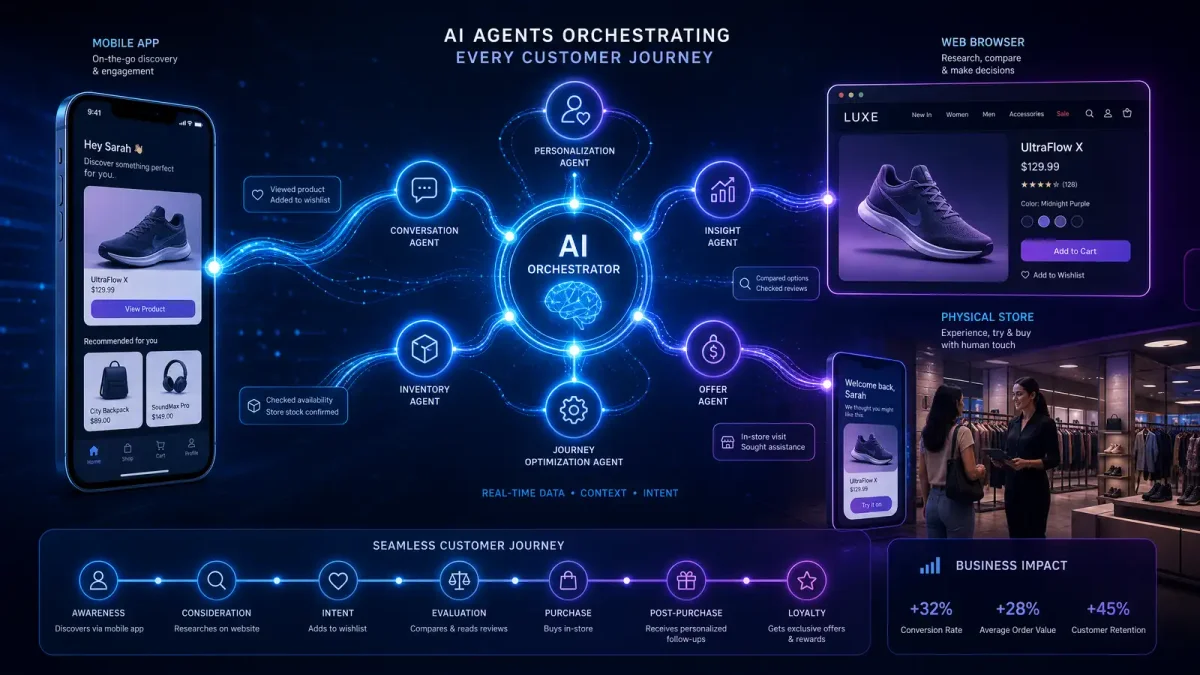
Agentic Customer Experience: Why AI Agents Are Rewriting the Digital Customer Journey in 2026
There is a paradox unfolding in customer experience right now. On one side, AI capabilities have never been more powerful — autonomous agents can now research, plan, and execute multi-step customer interactions with minimal human oversight. On the other side, most organizations are structurally unprepared to deliver on that promise. The technology is racing ahead of the operating model.
Adobe’s 2026 AI and Digital Trends report surveyed 3,000 executives and CX practitioners alongside 4,000 customers, and the gap is unmistakable. Organizations say they want highly personalized experiences in real time (80 percent), seamless journeys across digital and physical touchpoints (72 percent), and AI-powered interactions that still feel human and brand-aligned (60 percent). But data fragmentation, uneven alignment between leadership and frontline teams, and the sheer difficulty of enterprise-wide deployment keep these ambitions stuck in pilot purgatory.
This article examines how agentic AI is reshaping the customer experience landscape, what the data reveals about readiness gaps, and the concrete moves forward-thinking companies are making to bridge the divide.
From Chatbots to Agents: A Fundamental Shift
The traditional customer service chatbot was essentially a glorified FAQ engine. It matched keywords, pulled pre-written responses, and handed off to a human the moment a customer asked something outside its narrow script. For years, that was acceptable — barely.
Agentic AI changes the equation entirely. Unlike passive chatbots, autonomous agents can:
- Plan multi-step workflows — researching a customer’s purchase history, checking inventory across warehouses, processing a return, and scheduling a replacement delivery without human intervention.
- Access and reason over live data — pulling real-time CRM records, order status, and loyalty tier information to make context-aware decisions.
- Escalate intelligently — recognizing when a situation requires human judgment, summarizing the context, and transferring the conversation seamlessly rather than dropping the customer into a queue with no history.
The shift from scripted responses to autonomous reasoning represents the most significant change in digital customer experience since the introduction of self-service portals. And it is happening faster than most organizations’ infrastructure can absorb.
What Customers Actually Want in 2026
The Adobe survey data reveals three dominant customer expectations that are driving the agentic CX revolution.
Real-time personalization is no longer optional. Eighty percent of organizations say they are chasing experiences that adapt in real time to individual customer behavior, preferences, and context. But half of customers give promotional messages just two to five seconds before deciding whether to engage. That is not a lot of time to prove relevance.
Seamless cross-channel journeys are the baseline, not the differentiator. Seventy-two percent of organizations aim for experiences that flow effortlessly between mobile apps, websites, physical stores, and social channels. Yet most companies still operate these channels with separate data silos, separate teams, and separate technology stacks.
AI must feel human, not replace the human touch. Sixty percent of respondents want AI-powered interactions that remain human and brand-aligned. Customers are not asking for AI to disappear from their experience — they are asking for AI that understands when to step aside and let a real person take over.
This last point is critical. The companies that are winning with agentic CX are not trying to automate every interaction. They are using AI to handle the routine, the repetitive, and the data-intensive — then creating frictionless handoff points where human agents can step in with full context.
The Data Readiness Gap
Here is the uncomfortable truth that every CX leader needs to confront: you cannot deliver personalized, real-time, cross-channel experiences if your customer data lives in twelve different systems that do not talk to each other.
Adobe’s report identifies data fragmentation as the single biggest constraint on agentic CX deployment. And CMSWire’s own State of the CMO research reinforces the problem from a different angle. While 38 percent of marketing leaders now call their digital CX technology stack “advanced” — up from 17 percent in 2023 — that remaining 62 percent are still wrestling with integration debt.
The numbers are moving in the right direction. Fifty-one percent of organizations say their digital CX platforms are “working well,” more than doubling from last year. But “working well” is not the same as “ready for agentic AI.” Autonomous agents need clean, unified, real-time data feeds. They need APIs that expose customer context, not just transactional records. They need governance frameworks that define what the agent is allowed to do with that data.
The organizations that are actually deploying agentic CX at scale have done something that sounds boring but is revolutionary: they have built a unified customer data layer that their AI agents can query in real time. No magic. No new platform category. Just disciplined data architecture.
Agentic AI in the Customer Journey
So what does agentic customer experience actually look like in practice? Here are three patterns emerging in 2026.
Intelligent Triage and Routing
Traditional IVR systems force customers through rigid menus. Agentic triage agents listen to what the customer actually says, analyze sentiment and intent, pull the relevant account data, and either resolve the issue directly or route it to the most qualified human agent — with a full summary of the situation already prepared. The result is shorter wait times, higher first-contact resolution rates, and customers who feel heard rather than processed.
Proactive Engagement
Instead of waiting for a customer to call with a problem, agentic systems monitor signals — shipping delays, usage pattern anomalies, subscription renewal windows — and initiate contact with a tailored message and a proposed solution before the customer even knows there is an issue. This is the difference between reactive customer service and proactive customer success.
Continuous Journey Optimization
Agentic systems do not just handle individual interactions; they learn from thousands of them. They identify which resolution paths lead to the highest satisfaction scores, which messaging tones work best for different customer segments, and which escalation triggers predict churn. Then they adjust their own behavior in real time — not through manual configuration by a CX operations team, but through continuous learning loops.
Trust, Governance, and the Brand Alignment Problem
The CMSWire analysis of agentic CX readiness identified trust as the tripwire. When an AI agent is empowered to make decisions — offering a refund, changing a subscription tier, escalating to a supervisor — it is effectively representing the brand. If it makes the wrong call, the damage is real and immediate.
This is why governance is not a nice-to-have for agentic CX. It is the foundation. Leading companies are building:
- Decision boundaries — clear rules about what agents can and cannot do autonomously, with human-in-the-loop requirements for high-stakes actions.
- Audit trails — complete logs of every agent decision, the data it used, and the outcome, enabling continuous review and regulatory compliance.
- Brand voice guardrails — ensuring that AI-generated communications match the company’s tone, values, and messaging standards rather than sounding like a generic corporate robot.
- Escalation protocols — defined triggers for when an agent must hand off to a human, ensuring that frustrated customers never get stuck in an AI loop.
The Zcash incident in mid-2026, which exposed gaps in auditing standards for AI-driven financial decisions, serves as a warning across industries. When AI agents operate without transparent governance, the regulatory and reputational risks compound quickly.
The Human-in-the-Loop Imperative
One of the most persistent misconceptions about agentic CX is that it aims to replace human agents. The data suggests the opposite trajectory. The most successful agentic CX deployments are creating hybrid workforces where AI handles the volume and humans handle the nuance.
M-Files’ 2026 customer experience trends report identifies hybrid human plus AI workforces as the primary model transforming customer engagement. The AI agent processes hundreds of routine inquiries, gathers data, and prepares context. The human agent receives a customer who has already been understood, routed correctly, and provided with preliminary solutions — and can focus on empathy, complex problem-solving, and relationship building.
This model also addresses the talent challenge. Customer service has historically been a high-turnover, high-burnout function. When AI absorbs the repetitive load, human agents spend more time on meaningful interactions and less time reading scripts. Retention improves. Job satisfaction increases. And the overall quality of customer experience rises because the humans who remain are doing work that actually requires human judgment.
Five Moves for CX Transformation
Based on analysis of organizations that are successfully deploying agentic customer experience, five patterns emerge consistently.
One: Unify customer data before deploying agents. This is the foundational step. An AI agent is only as good as the data it can access. Invest in a real-time customer data platform or unified data layer that consolidates CRM, transactional, behavioral, and support history into a single queryable source.
Two: Start with narrow, high-volume use cases. Do not try to build a general-purpose customer agent on day one. Pick a specific workflow — order status inquiries, password resets, return processing — and deploy a focused agent there. Measure the results. Learn. Expand.
Three: Design escalation paths from the beginning. Every agentic workflow needs a clear handoff protocol to human agents. The handoff should include full context, not a restart. Customers should never have to repeat their story.
Four: Build governance into the AI lifecycle. Decision boundaries, audit trails, brand voice guidelines, and compliance checks should be part of the agent’s architecture from day one, not bolted on after something goes wrong.
Five: Measure what matters. Move beyond vanity metrics like “number of conversations handled by AI.” Track first-contact resolution rate, customer satisfaction scores, escalation accuracy, time to resolution, and — critically — the human agent experience. If your agents are burned out because AI is routing them the hardest cases without context, the system is broken.
The Bottom Line
Agentic customer experience is not coming. It is here. The technology exists. The customer expectations are set. The question is no longer whether AI will transform how companies interact with their customers — it is whether individual organizations will build the data infrastructure, governance frameworks, and operating models needed to deliver that transformation at scale.
The companies that move decisively on data readiness, start with focused high-impact use cases, and design hybrid human-AI workflows from the ground up will define the customer experience standard for the rest of the decade. The ones that wait for the technology to “mature” will find that the technology already matured — and their competitors already deployed it.
The gap between ambition and execution is real. But it is not a technology gap. It is an organizational one. And the organizations that recognize that distinction are the ones that will win.