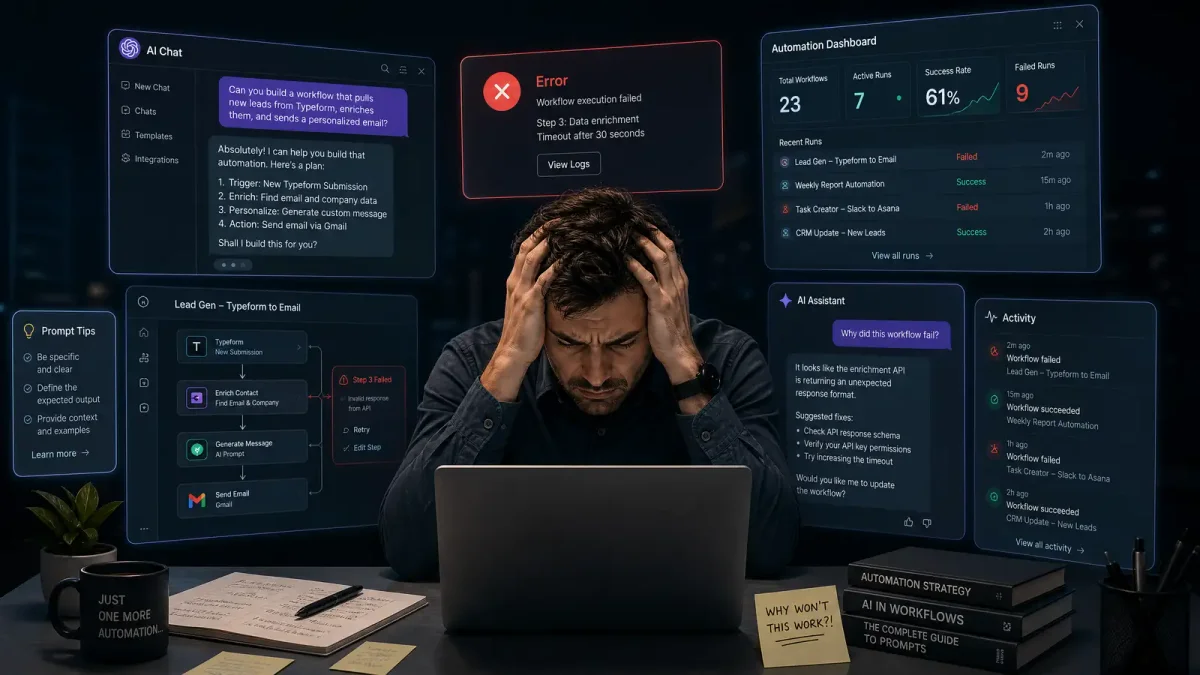
If you thought AI tools were supposed to save time, the latest data from The Register is going to feel like a plot twist. British workers are spending nearly six hours per week managing the very AI tools that were sold as productivity boosters. That is almost an entire workday lost to babysitting algorithms instead of delegating to them.
The Register’s June 2026 report called it “botsitting” — the awkward reality that AI agents and assistants frequently require human intervention: correcting outputs, re-prompting when they go off-track, reviewing decisions they were supposed to make autonomously, and troubleshooting integrations that break without warning.
Why Botsitting Happens
The core problem is a mismatch between what organizations expect from AI and what the tools can actually deliver without human supervision. Three factors stand out:
Over-ambitious deployment. Companies are handing AI agents tasks that involve judgment calls, not just rote automation. A scheduling bot that books meetings based on vague instructions will inevitably double-book, create conflicts, or invite the wrong people — each requiring human cleanup.
Integration fragility. AI tools that connect to Slack, email, CRMs, and project management systems create long dependency chains. When one API changes or a service goes down, the whole workflow stalls and someone has to manually intervene.
Output quality control. Even when an AI completes a task, the result often needs review. A document summarization tool that misses key details, or a code generation assistant that introduces subtle bugs, creates a hidden second pass that is rarely accounted for in ROI calculations.
What the Data Actually Says
The Register’s survey found the average worker spends 5.8 hours per week checking, correcting, or restarting AI tools. Broken down:
- 2.1 hours spent reviewing and correcting AI-generated content
- 1.8 hours troubleshooting tool integrations and broken automations
- 1.2 hours re-prompting or re-configuring tools that produced incorrect results
- 0.7 hours training or onboarding to new AI tools that replaced old ones
That adds up to roughly 73% of a full workday every week — time that was supposed to be saved, not consumed.
How to Reduce Botsitting in Your Workflow
Not all AI tools require this level of oversight. The difference comes down to how they are deployed and managed.
1. Start Narrow, Then Expand
The most successful AI deployments start with tasks that have clear success criteria. Email sorting, meeting transcription, data entry validation — these are bounded problems where you can measure accuracy and gradually increase autonomy. Throwing an AI agent at a complex, multi-step process with ambiguous outcomes guarantees babysitting.
2. Build in Automatic Checks
Instead of having humans review every output, build automated validation where possible. If an AI tool is processing data, add a checksum or range check. If it is generating content, add a plagiarism or tone analysis step. This catches errors before they reach a human reviewer.
3. Choose Tools With Good Error Handling
The best AI productivity tools fail gracefully — they alert you when they are uncertain rather than confidently producing wrong answers. Look for tools that:
- Show confidence scores for their outputs
- Provide clear explanations of what they did and why
- Allow you to set guardrails (budget limits, scope restrictions, approval workflows)
4. Track the Real Cost
Most organizations measure AI ROI by asking “how much time did it save?” A better metric is “how much time does it cost to manage?” If an AI tool saves 4 hours of manual work but requires 6 hours of oversight, it is a net loss. Track both numbers for every tool in your stack.
The Honeywell Perspective
Honeywell’s CEO commented in June 2026 that AI will “redefine automation” as labor shortages mount — a macro-level view that acknowledges the technology’s potential even as individual workers struggle with its current limitations. The tension between long-term promise and short-term friction is real, and it means organizations need patience alongside pragmatism.
The Bottom Line
AI tools are not yet the set-it-and-forget-it productivity solution they were marketed as. They are more like junior employees: capable of doing real work, but requiring supervision, feedback, and occasional course correction. The organizations that succeed will be the ones that treat AI deployment as a management challenge, not just a technology purchase.
Until then, six hours of botsitting per worker per week is the tax we pay for being early adopters.