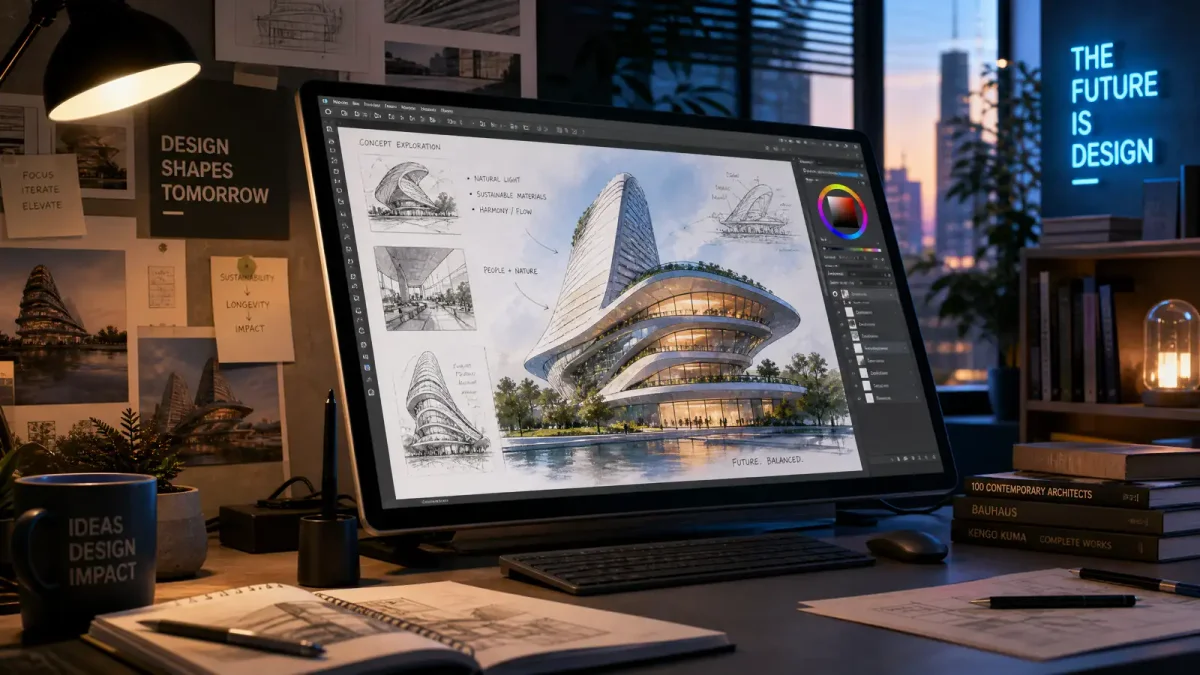
Disney announced on June 16 that Walt Disney Imagineering has partnered with Adobe to use custom Firefly AI models for theme park design, Axios reported. The deal uses Adobe Firefly Foundry, which lets enterprises train generative AI models on their own proprietary assets. In Disney’s case, those assets include decades of character designs, architectural concepts, and ride prototypes that have never been accessible to any AI system outside the company.
The announcement matters beyond the theme park industry. It is one of the clearest examples yet that a major creative studio has moved past the “should we use AI” debate and into the “how do we use AI responsibly” phase. The distinction is important, and it reveals a lot about where commercial AI art is heading.
What Firefly Foundry Actually Does
Adobe Firefly Foundry is not just the public Firefly image generator with a corporate login. It is a custom model training pipeline that lets organizations build AI models trained exclusively on their own intellectual property. The resulting model generates output in the organization’s visual style without risking copyright infringement, because the training data is owned by the organization itself.
For Disney, this means an Imagineer can type a prompt like “futuristic Epcot pavilion inspired by mid-century modern architecture” and get concept renders that look like Disney concept art — because the model was trained on actual Disney concept art. The same system can generate 3D model drafts of ride vehicles, character prototypes, and environmental designs that fit within Disney’s established visual language.
Disney emphasized that the AI output serves as a starting point, not a final product. Imagineers will still hand-craft the final designs. The AI accelerates the early concept phase — the part of the creative process where dozens of rough ideas get sketched out, evaluated, and discarded before the team commits to a direction.
Why Disney Chose Firefly Over Other AI Platforms
Disney could have partnered with any of the major generative AI providers. The choice of Adobe Firefly is not accidental.
Commercial safety. Firefly is the only major generative AI platform that was trained exclusively on licensed and public domain content. Adobe built this reputation deliberately, positioning Firefly as the “safe” option for enterprise customers who cannot risk copyright lawsuits. For a company as legally protective of its IP as Disney, this matters.
Integration with existing tools. Disney Imagineering already uses Adobe Creative Cloud extensively — Photoshop, Illustrator, After Effects, and Dimension are standard tools in concept art pipelines. Firefly models integrate directly into these applications, meaning Imagineers can generate AI concepts and immediately refine them in tools they already know.
Brand control. Firefly Foundry lets Disney specify exactly which assets the model trains on and which it does not. This means Disney can create separate models for different franchises — one trained on Marvel concept art, another on Pixar, another on classic Disney animation — without cross-contamination. A Marvel-trained model will not accidentally generate Mickey Mouse ears on a Star Destroyer.
The Broader Implications for AI Art in Creative Industries
The Disney-Adobe deal is a template that other studios and creative organizations will likely follow. Here is what it signals:
Proprietary training data is the moat. The value of a generative AI model in a commercial context is not the base model architecture — that is increasingly commoditized. The value is the proprietary training data that makes the model output unique to one organization. Disney’s decades of concept art, character designs, and architectural prototypes are an irreplaceable dataset that no competitor can replicate.
AI in concept phase, not production. Disney’s stated use case — accelerating early concept design — is the sweet spot for generative AI in creative workflows. The concept phase requires volume and variety: many rough ideas that can be generated quickly and evaluated by human creatives. The production phase, where final quality and consistency matter most, remains a human domain. This pattern will likely hold across the creative industries.
The IP licensing question gets more complicated. If Disney’s Firefly model produces a concept that resembles a specific existing artwork that happened to be in the training set, who owns that concept? Disney licensed the training data, so the output is legally Disney’s. But the individual artist whose work influenced the output may have questions. This tension between collective training data and individual creative contribution is not resolved by the Disney-Adobe deal — it is simply deferred.
Adobe’s AI Assistant Expansion
In a separate announcement this week, Adobe added its Firefly AI assistant to Premiere, Illustrator, InDesign, and Frame.io, according to TechCrunch. The assistant can now generate brand kits, product videos, and storyboards from text prompts. This expansion is closely related to the Firefly Foundry capability that Disney is using — both are part of Adobe’s broader strategy to embed generative AI into every stage of the creative workflow.
For creative professionals who already use Adobe tools, the assistant means fewer context switches: generate an image concept, edit it in Photoshop, lay it out in InDesign, and animate it in Premiere, all without leaving the Adobe ecosystem. For Disney Imagineering, this integration is likely a significant factor in the partnership decision.
The Lightricks Angle
The broader AI art tools market is also evolving. Lightricks recently launched a custom AI model builder that lets individual creators — not just enterprises — train models on their own visual style. While the Disney-Adobe deal operates at an entirely different scale, the underlying principle is the same: the future of AI art is not one giant model that everyone uses, but many smaller models trained on specific styles, brands, and creative identities.
This fragmentation of AI art models mirrors what happened in web design: early websites all looked similar because everyone used the same templates. As design tools became more sophisticated and accessible, websites diversified. AI art is following the same trajectory. The early phase was defined by everyone using the same base models and getting similar-looking output. The next phase will be defined by customized models that produce output specific to each creator or organization.
What to Watch Next
Three developments will shape whether the Disney-Adobe model becomes the industry standard:
Other studios follow. If Universal, Warner Bros., or Netflix announce similar partnerships with AI model providers, it confirms that proprietary AI training for creative concept work is becoming standard practice. If they do not, Disney’s move may be seen as an outlier driven by the unique demands of theme park design.
Artist pushback. Disney’s own animators and concept artists may have opinions about AI-generated concept art in their workflow. How the company manages this internally — whether AI concepts are treated as tools or as replacements — will influence how other creative organizations approach the same question.
Output quality at scale. The true test of Firefly Foundry in a Disney context is not whether it can produce one good concept image. It is whether it can produce hundreds of useful concepts across multiple franchises, each maintaining the distinctive visual identity that Disney audiences expect. If it can, the technology has proven its value. If it cannot, the partnership may remain a limited experiment.
Disney’s partnership with Adobe is not about replacing human creativity. It is about giving creative professionals a faster way to explore ideas before committing to the expensive, time-consuming process of building actual theme park attractions. That distinction — augmentation versus replacement — is the one that will determine whether AI art becomes a mainstream creative tool or remains a controversial experiment.