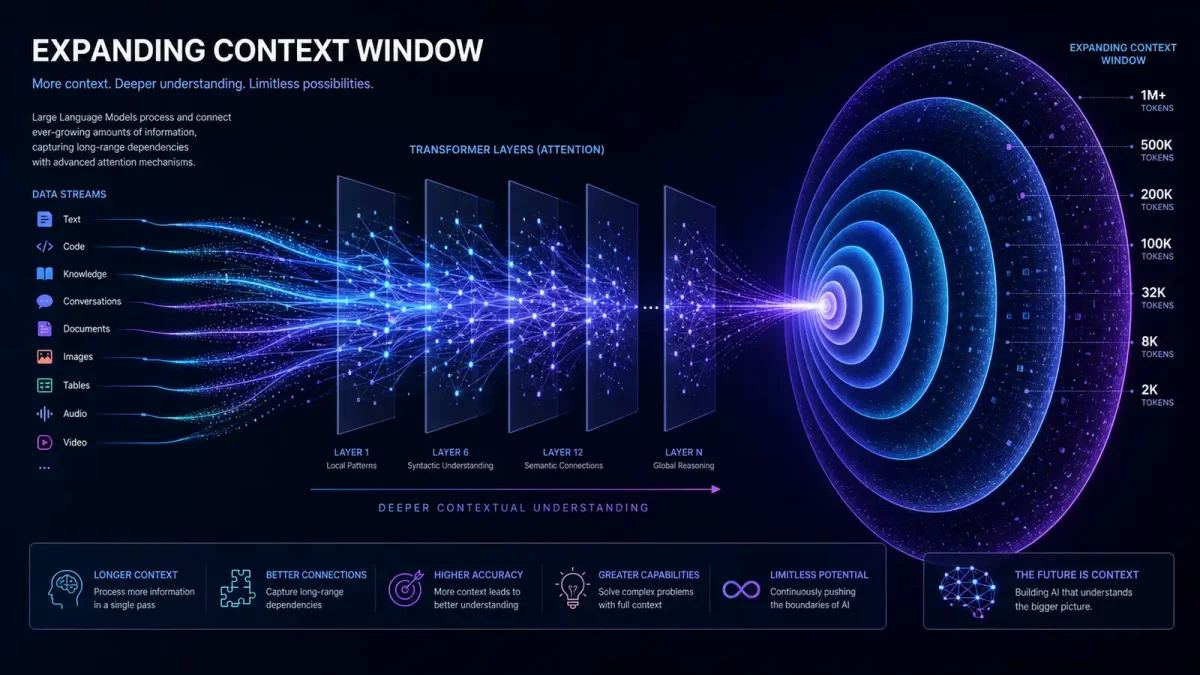
For most of the LLM era, if you wanted a model to read a long document, you had two bad options. You could truncate it and hope the important parts were near the top. Or you could use retrieval-augmented generation and hope the search step found the right chunks. Neither worked well. The fundamental problem was baked into the transformer architecture itself — attention scales quadratically with context length. Double the input, quadruple the compute.
That constraint is breaking. Not gradually. Two separate lines of research are converging on solutions that make million-token contexts practical on hardware that already exists.
Why Context Length Has Been the Hardest Problem
The transformer’s attention mechanism compares every token to every other token. For a sequence of length n, that means n² comparisons. A 4,000-token prompt requires 16 million attention operations. A 1-million-token prompt requires a trillion. The math does not bend.
Engineers have been working around this for years with clever hacks: sliding windows, sparse attention patterns, retrieval augmentation. Each one trades quality for efficiency. Each one introduces a new failure mode where the model misses something because it never saw it.
What has changed in 2026 is that two genuinely different approaches have matured to the point where they are not just research papers. They are shipping.
The Memory Hackers: Training Long-Context Models on Hardware You Already Own
The first approach does not change the architecture. It changes how you train.
QLoRA, introduced in 2023 but refined through 2025 and 2026, couples Low-Rank Adaptation adapters with 4-bit quantization. The effect is dramatic: finetuning a 65-billion-parameter model that once required multiple high-end GPUs now fits on a single card with under 48 GB of VRAM. This alone democratized long-context training, but it was not enough for extreme sequence lengths.
The real breakthrough came from chunking. Instead of processing an entire million-token sequence at once, chunk-recurrent methods split it into manageable windows. Only the current chunk sits in GPU memory. A system called OOMB demonstrated that this approach adds just 10 MB of memory overhead for every 10,000 additional tokens. On a single NVIDIA H200, researchers hit 4 million tokens without running out of memory.
Two complementary techniques push the envelope further. ParisKV selectively retrieves only the key-value vectors that are relevant to the current computation, boosting throughput by 2.8× at million-token ranges. MEMO balances swapping and recomputation to reach 1 million tokens on eight A800 cards — hardware that was mid-range when it launched and is now accessible to university labs and smaller companies.
Activation recomputation helps too. Instead of storing every intermediate tensor during the forward pass, the system discards them and rebuilds them during the backward pass. It trades extra compute for memory savings. Given that modern GPUs have far more compute than memory bandwidth, this tradeoff usually pays off.
The practical upshot: the hardware barrier for long-context training has dropped by roughly an order of magnitude in 18 months. What required a cluster now runs on a workstation.
The Architecture Play: Throwing Out Quadratic Attention Entirely
The second approach is more radical. Instead of making attention cheaper, replace it with something that does not scale quadratically in the first place.
Subquadratic, a frontier AI research company, released SubQ in July 2026 — the first LLM built on a fully sub-quadratic sparse-attention architecture. Traditional transformers scale at O(n²) with context length. SubQ scales at O(n). At 1 million tokens, the company claims it uses 64.5 times less compute than dense attention while maintaining performance on both long-context retrieval and general reasoning benchmarks.
The model supports context windows up to 12 million tokens. For perspective, that is roughly 9 million words — enough to hold an entire code repository, months of agent conversation history, or a small library of technical documentation in a single prompt without quality degradation.
This is not a small incremental improvement. Moving from quadratic to linear scaling is the kind of architectural shift that changes what models can be used for. An LLM that can hold an entire codebase in context does not need retrieval. It can reason across files, trace dependencies, and catch inconsistencies that a chunked approach would miss because the relevant code is scattered across a hundred files.
What Actually Changes When Context Stops Being the Bottleneck
The most immediate impact is on AI coding tools. Current tools spend a significant portion of their compute budget just managing context — deciding which files to include, which to drop, and how to summarize the rest. A model that can ingest a full repository eliminates that entire category of errors. The most common failure mode of today’s coding assistants is not writing bad code. It is writing code that looks correct in the three files it can see but breaks something in the 50 files it cannot. Long-context models change the failure mode from “missed a dependency” to “misunderstood a dependency,” which is a meaningful improvement.
Agent systems benefit similarly. Today’s agents maintain state through a combination of short-term memory and external storage, with the model itself seeing only a compressed window of recent history. A 12-million-token context means the agent can hold its entire interaction history — potentially hours of back-and-forth — in working memory. It can reference something the user said at the beginning of the session without a retrieval step that might return the wrong chunk or miss a key detail buried in a casual remark. This sounds incremental. For anyone who has watched an agent forget a constraint the user specified 20 messages ago, it is transformative.
Long-document analysis changes in kind, not just degree. Legal contracts, financial filings, and medical records have structure that spans hundreds of pages. A clause on page 3 modifies an obligation on page 147, and a retrieval system that splits the document into 500-word chunks will never connect them. A model reading the entire document in one pass can, at least in principle, find every cross-reference. The question is whether it actually does — and that is where the quality-at-length problem bites.
Scientific literature review is another application that shifts from impossible to merely hard. A single research paper is typically 8 to 30 pages. A literature review might need to cover 50 papers. Current approaches either summarize each paper individually and hope the summaries capture the relevant connections, or retrieve passages by keyword and miss the forest for the trees. A million-token context can hold 30 to 40 full papers, letting the model trace citation chains, identify contradictory findings, and spot methodological patterns across studies without intermediate summarization steps that lose fidelity.
The common thread across all of these is the elimination of retrieval as a mandatory pipeline stage. Retrieval is a lossy operation. Every time you chunk a document and search for relevant pieces, you are betting that the search query captures the right semantic intent and that the chunk boundaries do not split critical context across two pieces. Sometimes the bet pays off. Sometimes it does not. Long-context models let you stop making the bet.
The Catch
The KV cache remains the bottleneck. As activation memory shrinks through chunking and recomputation, the key-value cache grows linearly with context length. Processing 4 million tokens means storing 4 million tokens worth of attention state. For a model with 32 attention heads and 128-dimensional key vectors, a 4-million-token KV cache runs into tens of gigabytes on its own. New hardware — NVIDIA’s upcoming Blackwell GPUs promise higher bandwidth and larger on-board memory — will help, but the KV cache is the next wall to hit, and unlike the activation memory problem, there is no chunking trick that makes it go away.
Quality at extreme lengths is also an open question. Benchmarks like the Needle in a Haystack test measure whether a model can retrieve a specific fact from position 3.8 million in a sequence. That is a memory test. Whether the model can integrate information from positions 100, 50,000, and 3 million into a coherent analysis is a reasoning test, and the current generation of long-context techniques has not been evaluated on it comprehensively. Early indications from the SubQ benchmarks suggest the model holds up on retrieval tasks but no one has published results on multi-hop reasoning across million-token spans. Until someone does, assume the worst.
And the sub-quadratic architectures, for all their promise, are new. SubQ’s benchmarks look strong, but the model has not been deployed at scale long enough for the community to find the failure modes. Every architecture has failure modes. For sub-quadratic attention, the most likely candidate is that it misses long-range dependencies that a full attention mechanism would catch — the exact thing it was designed to avoid. Sparse attention patterns are approximations. Approximations have error bounds. At 12 million tokens, those error bounds may or may not matter in practice, but nobody has run the experiment yet at a scale that would settle the question.
There is also the question of training data. Models that can process 12 million tokens of context need training data that exercises context lengths of at least that magnitude. Most publicly available training corpora do not have documents anywhere near that long. Synthetic data generation for long-context training is an active area of research, but it is hard to verify that synthetically generated long documents contain the kind of real-world structure that the model needs to learn.
Where This Goes Next
The convergence of these two approaches — efficient training techniques that make existing architectures go further on existing hardware, and new architectures that fundamentally change the scaling math — suggests that the context window problem is transitioning from a hard constraint to an engineering tradeoff. You will choose between a dense-attention model trained with QLoRA and chunking, optimized for quality at moderate lengths, and a sub-quadratic model that goes extremely long at the cost of some fidelity.
Neither approach is finished. Hybrid attention schemes that combine dense and sparse patterns are an active area of research. Progressive compression techniques that summarize older context rather than dropping it entirely could bridge the gap between quality and length. And federated approaches that distribute the KV cache across multiple devices could push the practical ceiling past 10 million tokens without waiting for next-generation hardware.
The quadratic trap held for eight years because it was baked into the architecture that made transformers work in the first place. It is not holding anymore.