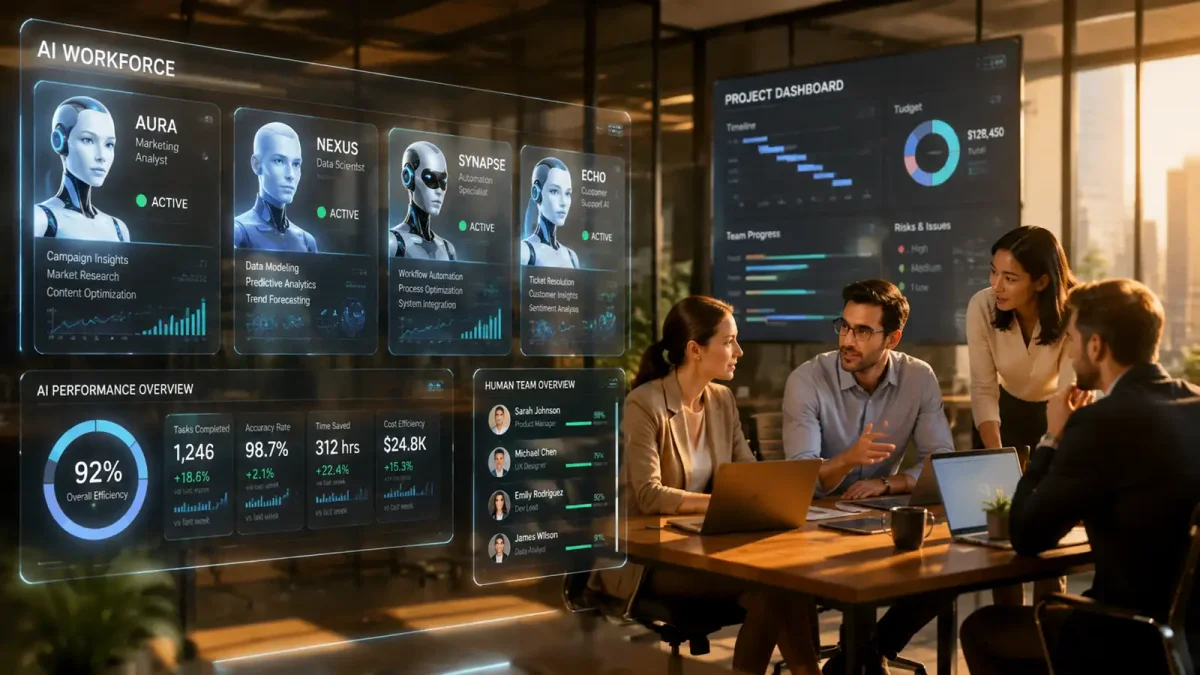
For the past two years, the enterprise AI conversation has been dominated by a single model: put a chatbot in front of your employees and watch productivity climb. It worked — to a point. But as companies moved from experimentation to production at scale, a structural problem became impossible to ignore. Chatbots are tools. Tools don’t have accountability. Tools don’t own processes end-to-end. Tools don’t trigger the kind of operational anxiety that comes with giving an algorithm the power to provision cloud infrastructure, approve vendor payments, or respond to security incidents at 3 AM.
The industry’s answer, rolling out in real time this week, is to stop treating AI as a tool and start treating it as a worker. Not in the metaphorical sense — in the governance sense. Job roles. Budgets. Scoped permissions. Audit trails. Performance reviews. The same management infrastructure enterprises already use for their human teams, now applied to AI agents.
The Platform Shift
Two major announcements on June 9, 2026 crystallized this shift within hours of each other.
Atomicwork launched the general availability of its AI Workforce Platform, a system purpose-built for enterprise IT, HR, Finance, and Workplace teams. The platform introduces the concept of “AI Coworkers” — each one assigned a job role, a skill set, a budget, and scoped permissions. A workforce control plane sits above them all, giving IT teams complete visibility into every AI agent in operation: spend limits, access boundaries, and an immutable audit trail for every action taken.
The platform is designed to layer on top of existing ITSM and ESM setups, which means enterprises can deploy AI Coworkers without ripping out their ServiceNow or Jira Service Management installations. The AI agents handle provisioning access, responding to incidents, onboarding employees, troubleshooting hardware, and managing business service operations — all with live enterprise context, without requiring human involvement at every step.
Vijay Rayapati, Atomicwork’s co-founder and CEO, put the ambition plainly: “Every AI story in this market ends up being a better interface on top of the same broken model. What Atomicwork does is different — it replaces the workflow model underneath IT. It’s not a better candle. It’s the lightbulb.”
NiCE, the enterprise customer experience company, announced its Workforce Empowerment Suite at NiCE World 2026 on the same day. While Atomicwork is focused on IT operations, NiCE is approaching the problem from the customer experience angle — providing a single operating model to manage, govern, and empower both human employees and AI agents at scale in contact center environments.
Jeff Comstock, President of CX Product & Technology at NiCE, described the hybrid reality: “Every enterprise is now running a hybrid workforce of people and AI agents. Our Workforce Empowerment Suite lets them govern, coach, and scale that workforce as one so every customer gets the same experience, whether they reach a person or an AI agent.”
The suite is built on compliance foundations enterprises already trust: SOC 2 Type II, ISO 27001, PCI DSS, and FedRAMP Moderate authorization. That last one — FedRAMP — is particularly significant. It means the platform is approved for handling US government data, which signals that the hybrid AI workforce concept isn’t just for forward-leaning tech companies anymore. It’s entering regulated industries.
Why This Matters for Digital Transformation
The shift from chatbot to coworker represents a fundamental change in how enterprises think about AI deployment. Three dimensions are worth tracking.
1. Ownership vs. Assistance
Traditional enterprise AI tools assist humans who retain process ownership. An AI-powered search tool helps an IT analyst find the right troubleshooting steps — but the analyst still decides, executes, and is accountable. AI Coworkers flip that model. The AI agent owns the process end-to-end: it receives a ticket, diagnoses the issue, executes the fix, documents the resolution, and escalates only when it hits a boundary defined in its scoped permissions.
This changes how IT departments are structured. Instead of growing headcount linearly with ticket volume, teams can grow their AI workforce while keeping human staff focused on the exceptions, the complex cases, and the strategic work.
2. Governance as a First-Class Feature
One of the biggest obstacles to enterprise AI adoption has always been the question: who’s responsible when the AI does something wrong? The governed AI workforce model answers this by making governance architectural, not procedural. Every AI Coworker has defined boundaries — what it can access, what it can spend, what actions it can take independently, and what requires human approval.
Every action is logged in an audit trail. That trail serves multiple purposes: compliance documentation, performance measurement, and incident investigation. It’s the same accountability infrastructure that exists for human employees, now applied to AI agents.
This approach directly addresses the concerns of CIOs and CISOs who have been hesitant to deploy AI beyond low-risk use cases. When an AI agent’s actions are bounded by policy, auditable, and reversible, the risk calculus changes dramatically.
3. Speed of Deployment
Both Atomicwork and NiCE emphasize rapid deployment — going from zero to a fully operational AI workforce “in days, not quarters.” That speed comes from two design decisions. First, the platforms integrate with existing enterprise systems rather than replacing them. Second, they come with pre-built AI Coworker templates for common roles — IT helpdesk, employee onboarding, incident response, financial reconciliation — that can be customized rather than built from scratch.
This matters because digital transformation projects have a well-documented failure rate, and timeline creep is one of the primary culprits. Enterprises that can deploy AI workforce capabilities in weeks rather than quarters are significantly more likely to achieve measurable ROI before organizational patience runs out.
The Broader Market Context
The Atomicwork and NiCE announcements don’t exist in a vacuum. They’re part of a broader wave of enterprise AI infrastructure investment. Tata Consultancy Services signed a multimillion-euro AI-powered services transformation deal with Canada Life on June 8, just one day before the Atomicwork and NiCE launches. The multiyear agreement covers AI-led modernization for one of the largest life and pension insurers globally — a sector that has historically been among the most conservative about technology adoption.
The message from these deals is consistent: enterprise buyers are no longer piloting AI. They’re committing to multiyear, multimillion-dollar transformation programs that treat AI as core infrastructure.
At VivaTech 2026 in Paris, enterprise AI was the dominant theme, reflecting Europe’s growing ambition to build its own enterprise AI ecosystem rather than importing solutions from American vendors. The conversation at the conference centered on the shift from experimentation to production at scale — precisely the problem that governed AI workforce platforms are designed to solve.
Industry analyst Sheila McGee-Smith of McGee-Smith Analytics called NiCE’s launch “one of the most consequential shifts in workforce operations in a generation,” noting that “every enterprise running customer service is about to confront the same question: how do you govern, coach, and scale a workforce that is half human and half AI?”
What IT Leaders Should Watch For
If you’re an IT leader evaluating these platforms, here are the questions that matter:
Integration depth. Does the AI Workforce Platform actually work with your existing ITSM/ESM tools, or does it require a greenfield deployment? Atomicwork’s approach of layering on top of existing systems is the pragmatic choice for most enterprises.
Governance granularity. How fine-grained are the permission controls? Can you set different budgets, access levels, and escalation thresholds for different AI Coworker roles? The answer determines whether the platform can handle your actual organizational complexity.
Audit quality. Is the audit trail comprehensive enough for your compliance requirements? For regulated industries (financial services, healthcare, government), this is the dealbreaker question.
Human-in-the-loop design. What triggers an escalation to a human operator? The best platforms will let you tune these thresholds by risk level, cost impact, and customer sensitivity.
Total cost of ownership. AI Coworkers consume compute resources, and those costs scale with usage. A well-designed platform should give you visibility into per-agent costs so you can manage your AI workforce budget the same way you manage contractor budgets.
The Bottom Line
The governed AI workforce isn’t a product category — it’s a management paradigm. It’s the recognition that AI agents have moved from being tools that humans use to being workers that organizations manage. And once you accept that framing, the requirements become obvious: you need the same governance, accountability, and performance management infrastructure for AI workers that you already have for human workers.
The platforms launching this week are the first generation of tools built from that premise. They’re not perfect — early adopters will encounter edge cases, integration friction, and the inevitable learning curve. But the direction is clear, and the companies that start building AI workforce governance capabilities now will have a structural advantage over competitors still treating AI as a chatbot upgrade.
The digital transformation playbook for the next three years won’t be about which AI model to use. It will be about how to build an organization that can effectively manage a workforce that is part human, part AI — and hold both to the same standards of accountability and performance.
Source: Atomicwork Press Release | NiCE Workforce Empowerment Suite | TCS Canada Life Deal | TechCrunch VivaTech 2026