There is a pattern that repeats across enterprises attempting digital transformation. A board approves a multi-year, multi-million-dollar initiative. Consultants produce strategy decks. Teams are assembled. Two years later, the organization has spent heavily and changed very little. The gap between the strategy and the deployment is where most transformation efforts die, and intelligent automation is the tool that bridges it.
The World Economic Forum’s Future of Jobs Report 2025 found that 86% of employers expect AI and information processing to transform their business by 2030, while 58% expect robotics and automation to do the same. Those numbers describe ambition. The reality on the ground is that most enterprises are stuck somewhere between a spreadsheet-based workflow and a fully autonomous AI system, and they do not know how to move from one to the other without breaking everything in between.
What intelligent automation actually means
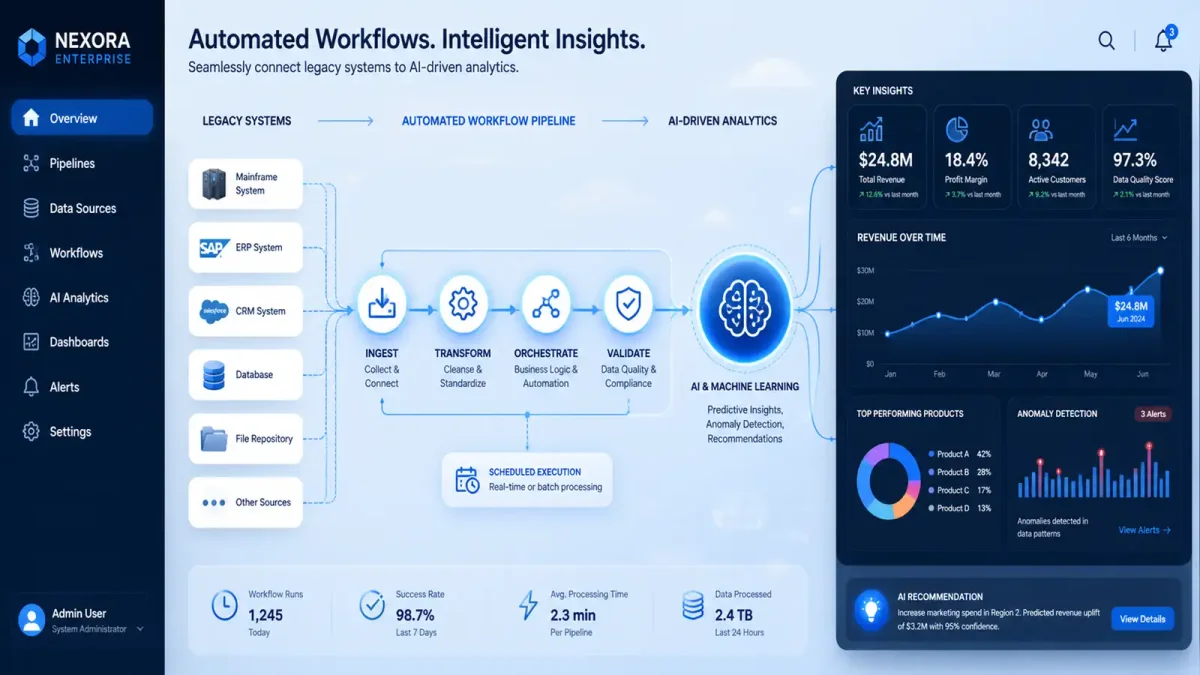
Intelligent automation sits between basic process automation and full AI deployment. Basic automation handles repetitive tasks: data entry, invoice processing, report generation. Full AI deployment means systems that learn, adapt, and make decisions with minimal human oversight. Intelligent automation combines the two: it automates complex workflows that require some judgment, using rule-based logic paired with machine learning models that handle variability.
A concrete example: an accounts payable system that matches invoices to purchase orders, flags discrepancies, routes exceptions to the right person, and learns from each resolution how to handle similar cases in the future. That is not a simple if-then rule, and it is not a fully autonomous system. It sits in the middle, handling the messy reality that pure automation cannot touch and pure AI cannot yet reliably manage at scale.
Why companies skip this step
The temptation is to go straight from manual processes to AI-powered everything. Vendor presentations make it look easy. The reality is that most enterprise data is not clean enough, most workflows are not standardized enough, and most organizations are not ready for the level of change that full AI deployment requires.
Intelligent automation forces you to do the unglamorous work first: mapping your actual processes (not the ones in the process documentation), cleaning the data those processes depend on, and building the integrations that let systems talk to each other. This is the work that makes AI possible later, but it is also the work that delivers immediate value on its own.
A 2026 nasscom analysis described this as the shift from “transformation programs” to “operating discipline.” Transformation programs have endpoints. Operating discipline is ongoing. Intelligent automation supports the latter because it builds capability incrementally rather than demanding a big-bang cutover.
Where intelligent automation delivers the fastest ROI
The highest-return applications tend to share three characteristics: high volume, moderate complexity, and clear success criteria.
Order processing and fulfillment is a common starting point. E-commerce operations involve inventory checks, payment processing, shipping label generation, returns handling, and customer communication. Automating the straightforward cases while routing exceptions to humans reduces processing time and error rates without requiring the system to make judgment calls it is not ready for.
Customer service triage is another high-ROI area. Intelligent automation can classify incoming requests, pull relevant account data, suggest responses, and escalate to human agents when the situation requires empathy or judgment. The key is that the system does not need to resolve every case; it needs to handle the easy ones and prepare the difficult ones for human attention.
Financial reconciliation and reporting benefits from intelligent automation because the rules are mostly clear but the data is messy. Matching transactions across systems, flagging anomalies, and generating reports with automated commentary handles the volume that would take a team days to process manually.
The legacy system problem
Every enterprise has them: older systems that do not integrate easily with modern tools but cannot be replaced without disrupting critical operations. Nasscom’s 2026 analysis identified legacy system migration as one of the ten challenges enterprises cannot ignore, and intelligent automation provides a practical path forward.
Rather than replacing legacy systems outright, intelligent automation can sit on top of them, extracting data through APIs or screen scraping, processing it through modern workflows, and feeding results back. This approach extends the life of systems that still work while gradually building the integrations that will eventually make replacement possible.
The alternative, waiting for a clean break to modernize everything at once, often means waiting indefinitely. Intelligent automation lets you modernize incrementally, delivering value at each step rather than betting everything on a single cutover.
Building the governance layer
AI governance is the piece that most organizations address too late. The nasscom analysis called it “the missing piece in AI strategy: governance that drives trust.” Intelligent automation makes governance easier to implement because the decision logic is more transparent than fully autonomous AI systems.
When an automated system flags an invoice for review, you can trace exactly why: the amount exceeded the threshold, the vendor was not in the approved list, or the purchase order number did not match. That traceability is a governance advantage. Full AI systems that make decisions through opaque model inference are harder to audit and harder to explain to regulators.
Building governance into your intelligent automation from the start means you have the logging, the decision trees, and the escalation paths in place before you layer on more complex AI capabilities. It is easier to add autonomy to a well-governed system than to add governance to an autonomous one.
Practical steps for getting started
Map three to five high-volume workflows. Do not try to automate everything. Pick processes that are frequent, relatively well-understood, and currently causing bottlenecks. Document the actual steps, including the exceptions and workarounds that people use but never formalize.
Assess your data readiness. Intelligent automation needs clean, structured data to work. If your customer records live in three different systems with inconsistent formatting, that is the first problem to solve. Data integration is not glamorous, but it is foundational.
Start with rule-based automation and layer in ML. Begin with deterministic rules that handle the straightforward cases. Once those are working reliably, add machine learning models to handle the variable cases. This staged approach reduces risk and builds institutional confidence in the technology.
Measure before and after. Track processing time, error rates, and exception volumes before automation and after. These numbers make the business case for expansion and help you identify where the automation is working and where it needs adjustment.
Plan for human oversight. Intelligent automation is not lights-out automation. Build in checkpoints where humans review decisions, especially for edge cases or high-value transactions. The goal is to reduce human workload, not eliminate human judgment.
What comes after
Intelligent automation is not the end state. It is the foundation that makes more advanced AI capabilities practical. Once your workflows are automated, your data is clean, and your governance is in place, you can layer on predictive analytics, natural language interfaces, and eventually autonomous decision-making with confidence.
Real numbers from real implementations
The business case for intelligent automation is not theoretical. IBM’s finance organization deployed watsonx.ai alongside RPA for journal-entry processing, reconciliation, and anomaly detection. Within three months, cycle time dropped by more than 90% and annual cost savings reached approximately $600,000. That is a single finance function, not a company-wide overhaul.
IBM’s CIO organization consolidated its data platform using watsonx.data and watsonx.ai, moving data from legacy systems and reducing redundancy. The result was $5.3 million in savings alongside a 26% reduction in duplicated data in one domain and a 7.7% reduction in another. The governance layer made the AI capabilities possible because the data was clean and accessible.
CXReview implemented call-transcript summarization and disposition automation using watsonx.ai, saving an estimated 23 agent hours per day by removing manual call-disposition comments. That is not replacing agents; it is freeing them to handle the calls that actually require human judgment.
These numbers share a pattern: the organizations did not attempt to automate everything at once. They identified specific high-volume processes, implemented intelligent automation to handle the routine cases, and measured the results before expanding.
The risk of waiting
The cost of inaction is rising. Customer expectations are increasing faster than most organizations can adapt manually. Competitors who have implemented intelligent automation are processing orders faster, responding to inquiries more quickly, and making better decisions because their data flows cleanly through automated workflows.
The nasscom analysis identified competitive pressure as one of the key drivers of digital transformation in 2026, and that pressure is only intensifying. Organizations that delay intelligent automation are not just missing efficiency gains; they are falling behind on the data infrastructure and process discipline that future AI capabilities will require.
The good news is that intelligent automation does not require a massive upfront investment. Start with one workflow, measure the results, and expand from there. The organizations that succeed are the ones that treat automation as an ongoing capability rather than a one-time project.
The organizations that skip this step and jump straight to AI deployment often find themselves with impressive demos that do not survive contact with production data. The ones that build the intelligent automation layer first have the infrastructure to scale AI safely.
The future of enterprise technology is not about choosing between automation and AI. It is about building the discipline to use both, in sequence, with the governance to do it responsibly.
Sources
- Shopify, “How To Use Intelligent Automation in Digital Transformation,” 2026
- Nasscom, “Digital Transformation Trends Every Business Should Know in 2026,” 2026
- Shopify, “Key Drivers of Digital Transformation: 5 for Commerce,” 2026